The site’s geological interest is related to the extraordinary abundance of fossils of Sedimentary rock whose main component is calcium carbonate (CaCO3). Its origin can be chemical, organic or detritic.</p><p><br></p></div>">limestone algae, known as rhodoliths or red algae, and the tiny fragments derived from their destruction, which constitute the rocks, and their sedimentary disposition. The concentration of algae nodules is such that the geological tectonic, eustatic or antropical processes</span></p></div>">outcrop is truly extraordinary.
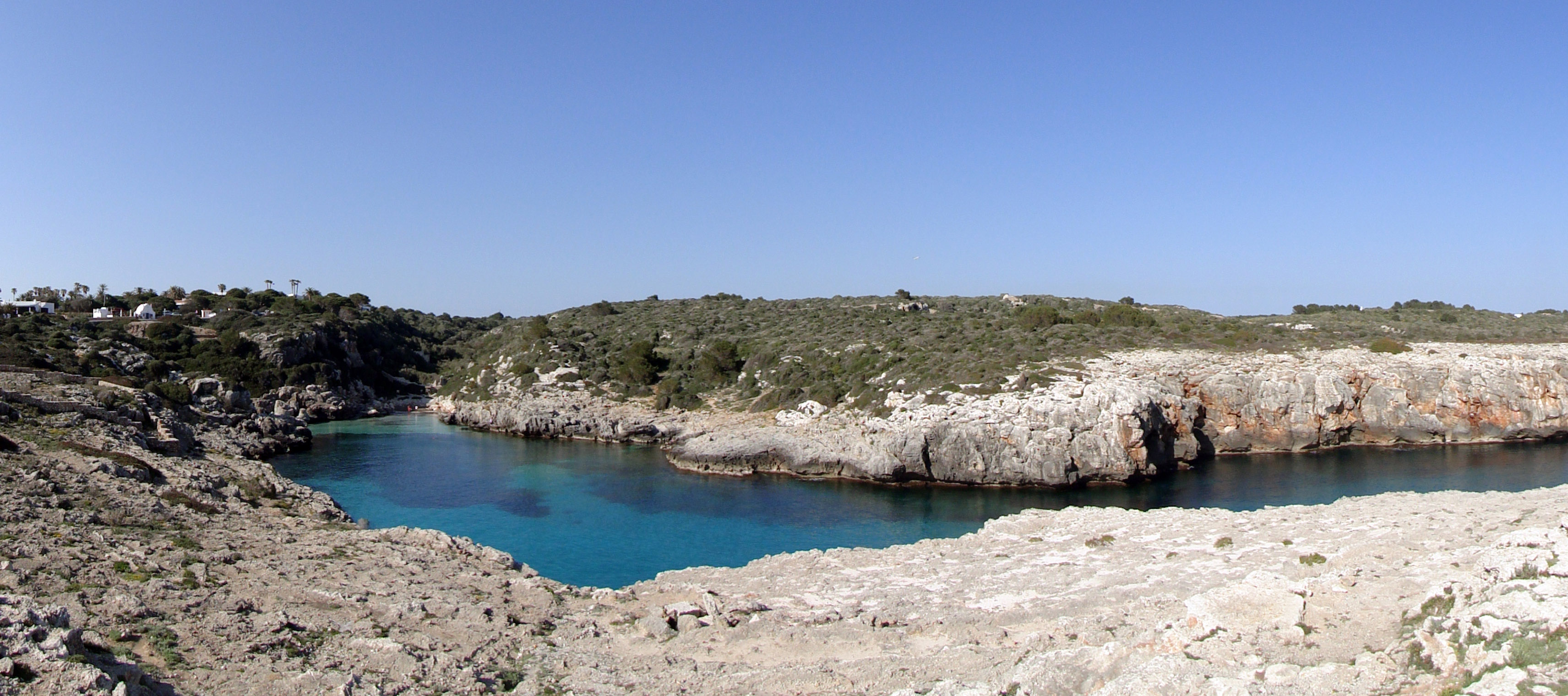
General view of Cala Binidalí from the suggested observation point.
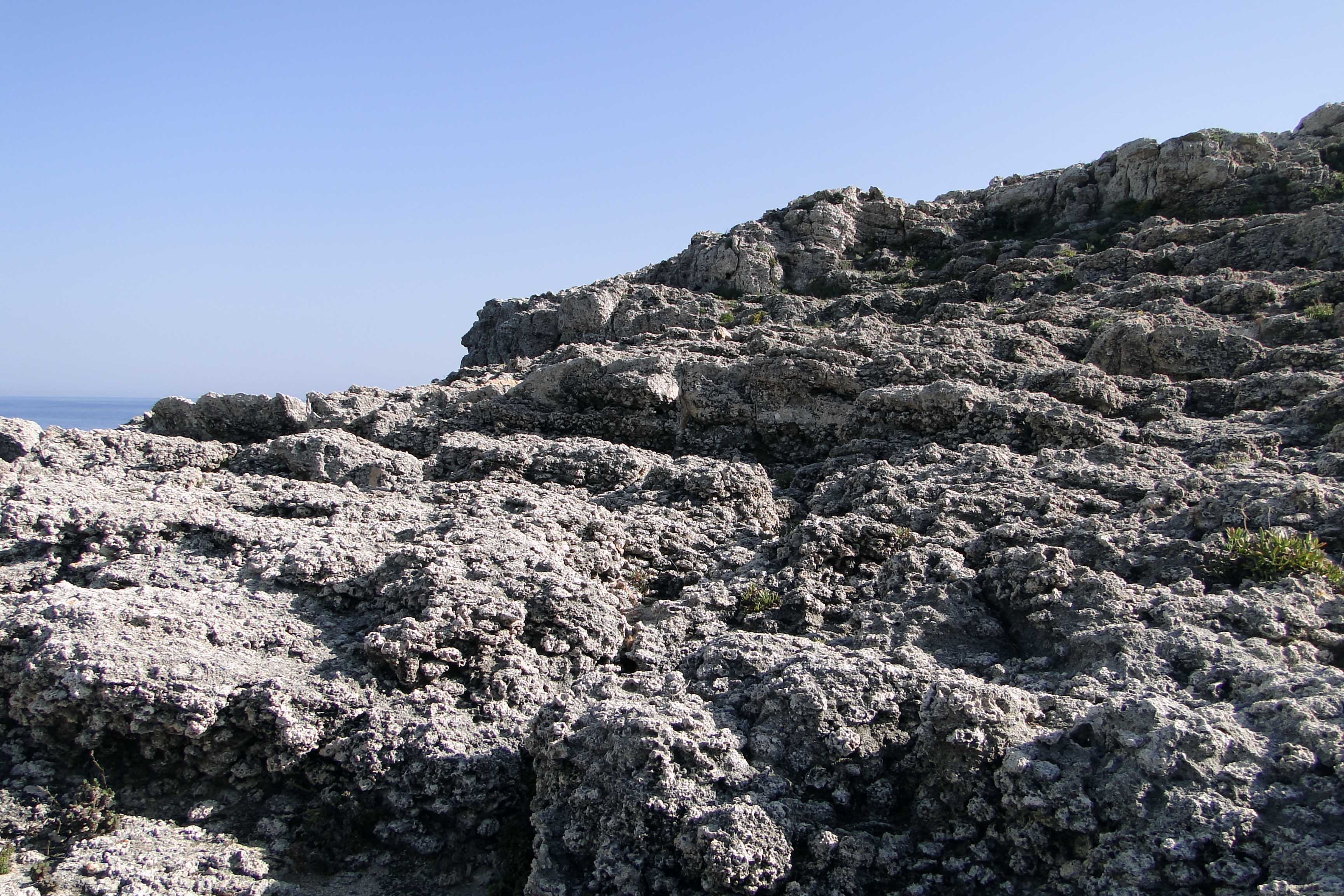
View showing the spectacular concentration of globular algae fossils in the cove.
Rhodoliths are nodules of algae made up primarily of coral algae that grow around the remains of a solid, such as a cobble or a shell fragment. Since algae need light to grow, they always develop in the area between the surface of the sea water and the shallows, known as the the photic zone, from which point on photosynthesis is not possible as there is insufficient sunlight.
These algae are characterised by the fact that they can incorporate calcium carbonate into their tissues, in other words, they calcify, making it easy for them to become fossilised. As they grow, most of these types of algae become somewhat spherical due to the dynamics of the environment caused by the movement they are subjected to from the currents and waves. In other words, the tumbling they are subjected to by the movement of the seawater where they live gives them this shape. Despite this, their external morphology may vary, among other shapes, from spherical to more or less flat.
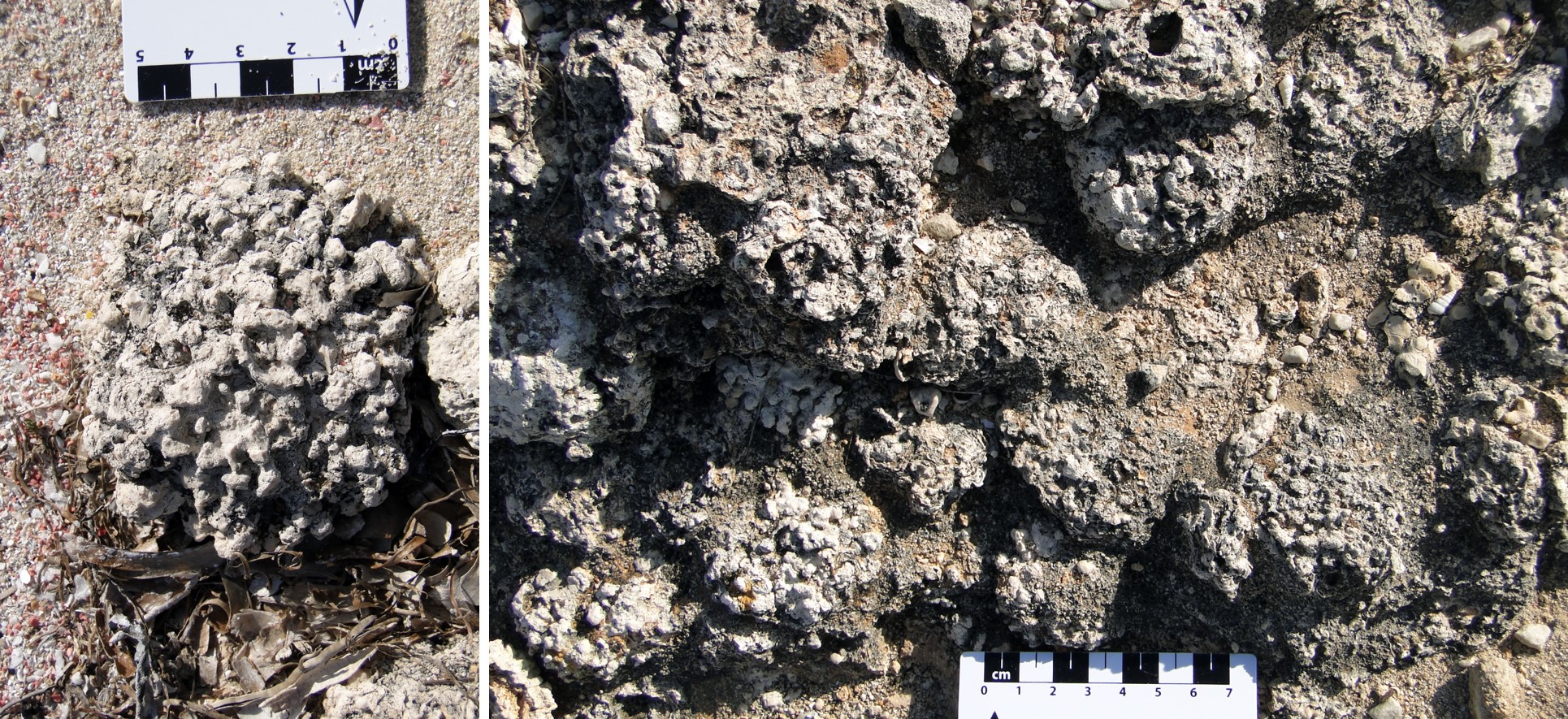
Rhodoliths usually take on an ellipsoidal shape. On average, they measure between 7 and 4 cm at their core. The largest can grow up to 8 cm and the smallest 2.5 cm.
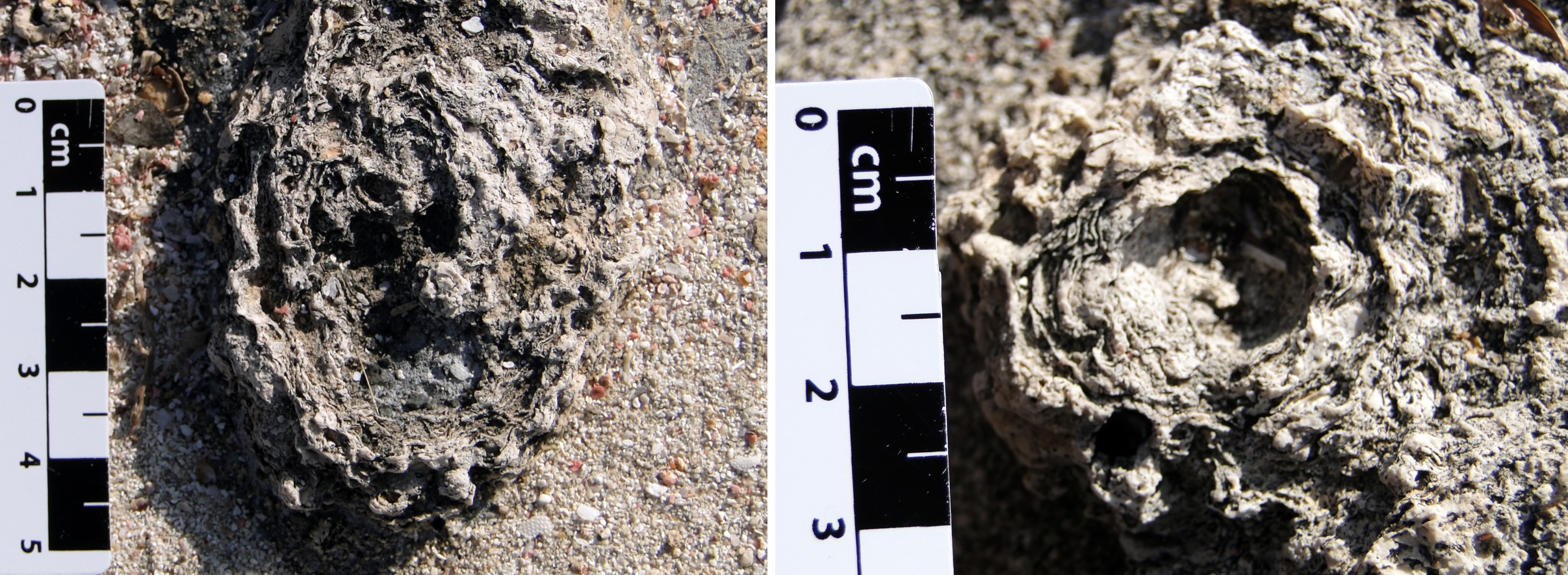
This cross-section shows that the nodules have a concentric structure as a result of their growth. Rhodoliths develop from a nucleus that may display the most extraordinary variety of natures. At the centre of the fossil, we can intuit the nucleus from where it forms.
Red algae or rhodoliths have been present in the sea around Menorca for millions of years; they now inhabit the area from the shoreline to depths of around a hundred metres at most, they are not subjected to a fixed substratum (which makes them move and gives them their spherical shape) and are popularly known on the island as ‘crespell’’. Their ridged shaped means that they can easily get caught in fishermen’s nets. They are known internationally as ‘maërl’ or ‘Sedimentary rock composed of clay rich in calcium carbonate. </p></div>">marl beds’. Rhodoliths can form very dense aggregations (blankets) over the subtidal coastal area, the extent of which may vary from a few metres to several kilometres. We should stress that Sedimentary rock whose main component is calcium carbonate (CaCO3). Its origin can be chemical, organic or detritic.</p><p><br></p></div>">limestone algae are one of the dominant fossils on the rocks in southern Menorca (marès).
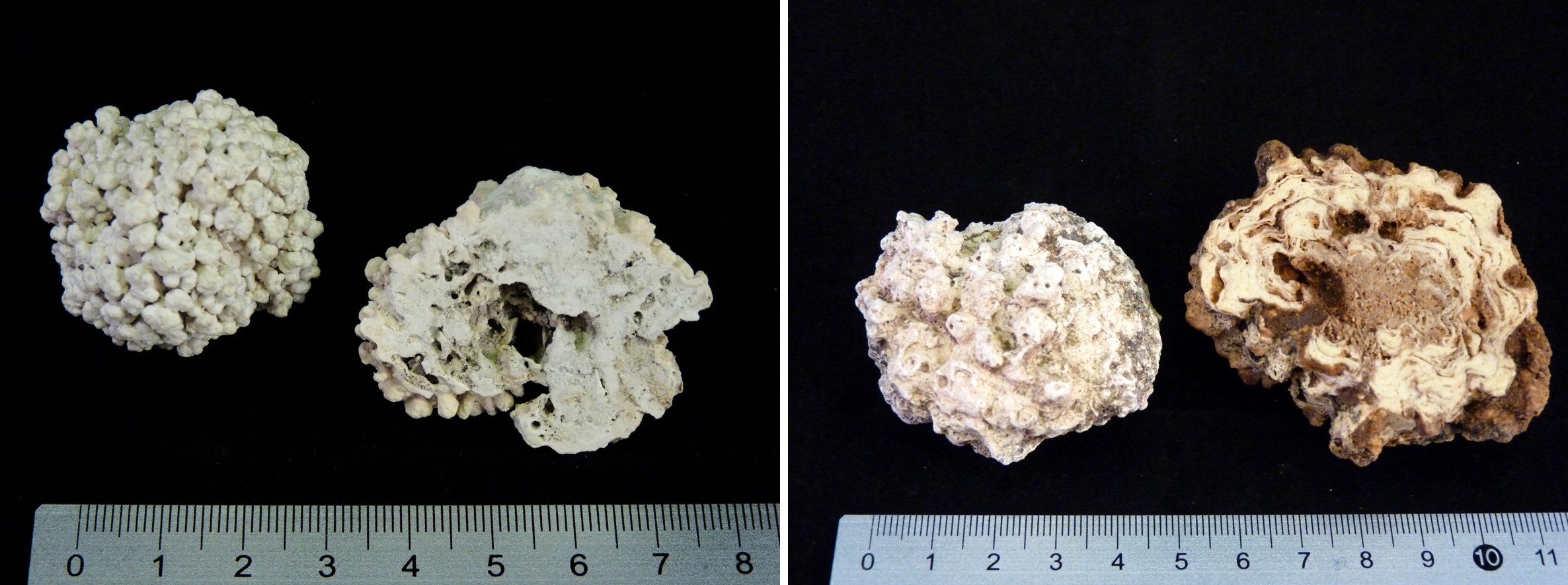
Examples of modern rhodoliths (left) compared with rhodolith fossils (right) at Binidalí at the Menorca Geology Centre. They are displayed whole and in cross-section, which helps us make out their concentric structure.
The most recent scientific studies of the area used the fossils that had been identified to help determine that these rocks were formed between 11 and 7 million years ago (in the Tortonian) at a depth of between 70 and 100 metres. The rhodoliths form gently south-sloping parallel layers. In other words, they lie next to each other and are joined together by a matrix of tiny calcium carbonate particles forming the strata and giving the Sedimentary rock whose main component is calcium carbonate (CaCO3). Its origin can be chemical, organic or detritic.</p><p><br></p></div>">limestone rock a granular appearance.
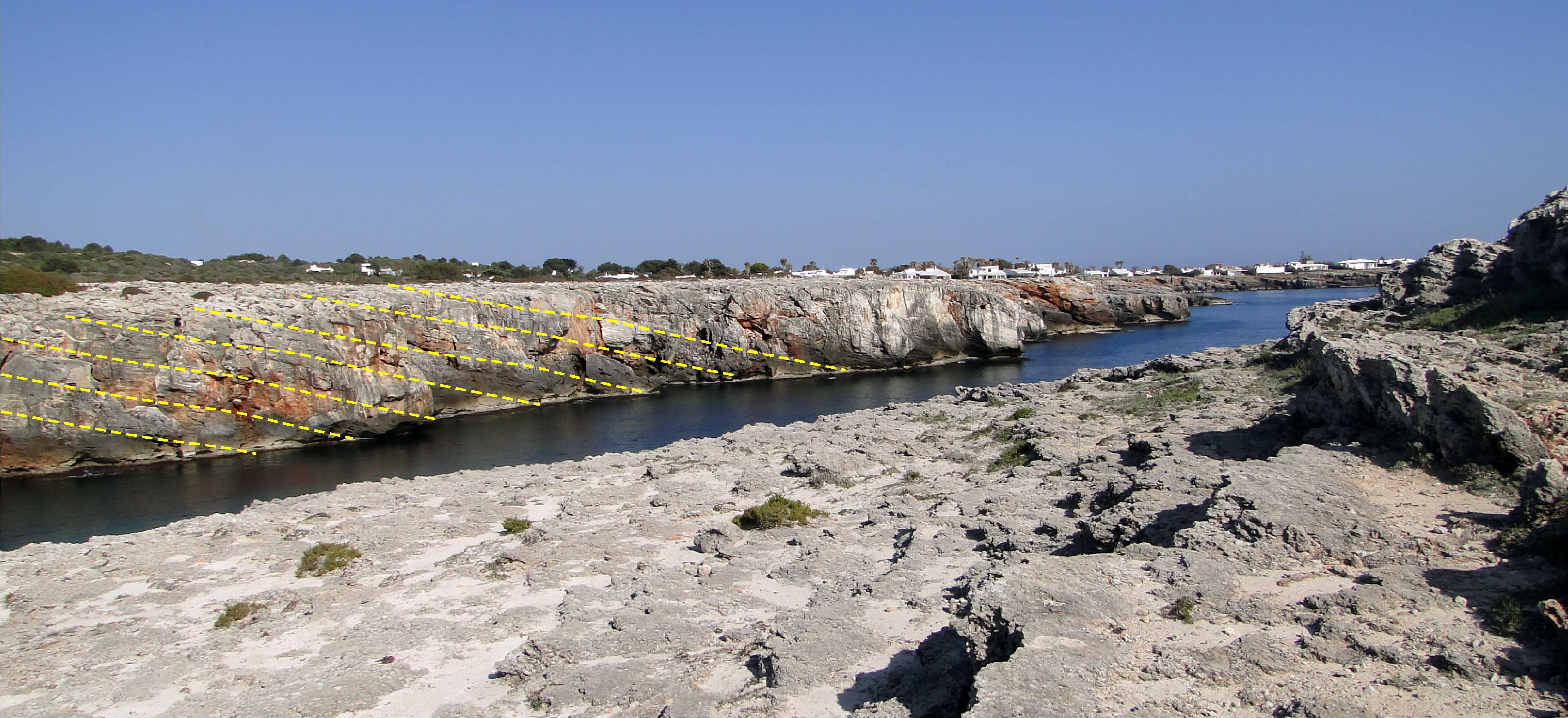
The sediments display a lamination that slopes around 15º-20º towards the open sea (southwards). The layers sometimes reveal levels of red, which are clays that were formed by karst erosion of the limestone rocks in the area.
Consequently, the value of the Site of Geological Interest is fundamentally linked to the presence of the fossils. Fossils are exceptional and essential elements in knowing the history of our planet and, consequently, of Menorca. If they are removed from the field by non-specialists, the information that they contain will be lost, so it is essential that you do not collect these specimens in order to conserve the geological outcrops and to allow everyone to be able to enjoy them. If you identify a fossil, it is very important that you do not remove it and that you leave it where it was found and not contribute to the fossil-hunting in the area. We should not forget that fossils are geological elements that may contain exceptionally important information and must not be extracted from the field unless it is for scientific reasons, and if they are removed, they must be deposited in museums.
These outcrops were seriously threatened in 1979 by the growing urbanisation of the cove. The involvement of different scientists from the Autonomous University of Barcelona and the Geological and Mining Institute played an important role in preventing construction and consequently preserving part of the site of geological interest.
