Sedimentary rock whose main component is calcium carbonate (CaCO3). Its origin can be chemical, organic or detritic.</p><p><br></p></div>">Limestone concretions are very common in Menorca’s Miocene rocks (in the south and west of the island), but the ones in the place of interest are particularly interesting and spectacular. Concretions are accumulations of mineral layers that have been transported dissolved in water and have then precipitated. Sedimentary rock whose main component is calcium carbonate (CaCO3). Its origin can be chemical, organic or detritic.</p><p><br></p></div>">Limestone concretions comprise primarily two types of minerals, calcite and aragonite, which are the two crystal forms that calcium carbonate can take, although the first is more common.
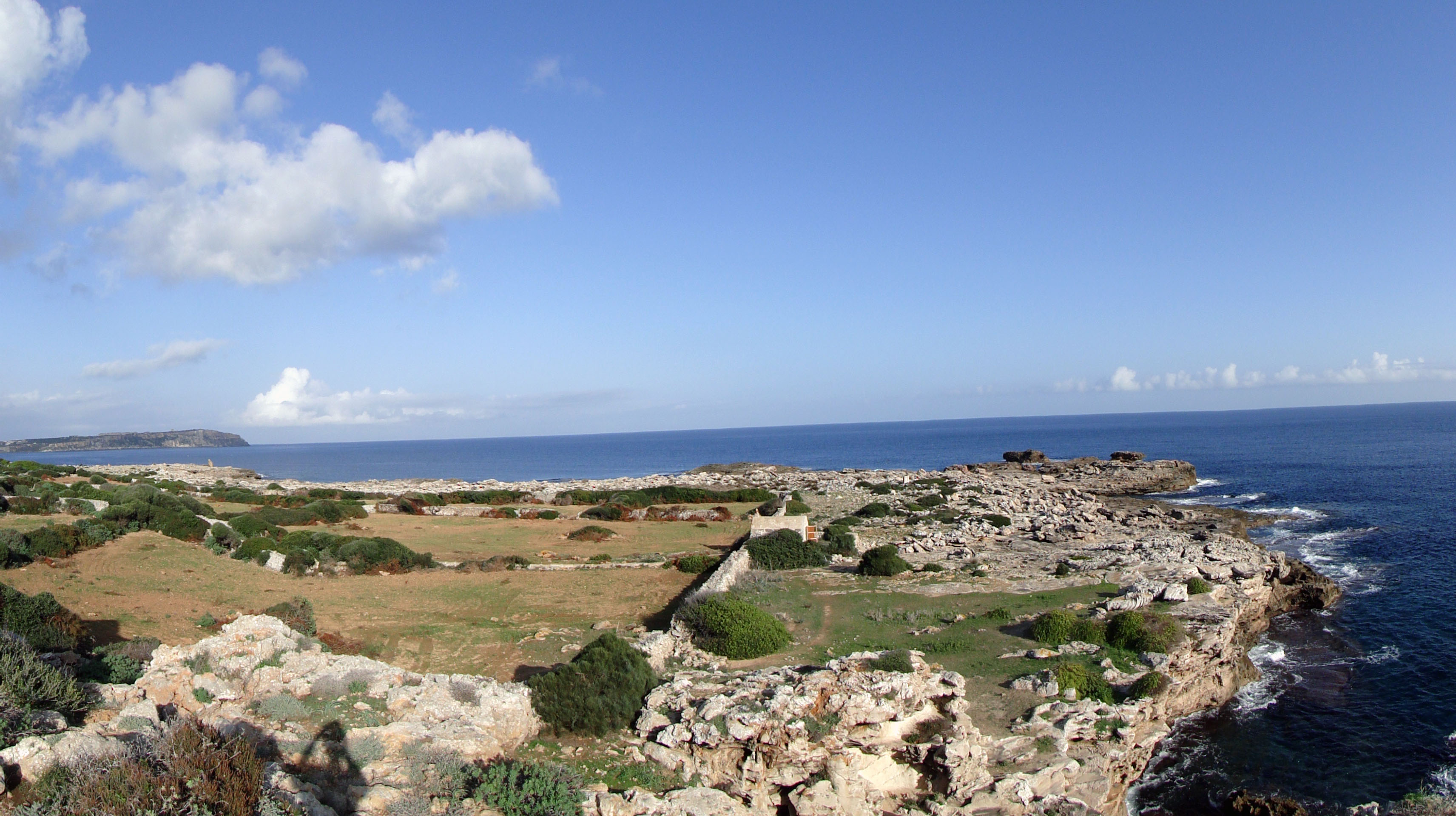
General view of the area of interest from the Sa Cigonya part (southern tip of the Site of Geological Interest).
The best-known examples of these forms are stalactites and stalagmites found in caves. Depending on the concentration of carbon dioxide and the temperature, these mineral deposits form because the water that circulates in the subsoil is able to dissolve the rock and is consequently laden with minerals. When it reaches the cavities, there is a reverse reaction where the presence of air releases the carbon dioxide, which alters the water’s ability to maintain these minerals in dissolution, causing them to precipitate. In other words, when the water reaches the cave, it remains briefly suspended as droplets before falling to the ground. While the droplet is hanging from the ceiling, carbon dioxide is lost into the atmosphere of the cave, so it precipitates a small amount of calcite that builds a ring around the droplet, forming stalactites. When this droplet falls to the floor of the cave, it continues to give off carbon dioxide and calcium carbonate is deposited, forming stalagmites until over-saturation stops. These mineral forms grow extremely slowly, as it is estimated that for a stalactite to develop by 2 cm, it may take around 4,000 years.
The dominant Sedimentary rock whose main component is calcium carbonate (CaCO3). Its origin can be chemical, organic or detritic.</p><p><br></p></div>">limestone concretions at Cala Sant Esteve are elongated. The scientists in charge of the various studies carried out in the area say that these shapes reflect the preferential circulation of ancient subterranean water, as the concretions developed with elongated pillars that ran parallel to the direction of the flow of this water. They also say that the differences in shape, size and orientation correspond to the fact that the concretions were formed over two stages, the first relating to the horizontal circulation of the subterranean water and the second possibly by meteoric water (water that penetrates directly from the surface of the land).

Close-up of precipitation structures near the Torre d’en Penjat (above) and next to the Caló des Vi Blanc (below).
These concretions were formed in dolomitized marès rocks. Dolomitization is a process that very often affects Menorca’s Sedimentary rock whose main component is calcium carbonate (CaCO3). Its origin can be chemical, organic or detritic.</p><p><br></p></div>">limestone rocks, so a rock that was originally calcium carbonate (Sedimentary rock whose main component is calcium carbonate (CaCO3). Its origin can be chemical, organic or detritic.</p><p><br></p></div>">limestone) becomes partially or completely magnesium calcium carbonate (dolomite). This process, which can occur at any time before or after the deposition of the Sedimentary rock whose main component is calcium carbonate (CaCO3). Its origin can be chemical, organic or detritic.</p><p><br></p></div>">limestone sediment, often destroys the fossils and the original sedimentary structure of the rock.
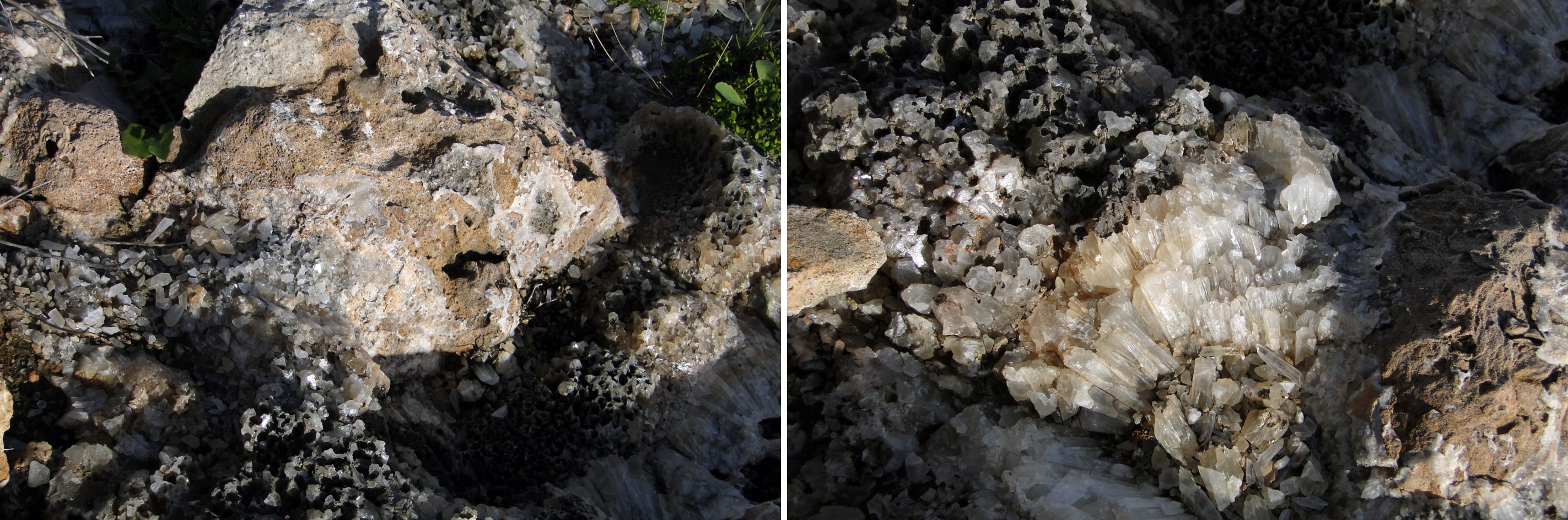
Calcite crystal aggregates that grow parallel in the area and which are popularly known in Menorca as ‘sal bruixa’ (Witch’s salt).
