The first description of the place as a Site of Geological Interest in 1988 focused interest primarily on the mesa of Fornells cliffs. The cliffs constitute an abrupt coastline slightly in excess of 100 metres in height to the west and that drop in height to the east as far as the Punta Pentinat headland.
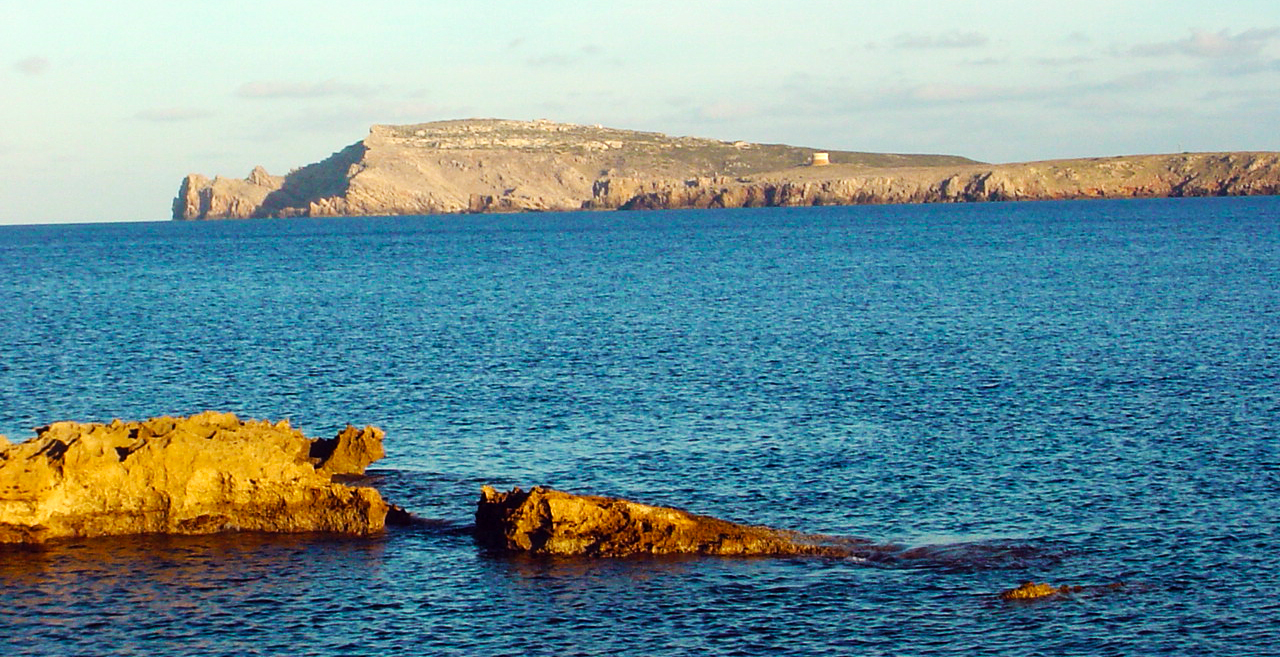
General view of the Site of Geological Interest Cap de Fornells crowned by the defence tower, with Mola de Fornells behind it.
The cliff faces at Mola de Fornells are undergoing a constant process of erosion. These vertical cliffs are slowly receding due to the sea, a process that led in its day to geological interest in the site. The continuous erosion by the waves is undermining the base of the cliff to a point where it causes large blocks to fall away, which gather at their base. The fallen blocks are dragged along and smash into the base of the cliff, increasing the erosive power of the waves. The process leads to a significant retreat of the cliffs and the formation of abrasion platforms or wave-cut platforms.
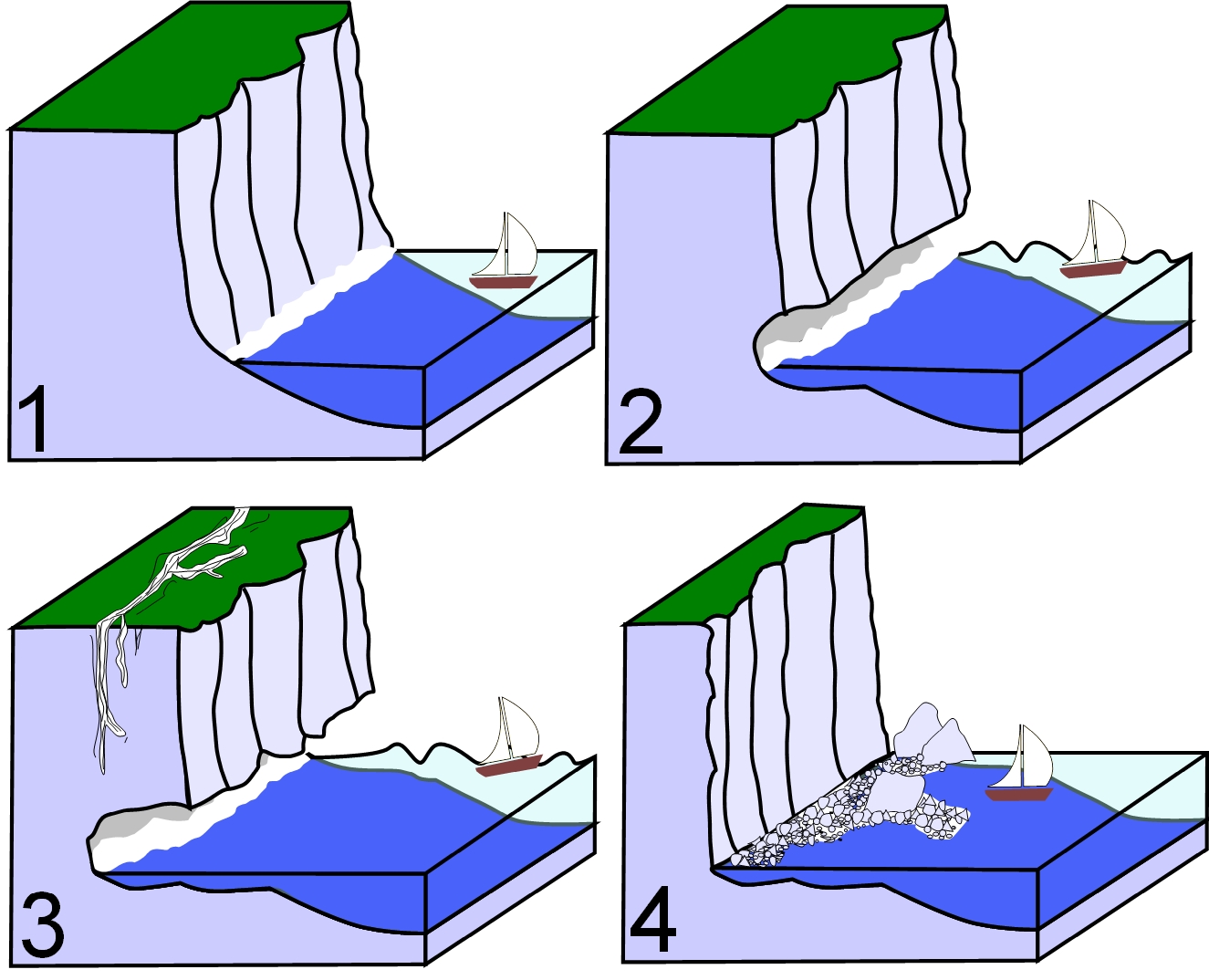
Evolution of a cliff caused by erosion leading to large landslides that can form an abrasion platform. Erosion due both to rain and wind and to the waves (1) steadily erode the cliff and, over time, can cause a phenomenon of undermining at its base (2). The evolution of this process can cause significant instability with the appearance of fractures (3), which can end in the cliff collapsing, creating an abrasion platform at its base (4), in other words, a flatter surface at the base, caused as a result of the erosion of the cliff and sedimentation of the materials that have eroded in it.
This way, the cliffs are subject to severe pressure from the sea, encouraged by the Tramuntana north winds, which also causes numerous sea caves scattered along the base of the cliffs. The caves are irrefutable proof that Mola de Fornells, of Sedimentary rock whose main component is calcium carbonate (CaCO3). Its origin can be chemical, organic or detritic.</p><p><br></p></div>">limestone origin, is extremely water permeable. As it is filtered through the rock, this water is heavy with CO2, acquiring a slightly acid pH that enables it to dissolve the rock slowly in a process that can last millions of years and that gives rise to the development of karst structures, such as the caves we see on the coast. In some of these caves, the drops of water hang for a time to the cave ceiling before falling, which makes some of the water evaporate, leaving a Sedimentary rock whose main component is calcium carbonate (CaCO3). Its origin can be chemical, organic or detritic.</p><p><br></p></div>">limestone deposit on the ceiling in the shape of an icicle called a stalactite. Of all the caves in the area, Polida de Fornells is outstanding as it is the most popular and extensive cave in the Tramuntana region of Menorca, measuring 543 metres in length. It is a cave of clear karst erosion origin, but also affected by the mechanisms of coastal erosion. The pounding of the waves has widened the cave opening, where sea erosion also plays a decisive role in the formation of these elements. This way, they are caves that have increased in width over time and can even end up collapsing, in other words, the ceiling can cave in.
On the surface, the rocks on the La Mola mesa, and also on the Cap de Fornells headland, take strange forms that create fields of grooves and sharp peaks called clints or lapies due to erosion by rainwater, which reacts with the CO2 and dissolves the rock as it moves across the surface (surface runoff). In other words, the same process that forms the caves and that we know as karst erosion, but that in this case occurs on the surface and can even form incisions measuring a few metres.
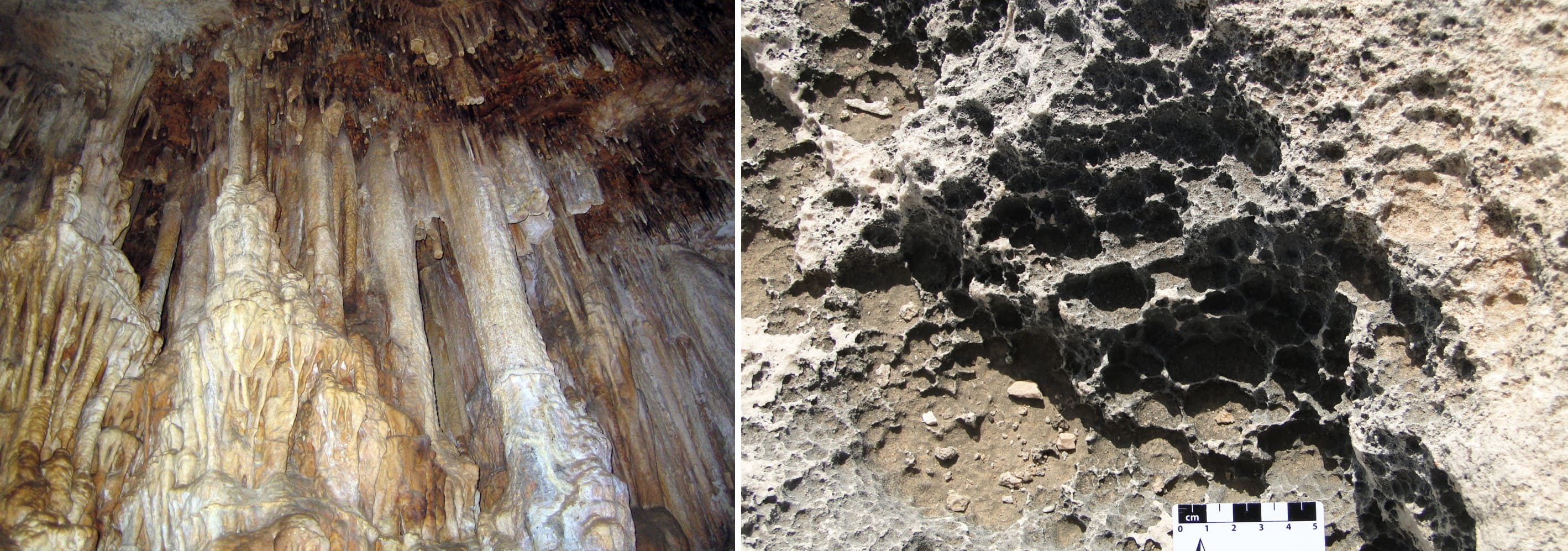
Cap de Fornells and especially Mola de Fornells display a landscape abundant in karst erosion phenomena, a product of which are the caves (Cova de na Polia in the photo), where speleothems abound, such as stalactites, or the formation on the surface of sharp crests known as clints.
However, the site’s interest is not just limited to the phenomena of erosion, but also includes the geological series itself. From the Fornells defence tower, you can see a good example of angular stratigraphic series or successions.</p><p><br></p></div>">discordance at La Mola. The same as at Cap de Cavalleria, you can see how the lower strata at La Mola are inclined, while the upper ones lie horizontally. The ones underneath are older, sedimented in the Jurassic, while the ones above are much more modern and were sedimented in the Quaternary. A stratigraphic series or successions.</p><p><br></p></div>">discordance is a geometric relationship between layers of sediments that represent a change in the conditions in which their process of deposition occurred. In other words, in the absence of tectonic movements, the sediments were deposited in horizontal and parallel strata (layers), as was the case with rocks in the Jurassic. Afterwards, tectonic forces caused them to incline as a whole, and later the rocks underwent intense erosion, forming a practically flat relief. Finally, (in this case, the Quaternary), horizontal strata were deposited once again on the inclined strata.
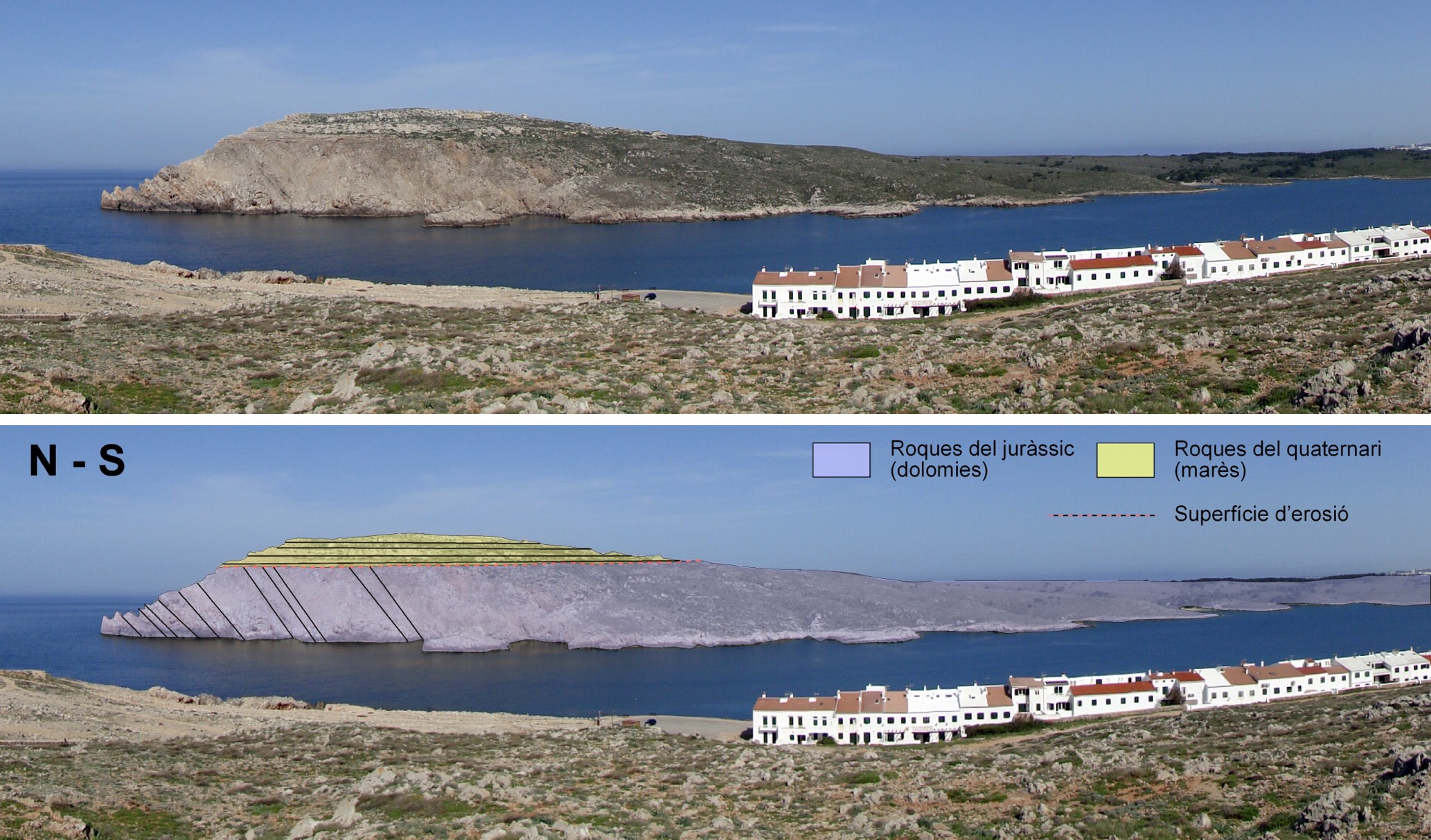
View of La Mola de Fornells, from north (left) to south (right) from the defence tower and a geological diagram of the mesa.
We should highlight that La Mola is not only made up of Jurassic rocks, but that the eastern half, except for the far northern part, is made up of rocks sedimented during the Cretaceous. The Quaternary rocks in the area are defined as calcarenites (marès) deposits transported by the wind in the proximities of a beach that acted as the source of sand. They contain abundant fossils of land snails. We do not find any of these Quaternary rocks at Cap de Fornells, either they were not deposited here or were worn away by erosion. As a result, at Cap de Fornells, around the tower, we only find outcrops of the inclined rocks of the Jurassic, which we can also identify at the lower part of La Mola de Fornells. The presence of fossils at the Site of Geological Interest makes them fall easy victim to fossil hunting. It is essential that you do not collect these specimens in order to conserve the geological outcrops and to allow everyone to be able to enjoy them.
These rocks are predominantly dolomites, but at Cap de Fornells we can also identify one of the few outcrops made up of marls from the Menorcan Jurassic, a sedimentary rock that contains between 35% and 65% of calcium carbonate, with the rest being clay, with an earthy appearance and that erodes easily. They are of special scientific interest as they contain fossils of algae, crinoids and brachiopods, which enable us to date these rocks and, therefore, know that they were sedimented 180 million years ago.
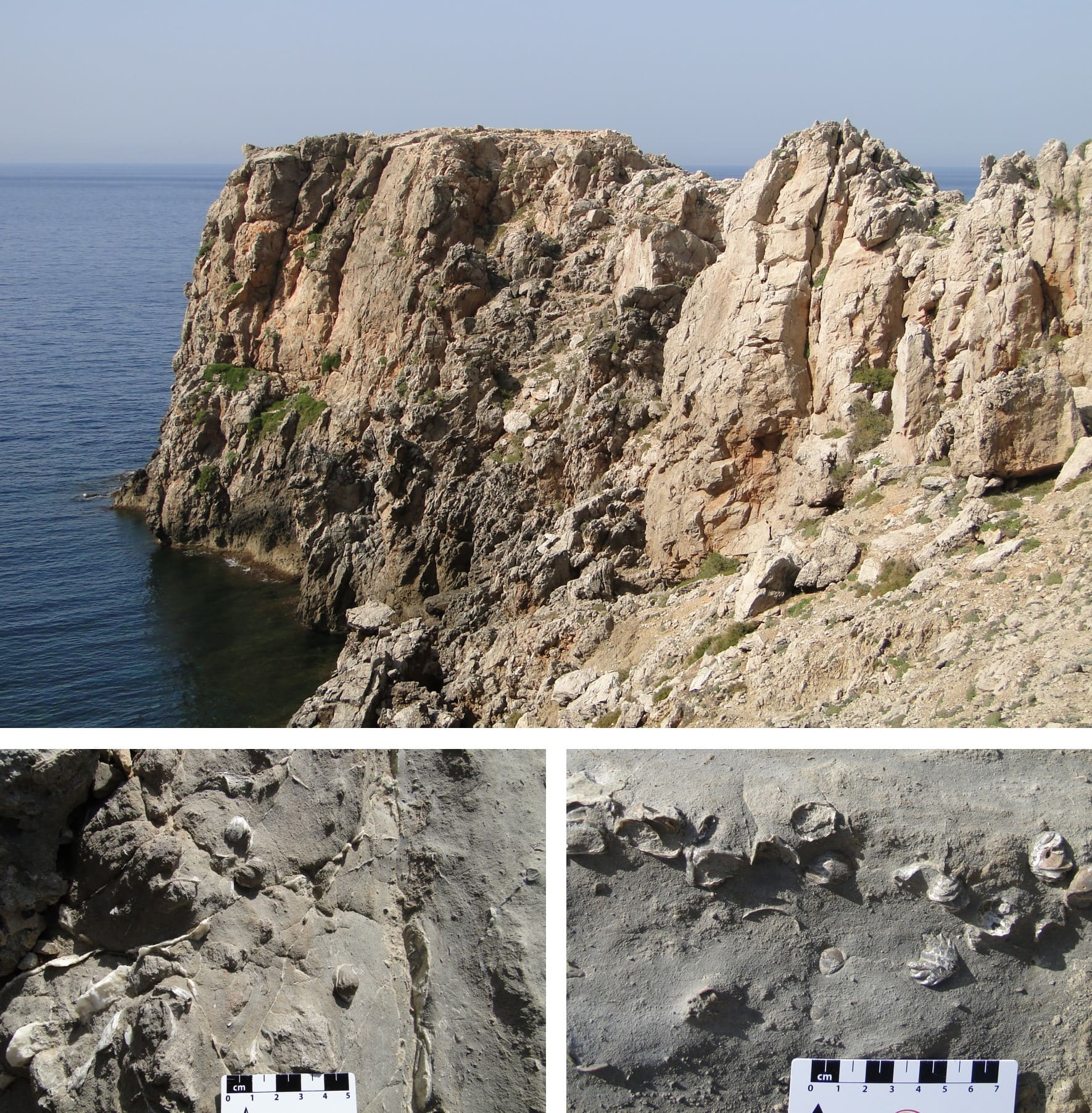
Cap de Fornells and close-up of the fossils (brachiopods in the photo) that enabled the rocks to be dated.
