The absence of urbanisation on the west of Cala Tirant has enabled the preservation of interesting geological outcrops. It is here where we find the rocks considered to be the oldest in the Balearic Islands. The presence of fossils of graptolites among its rocks allow us to determine that they were sedimented around 400 million years ago (late Silurian – early Devonian) on the seabed.
The word graptolite comes from graptos (writing) and litos (stone) and they are fossils that generally appear as jagged white lines on the surface of clayey rocks such as lloselles and slates. They were colonial marine organisms (hemichordata) that lived exclusively in the Palaeozoic, where they were widely distributed in its seas. They are of great interest for dating rocks of the Ordovician and Silurian periods of the Palaeozoic, when these organisms acquired their maximum development, just before their total extinction.
They are difficult fossils to identify that are often crushed inside rocks like small pressed leaves, which means their remains can easily be confused with plant fossils. Also, the subaerial exposure of the rocks very often erases their print, which hinders recognition even further. These fossils were identified at Macar Petit de Tirant in slate-like rocks: a black sedimentary rock which tends to exfoliate in small flakes, similar to sedimentary rock formed by clay.</p></div>">pelite. </p></div>">llosella, derived from clays rich in organic matter.
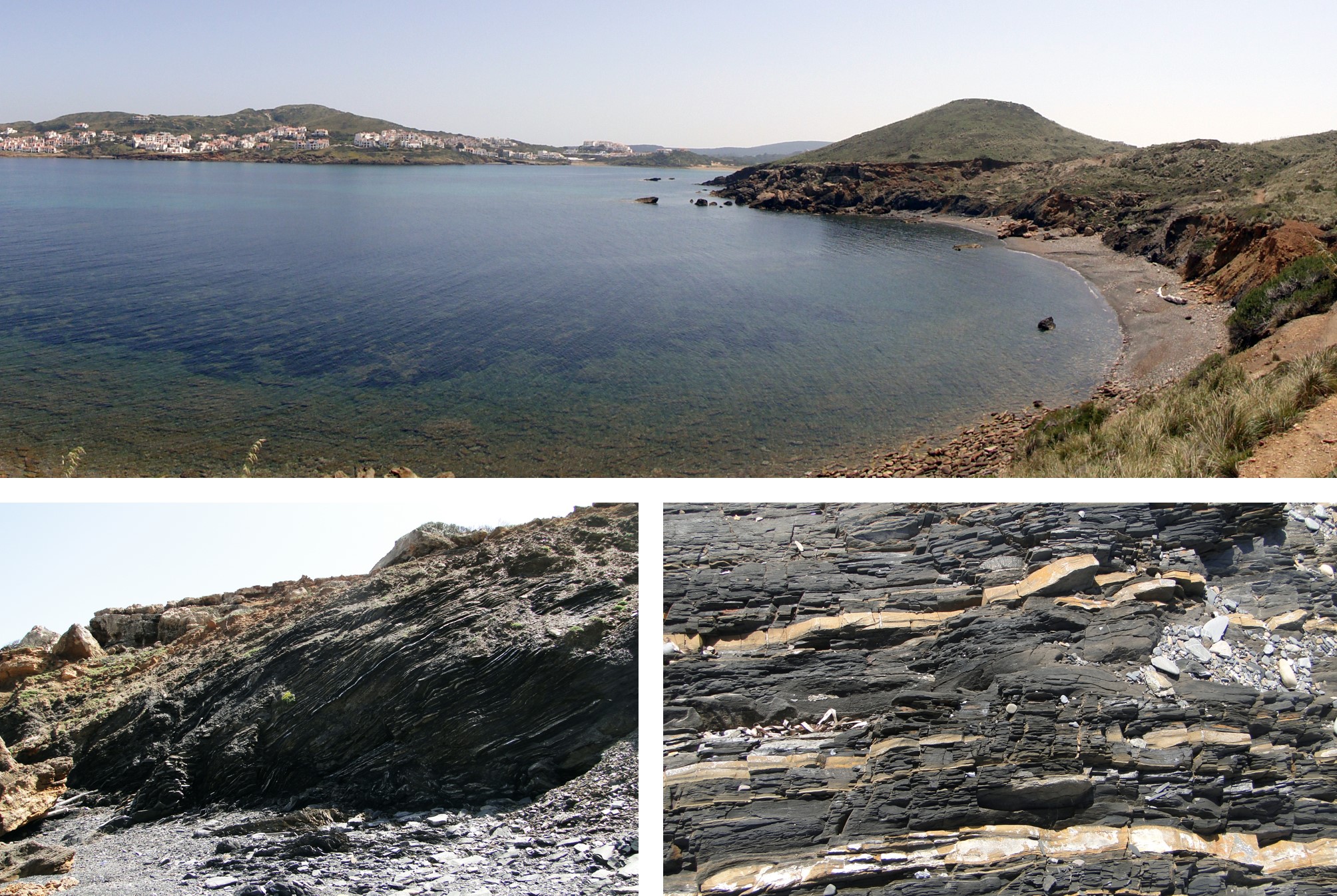
General view of Macar Petit and outcrop and close-up of the black lloselles in the cove. Frequently layered in the black loselles are lighter layers of limestone rocks.
The entire area displays numerous folds, some of them quite spectacular. The sedimented rocks are characterised by their stratified rocks, in other words, they are formed of strata or layers that are piled horizontally on top of each other. This means that if we find a rock with its strata folded or broken, we can say that the rock has been deformed. Deformations are a consequence of the action of forces in the Earth’s crust that can break a rock if it is rigid or fold it if it is plastic. The folds at Tirant bear witness to the enormous stresses to which the rocks were subjected in the late Carboniferous (some 300 million years ago). These stresses raised the sediments accumulated on the seabed and formed large mountain chains. These folds go by the name of Hercynian orogeny and gave rise to the formation of a primitive Menorca.
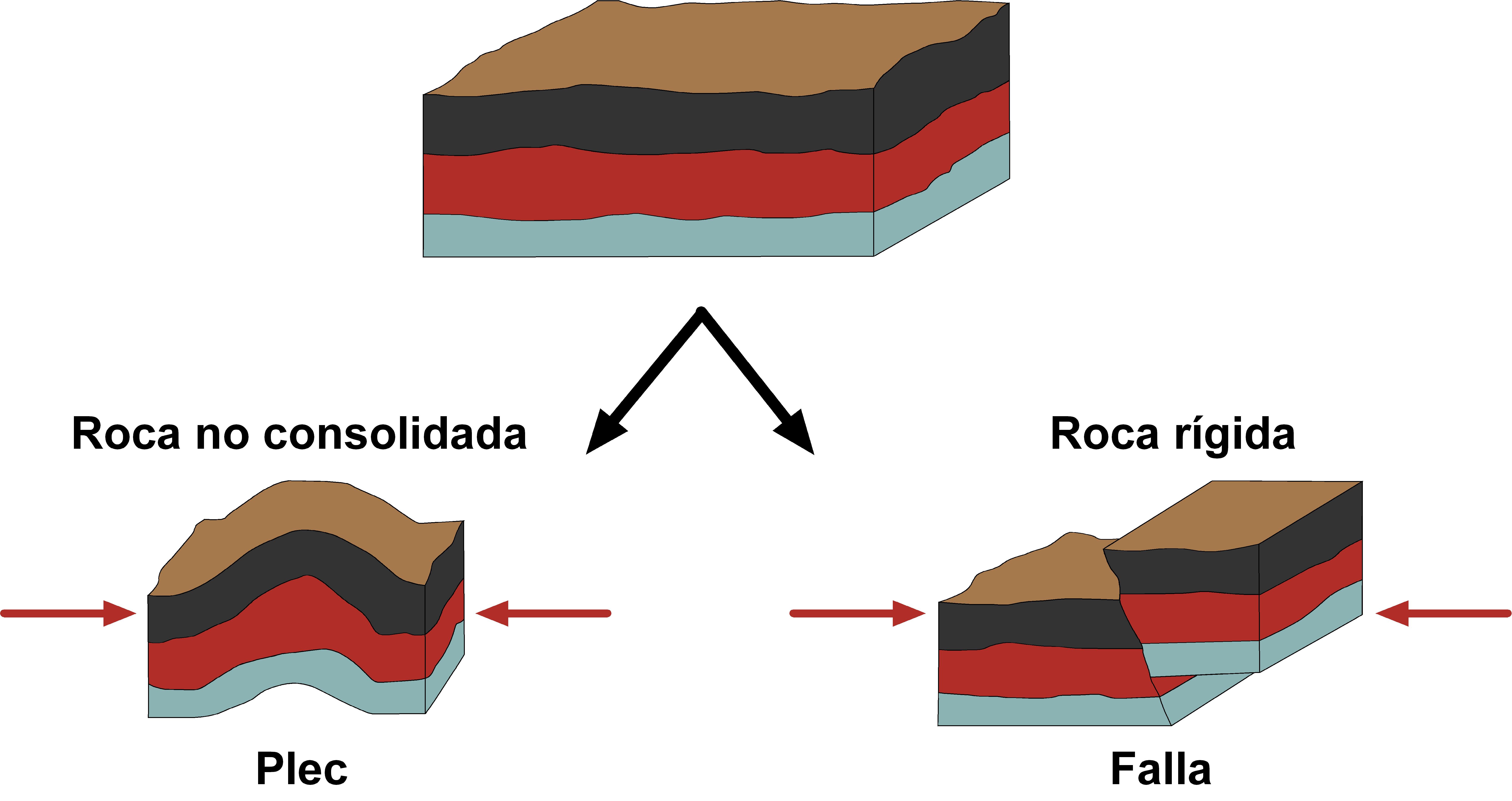
The rocks at Tirant are very deformed as a consequence of the compression forces to which they were subjected, which first caused folds (as the rocks were not consolidated) and, much later, fractures and faults once the sediments had become rigid rocks.
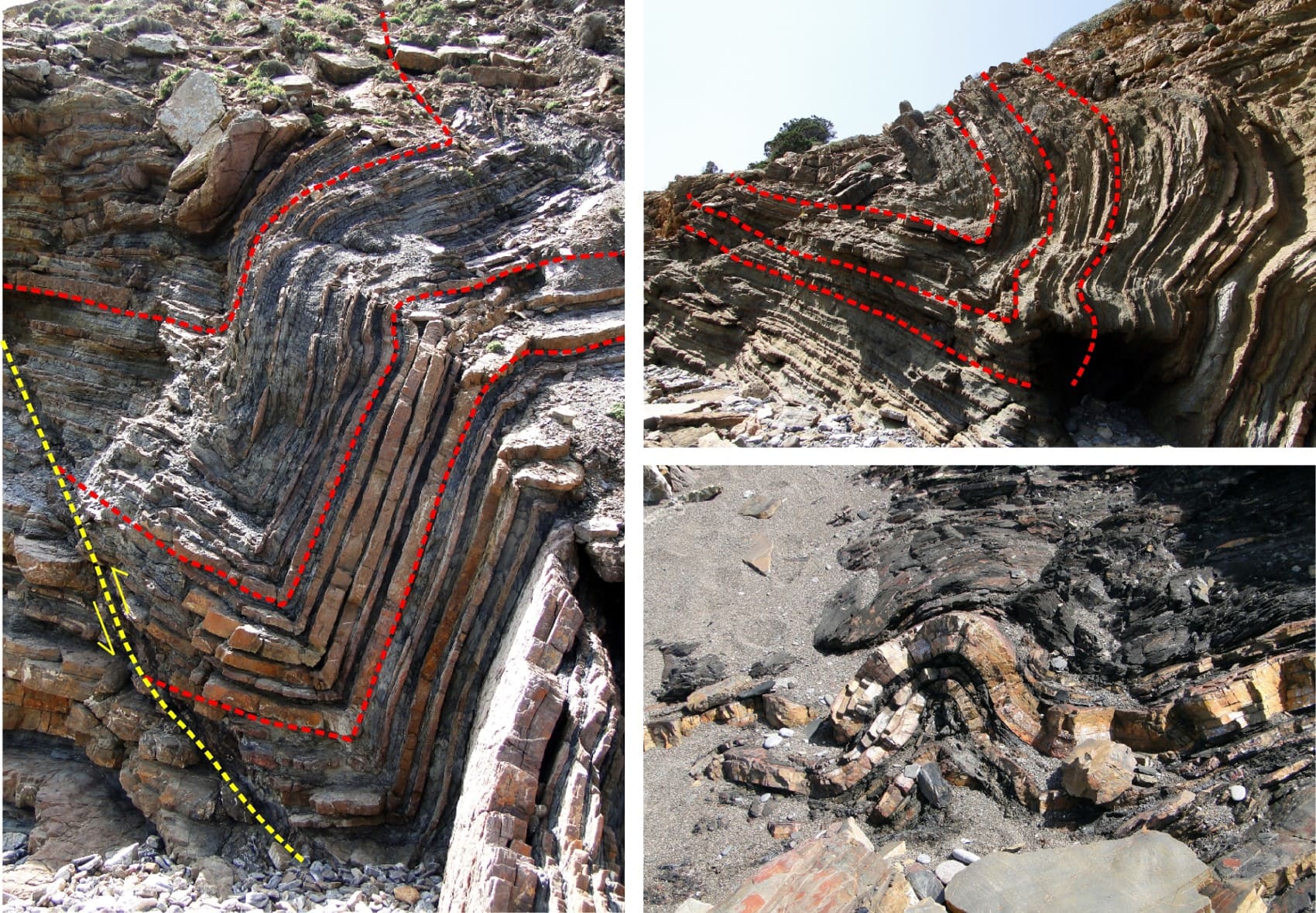
Impressive examples of folds at Tirant in fine-grained sandstones interleaved in layers of llosella. As an example, the red lines show the traces of folds formed when the rocks had not yet consolidated, while the yellow line traces a fault that deformed the rocks when they had become rigid.
At Macar Gran o Cala de Binidonaire, the sequences of rocks sedimented by turbulent flows are easily identified. In other words, by currents of dirty water that dragged the sediments from shallow areas to the great sea depths, where they deposited them. Occasionally, they display structures that reflect the transport to which they were subjected: a fluted and undulating appearance that indicates the action of the turbulent water flow, which led to a succession of small grooves and piles of sand.

Bank of rocks sedimented by turbulent flows at Binidonaire (affected by faults and folds) and close-up of the undulations caused by the flow when dragging the grains of sand.
In this cove, the rocks are frequently interleaved with layers of Sedimentary rock whose main component is calcium carbonate (CaCO3). Its origin can be chemical, organic or detritic.</p><p><br></p></div>">limestone. These often attract attention due to the large presence of diaclasses (fractures in the rocks with no relative displacement of the parts) that have been mineralised by white calcite.
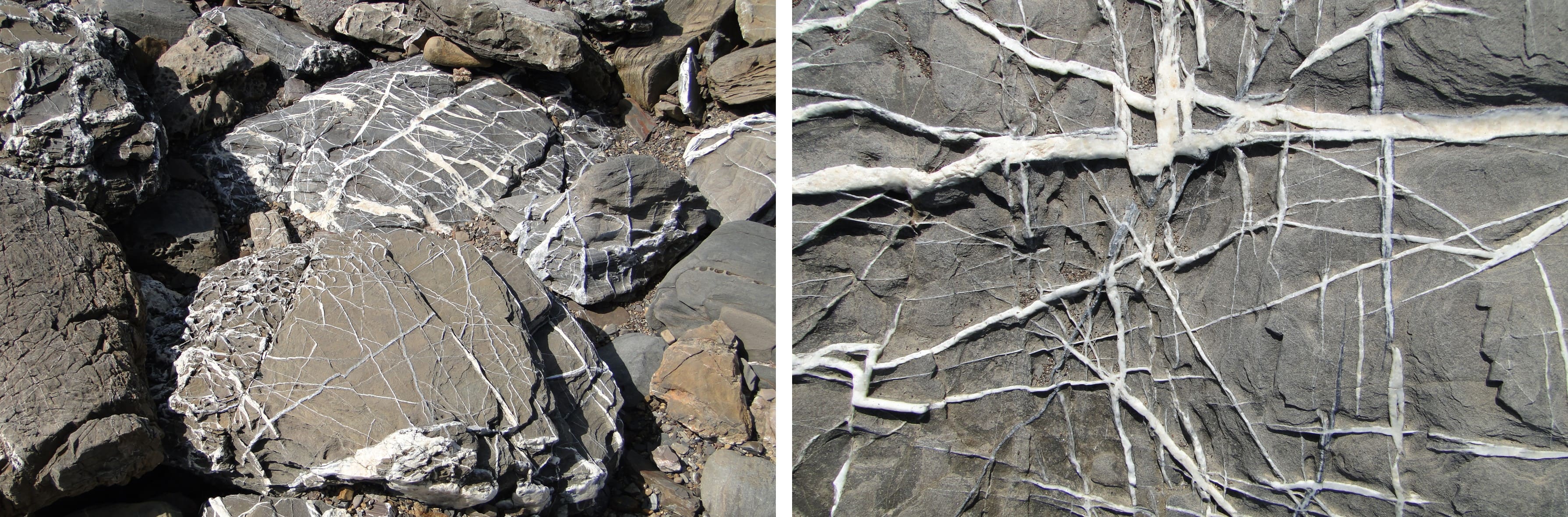
Limestone densely scored by an irregular network of lines corresponding to diaclasses mineralised in calcite.
Finally, we should highlight the presence throughout the Site of Geological Interest of strata of marès from accumulations of consolidated sand from old dunes from the Quaternary (the most recent geological period). In these deposits, we can very often observe a series of sloped lines that indicate the movement of the sand, which was blown by the wind inland from the beach, where it piled up in an area near the coast.
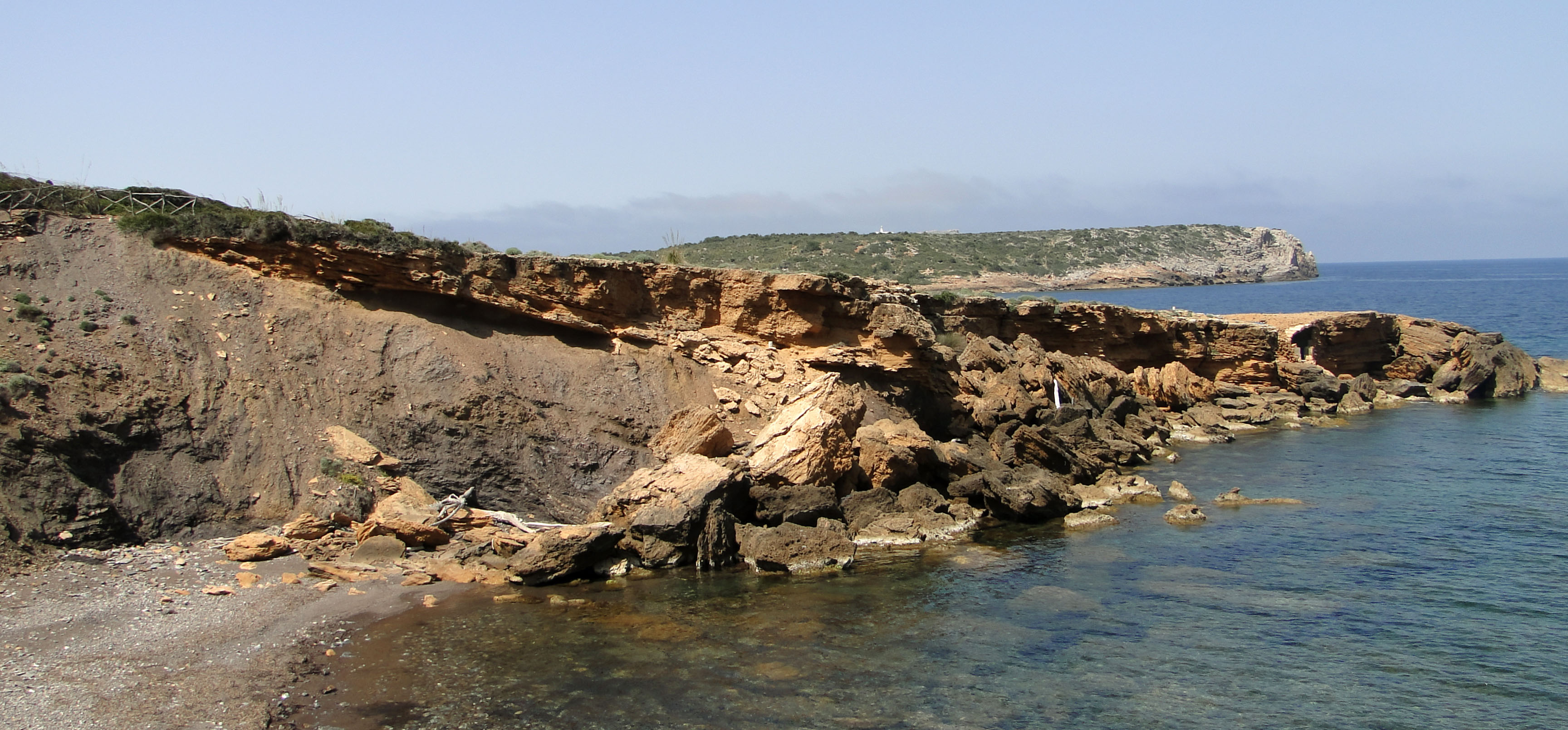
Marès sedimented on the layers of llosella and sandstones from the Silurian-Devonian, corresponding to an old dune from the Quaternary period, on the side demarcated to the north by Macar de Binidonaire. Note the wedge shape adopted by the fossil dune, narrowing as it goes inland due to the effect of the sand being dragged from the sea towards the hinterland.
