On the night of 19th December 2008, on the eastern slope of the Puig de s’Alcadena took place an avalanche of rocks that generated a fall of some 60,000 m2, visible from a large part of the island of Mallorca.
Fortunately there were no losses of human life or damage to constructions, although the houses of Son Cocó, the estate affected by the avalanche, narrowly escaped being swept away.
The cause of the phenomenon lay in an extraordinarily cold and rainy period that lasted from November 2008 to January 2009.
It was precisely this combination of cold and rain that generated a process of breakage of the rock known as gelifraction, which consists in the opening of cracks in the rock as the water freezes and expands inside it.
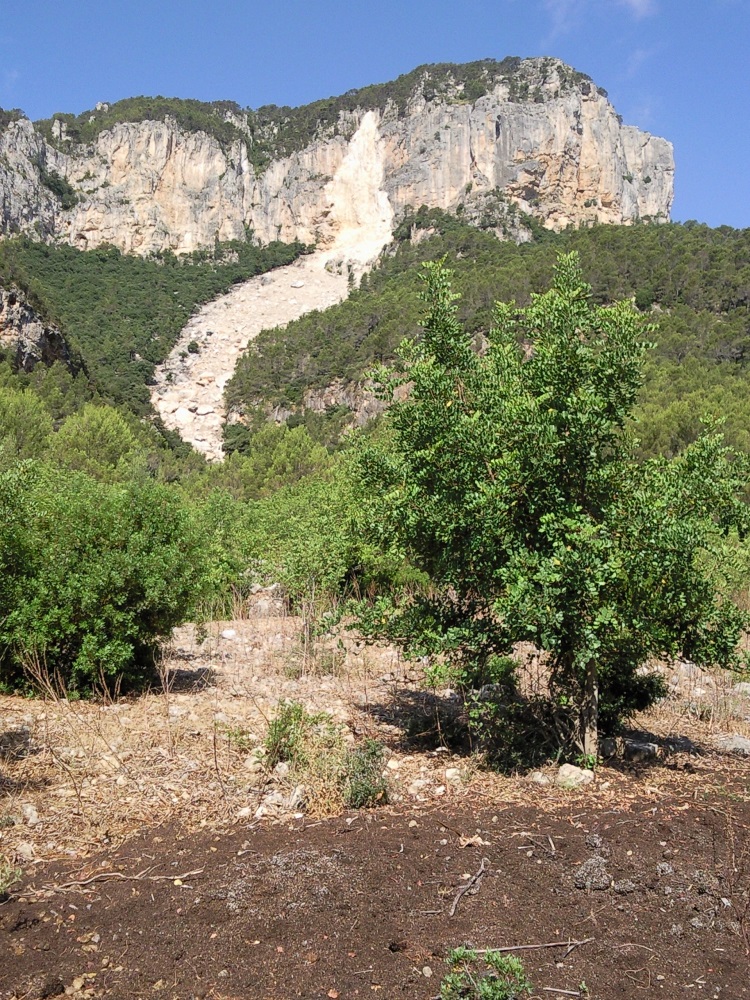
General view of the rockfall.
In the particular case of Son Cocó, the breakage of the rock followed two large convergent vertical fractures situated in the highest part of the cliff, some 150 metres in height.
The rock avalanche flattened the forest located on the hillside beneath the cliff zone and formed a tongue which accumulated some 300,000 m3 of rocks.
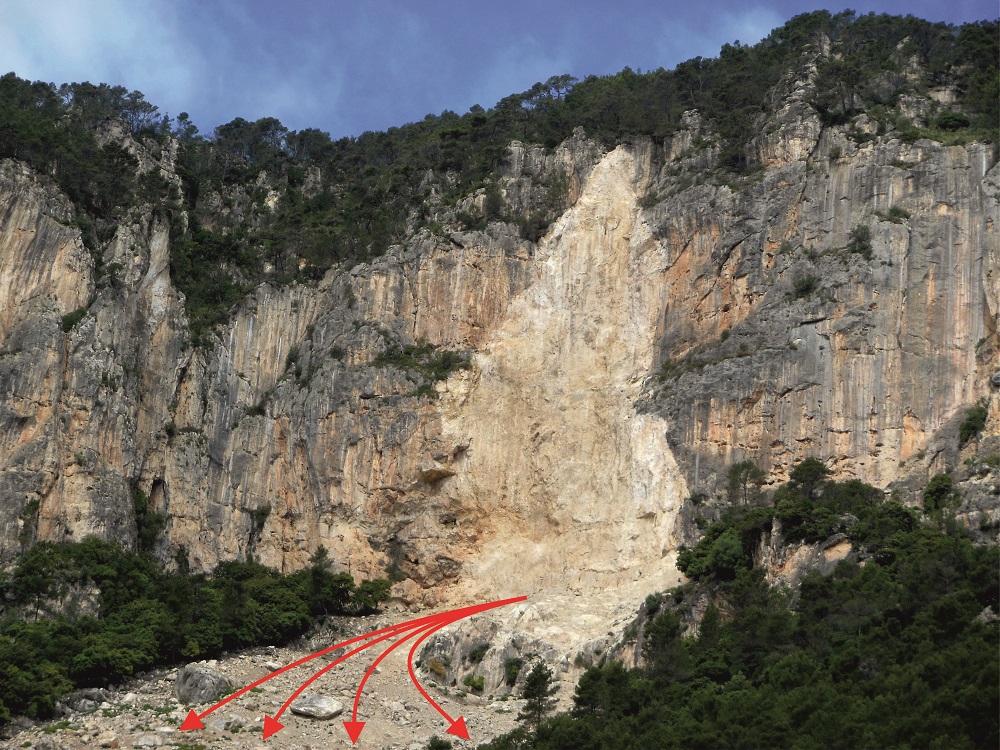
Detail of the head of the rockfall.
The rock avalanche flattened the forest located on the hillside beneath the cliff zone and formed a tongue which accumulated some 300,000 m3 of rocks.
If the phenomenon did not have greater dimensions (with which it would have destroyed the houses of the area) it was thanks to the topography of the terrain, which prevented a greater dispersion of the materials, and thanks also to the forest itself, which absorbed a part of the energy and divided the flow of rocks.
Most of the rocks are several metres in height and weigh thousands of tons, although, due to the dynamics of the movement (like a high-energy fluid), during the avalanche they travelled in the most superficial part of the moving mass.
The Son Cocó rockfall is not an isolated case, because there are numerous processes of instability in the rocky embankments of the Tramuntana range, especially in its northern face, but this one was notable for its enormous scale.
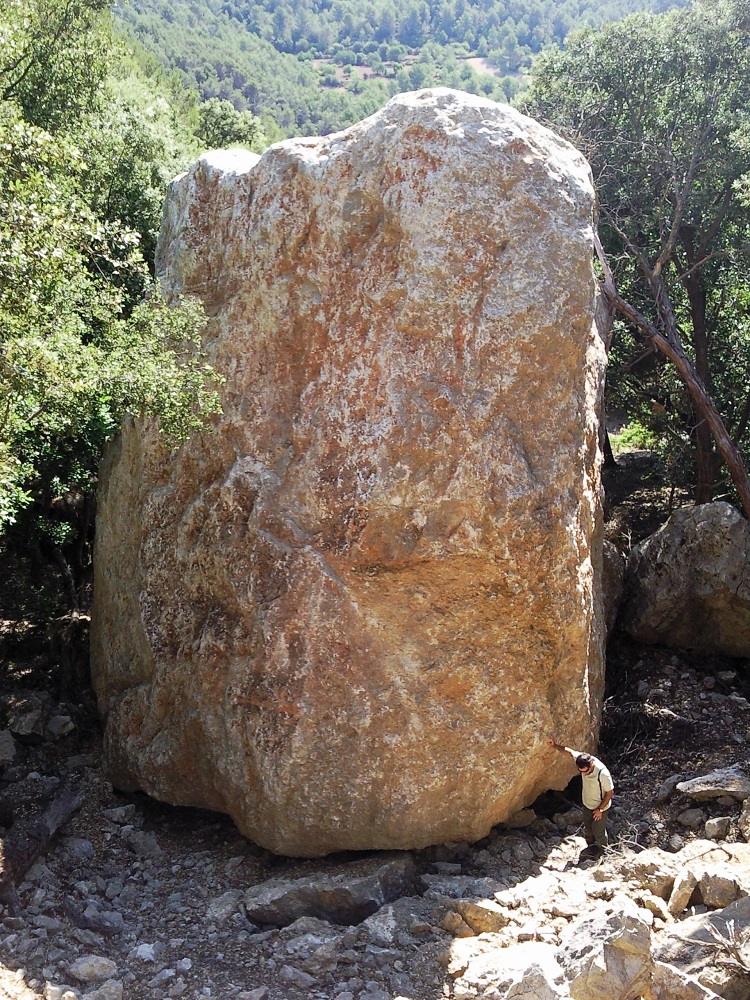
Large block in the final part of the rockfall.
