The quarry of S’Estret des Temps is famous for the existence of an important paleontological site preserved in the dunes which during the Pleistocene developed in many coastal zones of Mallorca. The material that forms them is the typical sandy Sedimentary rock whose main component is calcium carbonate (CaCO3). Its origin can be chemical, organic or detritic.</p><p><br></p></div>">limestone known in the Balearics as marés.
Because marés is abundant in the zone, it was exploited in several quarries, which allow clear geological sections to be seen in their walls, showing the undulating morphologies and cross-stratification typical of dunar deposits, formed by the action of the wind some 40,000 years ago. The fossil dunes of S’Estret des Temps adjoin some ancient cliffs formed by rocks from the Upper Miocene, of some 6 Ma ago.
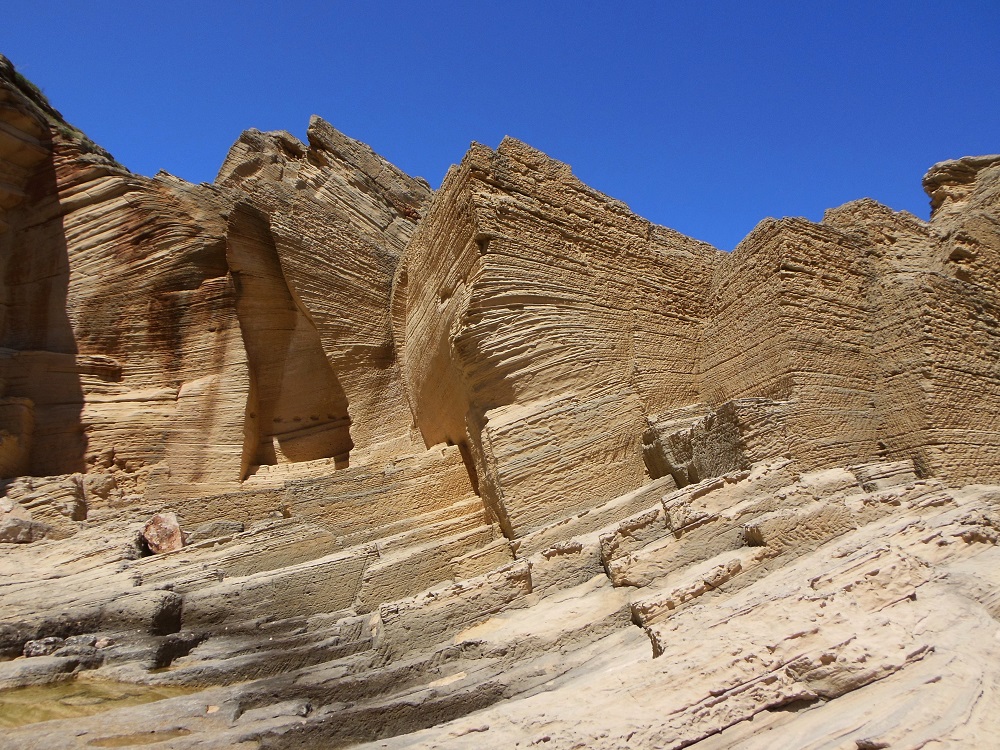
Spectacular cross-stratifications in the walls of the quarry.
In this period, in which the island’s climate was cold enough for the sea level to be several metres below its present-day level, the zone was inhabited by an autochthonous bovid of the Balearics: the Myotragus balearicus.
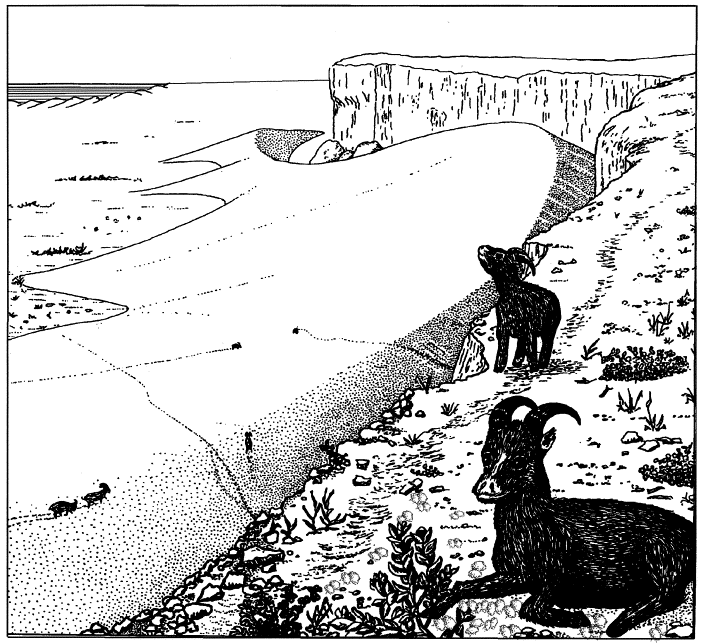
Recreation of Myotragus balearicus in S’Estret des Temps (taken from Fornós et al. 2002).
The hoofprints (technically named ichnites) of this animal, fossilised by the dunes, were exposed during the quarrying operations for extracting marés. It was not until the 1980s that scientists became aware of the existence of this type of fossils in a material that was not very appropriate for their preservation.
The clearest prints can be seen on the stratification surface of the marés, in circular shapes and grouped into the form of a track, which indicates the route taken by a particular individual. At the beginning of this century it was decided to give this type of ichnites a scientific name, Bifidipes aeolis.
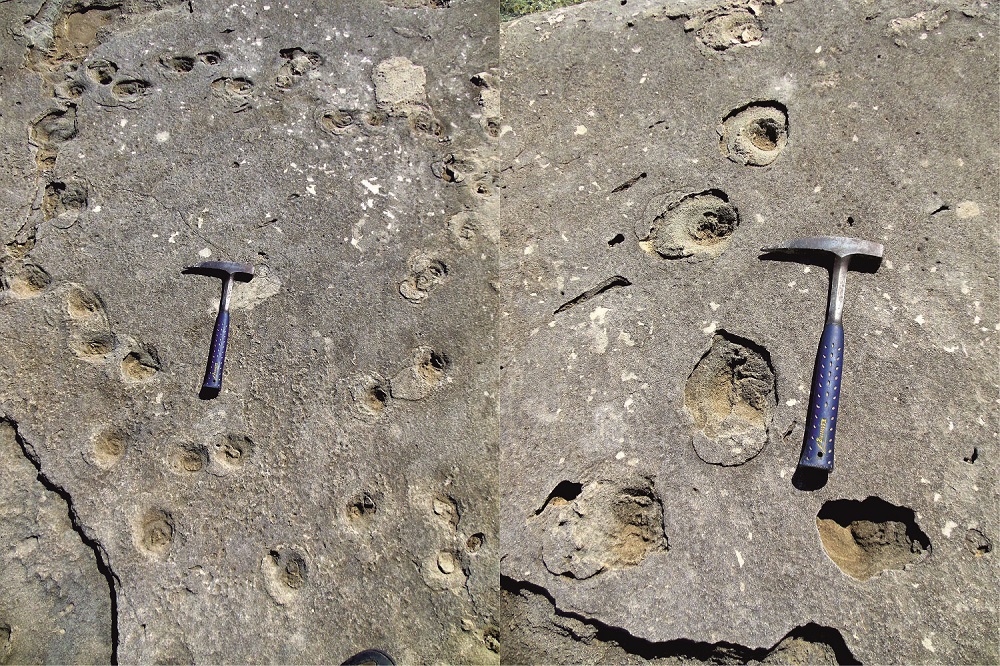
Two views of hoofprint tracks with their characteristic shapes a circular tendency.
In the quarry of S’Estret des Temps we can see hoofprints not only on the surfaces of the calcarenites but also in the vertical embankments, in the form of concavities which break the horizontal laminations of the calcarenite, along with root moulds of the plants that lived on the dunes.

Hoofprints in transversal section.
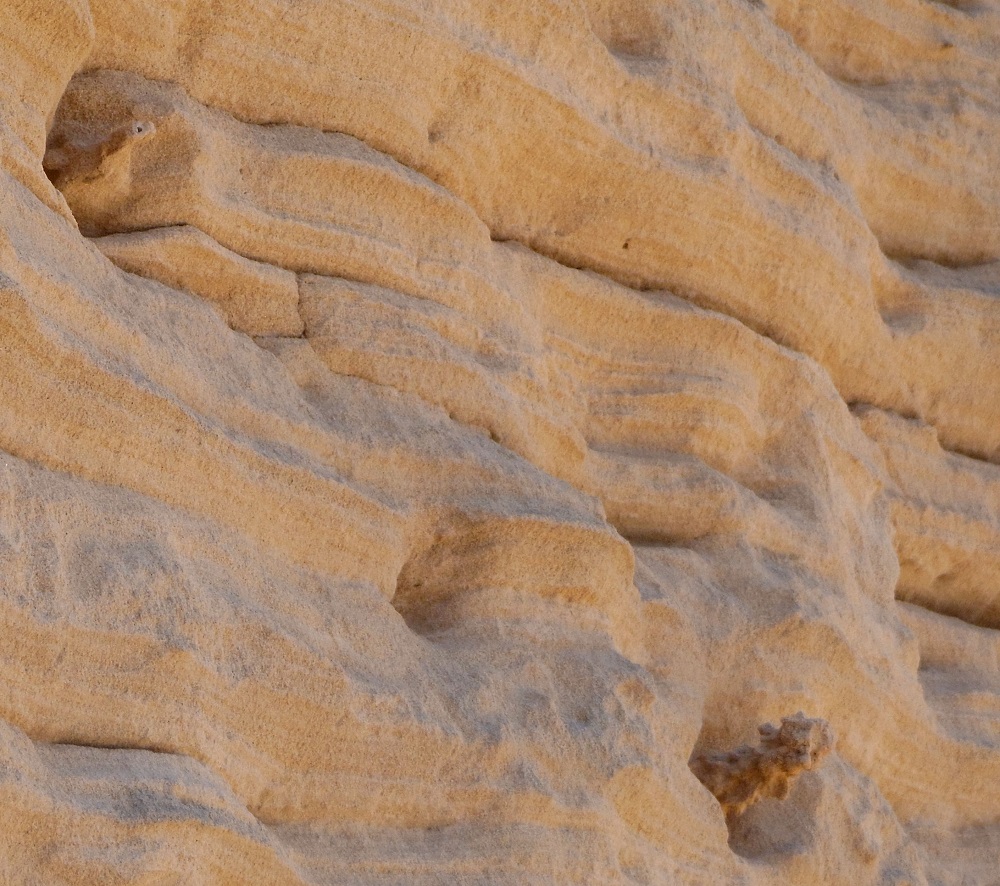
Root moulds.
The cliffs surrounding the quarry are formed by rocks of the Miocene belonging to the Santanyí Formation and correspond to ancient mangrove swamps, tropical coastal zones populated by mangrove trees, which are very resistant to saltwater. The moulds of their roots still survive along with some fossils of molluscs in levels of whitish marls. Above these there are levels that mark a replacement of the mangrove swamp by extensive plains moulded by the action of the waves. This upper section is composed of a type of rock called oolitic Sedimentary rock whose main component is calcium carbonate (CaCO3). Its origin can be chemical, organic or detritic.</p><p><br></p></div>">limestone, which contains remains of biological activity technically named bioturbations.

View of the cliff: the whitish marls with root marks on the mangrove facies, and the orange-coloured oolitic limestones of Santanyí
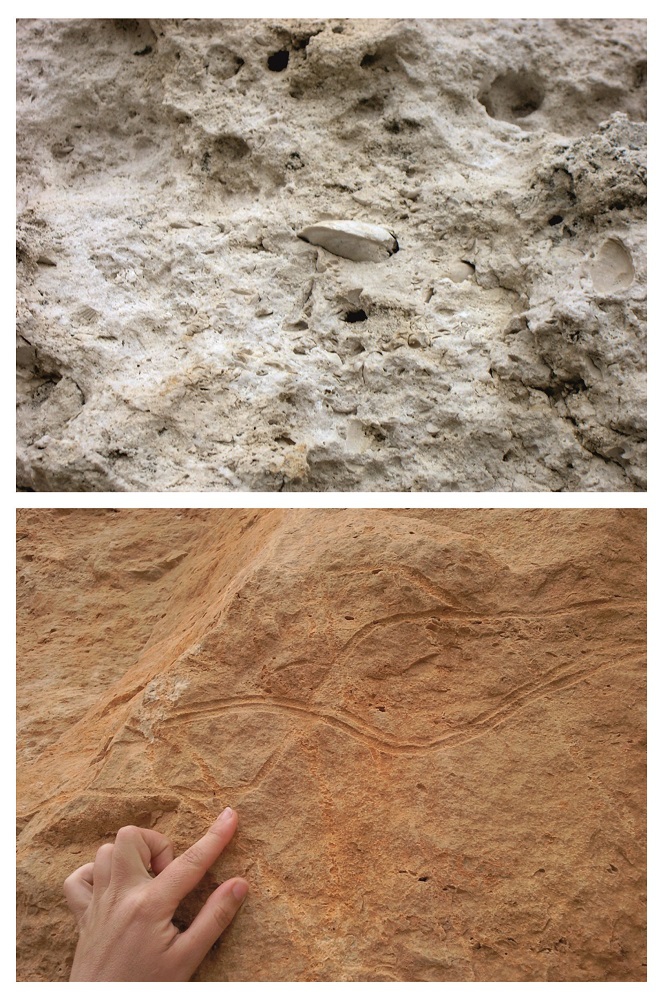
Detail of the fossils of bivalves in the marls of the mangrove facies and the bioturbations in the oolitic limestones.
