In the cliffs near the Moll de l’Oest of the Palma harbour it is possible to observe the stromatolites of the Terminal Unit of the Upper Miocene.
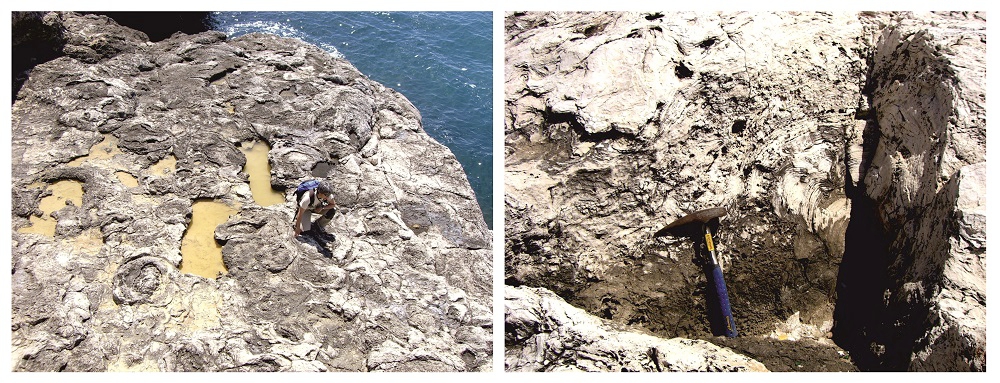
General view of the outcrop and detail of a transversal cut of a stromatolitic structure.
The stromatolites are structures in monticule form created by cyanobacteria which induce the precipitation of carbonates in superimposed layers over a fixed substrate.
Although in the present day their presence in ecosystems is residual (Australia having the best examples), stromatolites have been forming reefs all around the world for some 2,500 Ma, but the first items of biological evidence are over 1,000 Ma older.
Their importance resides in the fact that they are the main causal factors of the enrichment of oxygen in the atmosphere by means of photosynthesis, which is indispensable for most forms of life.
They are organisms that develop in conditions of high salinity, which makes them important paleoclimatic indicators.
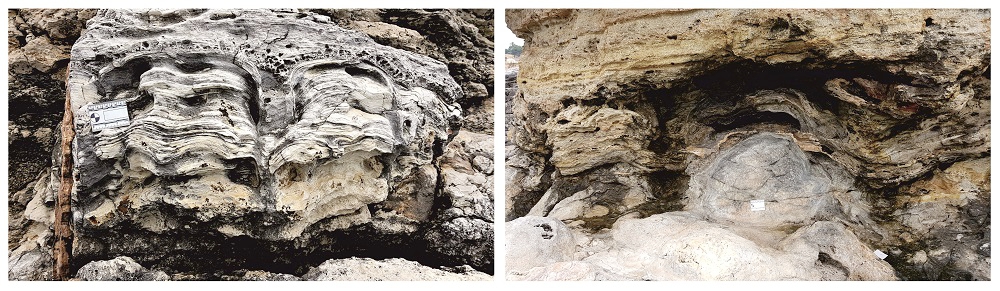
Detail of domes of sectioned stromatolites, with the superimposition of carbonate laminas.
In the case of Porto Pi, the stromatolites are from some 6.0 Ma ago and belong to the formation of the large coral reefs of the Upper Miocene and the great desiccation of the Mediterranean which marked the end of that geological time. The largest ones are more than three metres in height and one metre in diameter.
The stratigraphic unit described here belongs to the Santanyí Formation, a zone where this terminal Miocene is best represented. This geological formation, also called ‘Terminal Complex,’ has continuity here above the stromatolites.
If you follow the cliff along its south-east part (where there are steps excavated into the rock), you can see some levels rich in fossils of tubiculous worms, oysters and pectinids (bivalves similar to present-day scallops).
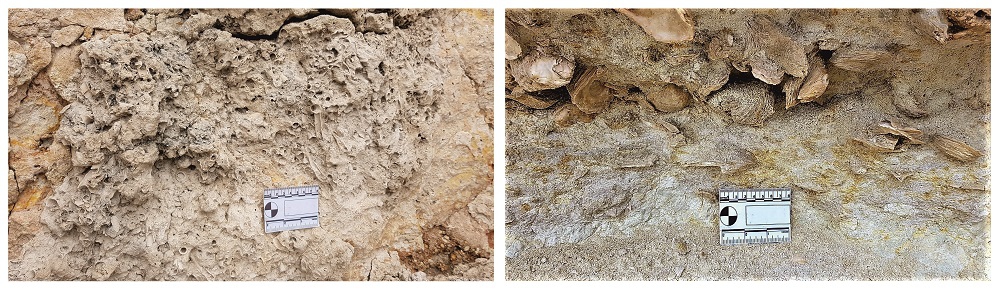
Levels of tubiculous worms and ostreids.
Above these there is the ‘’Oolitic Unit’, formed primarily of oolites, particles of sediment which, being in suspension in an aquatic medium, were covered by layers of carbonates and finally formed small spherical bodies which can be observed in the stone with a magnifying glass. This unit presents various types of stratification due to a medium in movement caused by marine currents and storm episodes.
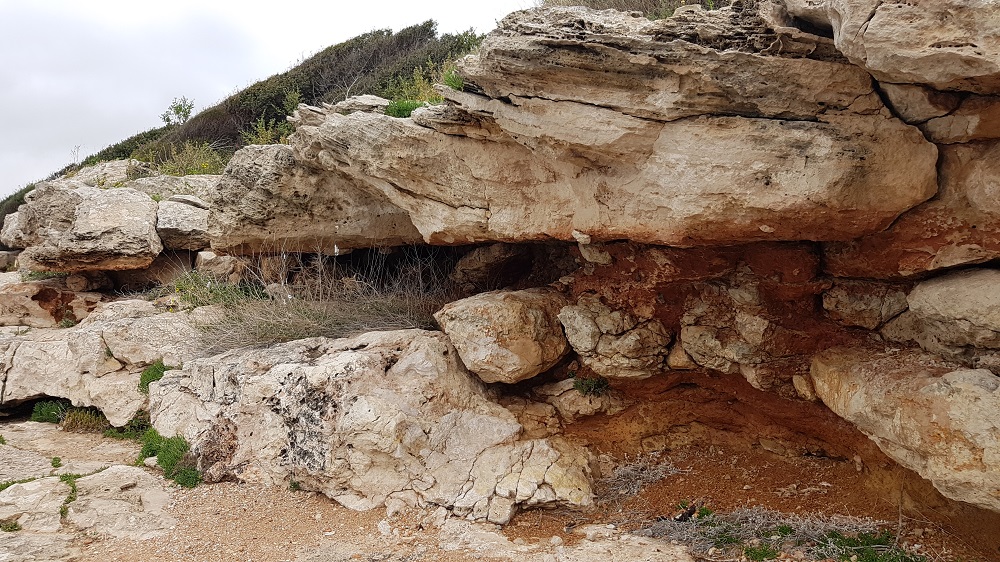
Oolitic unit in the upper part of the cliffs.
