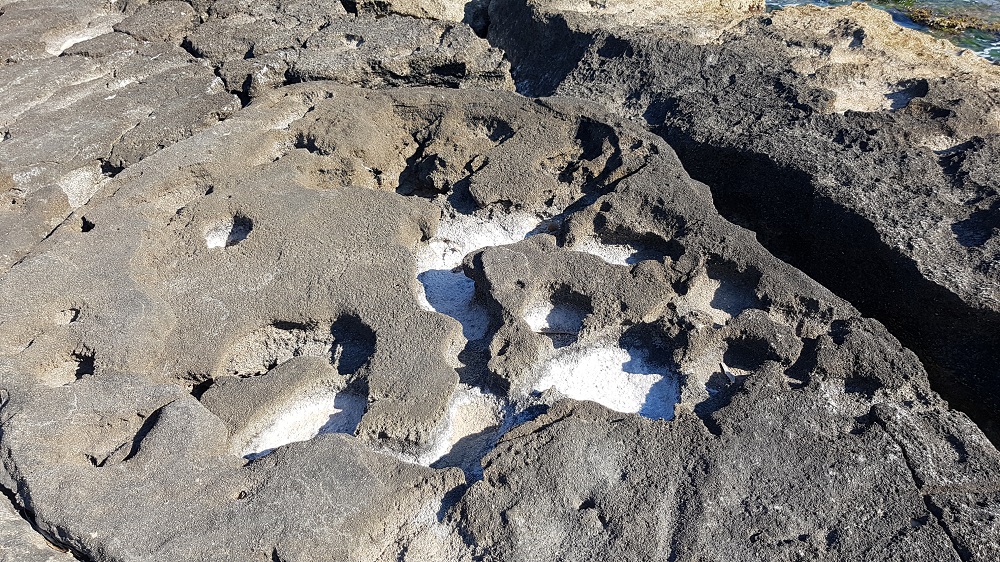
One of the most emblematic paleontological sites of the Balearic Islands is, without doubt, Es Carnatge.
It was discovered in the 1940s, but no scientific studies began to be published until the following decade, when a description was given of the stratigraphy of the place and an important faunistic fossil collection from the Pleistocene, composed mainly of marine molluscs.
Its distribution had rapid repercussion, with an international congress specialising in the study of the Quaternary (INQUA) visiting the tectonic, eustatic or antropical processes</span></p></div>">outcrop.
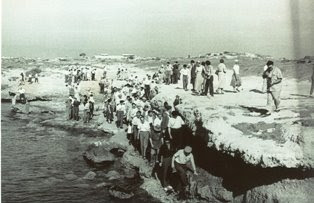
Visit to Es Carnatge by the INQUA in 1957. Taken from Galiana (2015). Photo: Andreu Muntaner.
Since then, numerous works have been published on the zone, making it, perhaps, the most publicised paleontological site of all those of the archipelago.
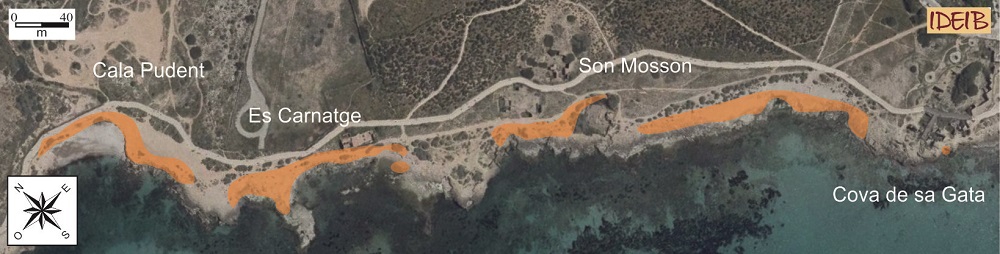
The beaches of the Pleistocene (in orange) along the shore of Es Carnatge.
In reality, the site of Es Carnatge is a discontinuous and heterogeneous series of beach deposits (terraces), located between Coll d’en Rabassa and Can Pastilla. Although the place names may change according to the source, in general terms the following outcrops can be differentiated: Cala Pudent (also named Camp de Tir), Es Carnatge, Son Mosson and the Cova de Sa Gata.
Within the beach deposits, up to four stratigraphic units have been individualised, dated with absolute methods between approximately 135 and 100 thousand years, although recent studies set the latter data at around 120 thousand years. The best place to see these formations is at the Carnatge houses, an old site for disposal of dead animals, today abandoned.
The first two stratigraphic units (U1 and U2) are arranged horizontally and superimposed. Following an erosive event which partially dismantled them, unit three (U3) was deposited, consisting primarily of blocks of the previous units, piled up by the waves of the Pleistocene. This set forms a slope over which the last unit (U4) lies, slightly inclined.
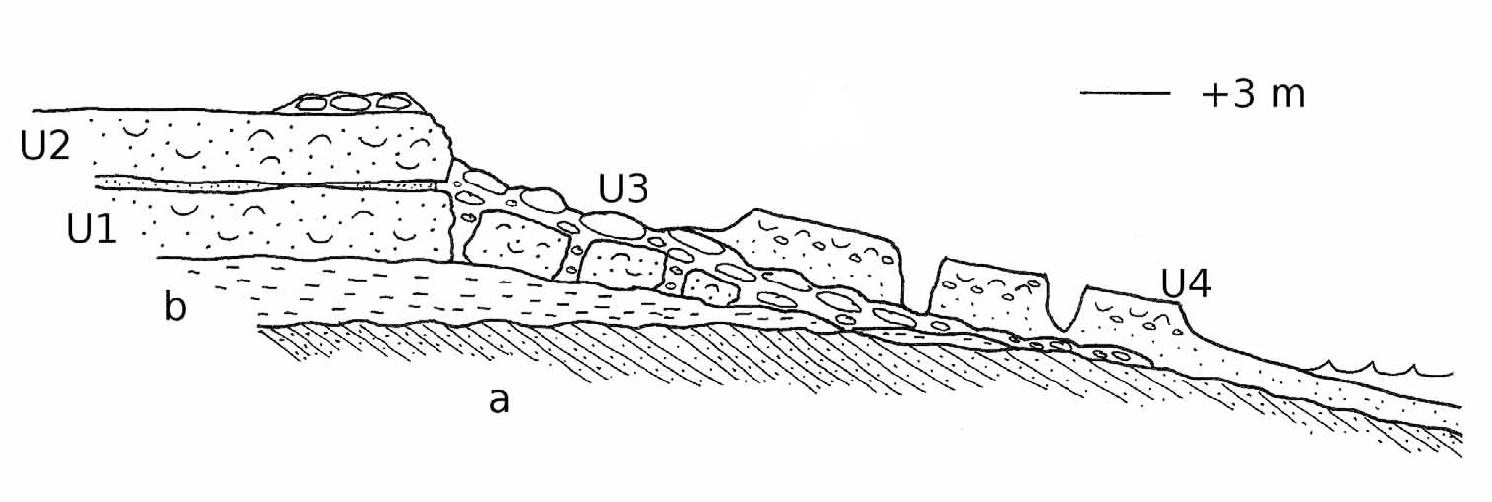
Synthetic geological cross-section showing the different stratigraphic units in the close to the houses of Es Carnatge. The units with marine fauna (U1-4) are preceded by a dunar deposit (a) and a paleosol (b), both easily observable in the sector of Cala Pudent. Taken from Ginés et al. (2012).
Cala Pudent is the best place for observing the substrate over which the beach deposits were deposited: fossil dunes (unit ‘a’ in the cross-section) and a powerful paleosol formed by reddish silts (unit ‘b’ in the cross-section).
In addition, and within the beach deposit, a progressive change is observed in the lithology and the fauna, going from its south-east end (with marine fauna) to the north-west (with terrestrial fauna).
The level of reddish silts contains terrestrial gastropods of some 185 thousand years of age. Both these and those which appear in the beach deposits are endemic and still life in the island, with the exception of a species which disappeared at the end of the Pleistocene.
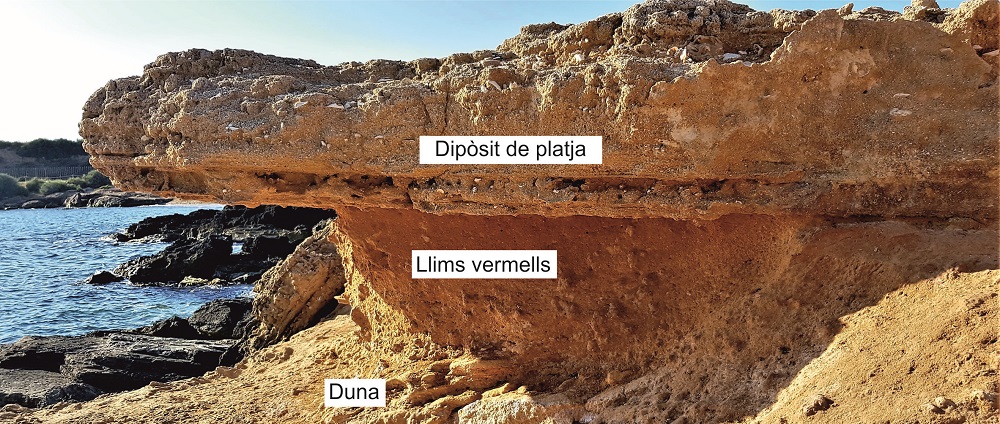
Natural cross-section of the south-east end of Cala Pudent. The stratigraphic sequence begins in the zone with a dunar deposit, followed by the level of reddish silts with terrestrial gastropods and ending with the beach deposit. In this last level there is a progressive change of the fauna, passing from marine to terrestrial towards the north-west sector.
In front and West of Carnatge houses and where the different beach deposits previously described are best observed.
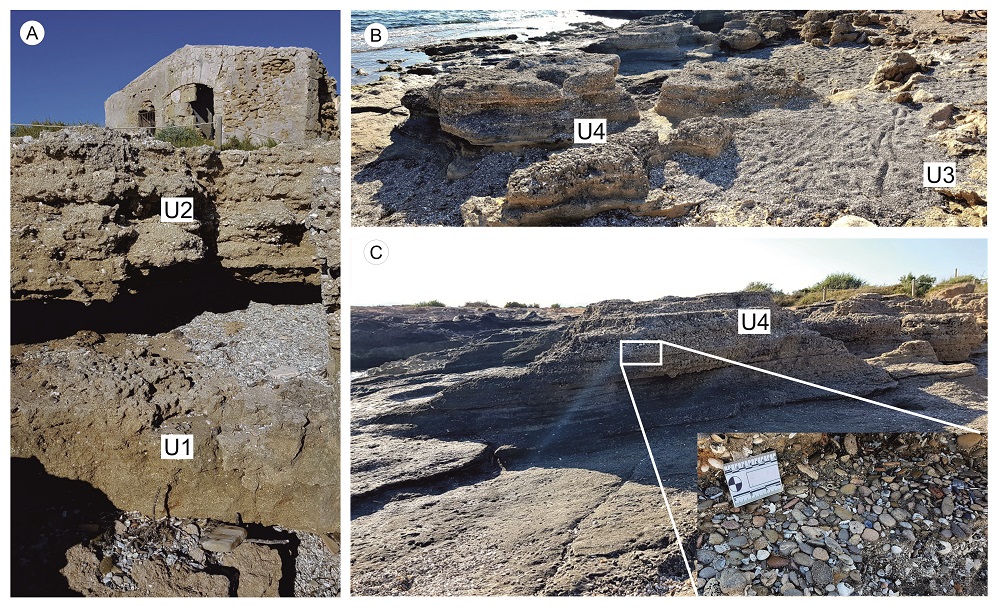
The different stratigraphic units with marine fauna in Es Carnatge: A) U1 and U2 in front of the ruins of the houses, B) U3 (partially covered by sand) with U4 lying over it in the west of the ruins, C) U4 and detail of the sediments of the conglomerates which compose it in its upper part in the same spot.
In the rest of the outcrops, the stratigraphy is not as complete, normally lacking the topmost units. Even so, the deposits can be correlated with those described above and also have high paleontological interest.
The most characteristic rock of the beach outcrops is calcarenite or calcareous sand-sized clasts.</p><p><br></p></div>">sandstone, which is formed in the zone by small fragments of molluscs, clasts of Sedimentary rock whose main component is calcium carbonate (CaCO3). Its origin can be chemical, organic or detritic.</p><p><br></p></div>">limestone and an extensive collection of microfossils. The material, of certain hardness, is the result of a rapid cementation process called beachrock, typical of warm beaches rich in carbonates. The formation of a beachrock is almost instantaneous in geological terms, cementing the sediment in just a few years or even months. This type of deposit corresponds to the wave beating zone and tends to contain marine fauna.
As occurs in Cala Pudent, there may be a progressive lateral change in the lithology and the fauna, passing from exterior beach zones (more marine) to interior zones (more terrestrial).
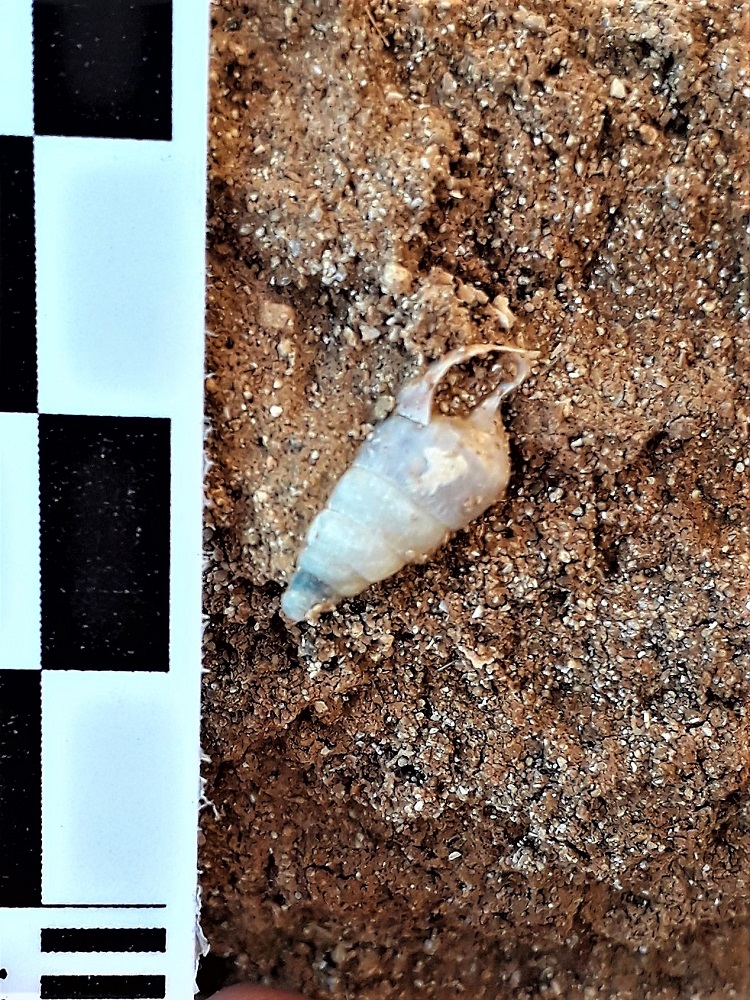
Chondrula gymnesica, an endemic terrestrial gastropod now extinct. Cala Pudent.
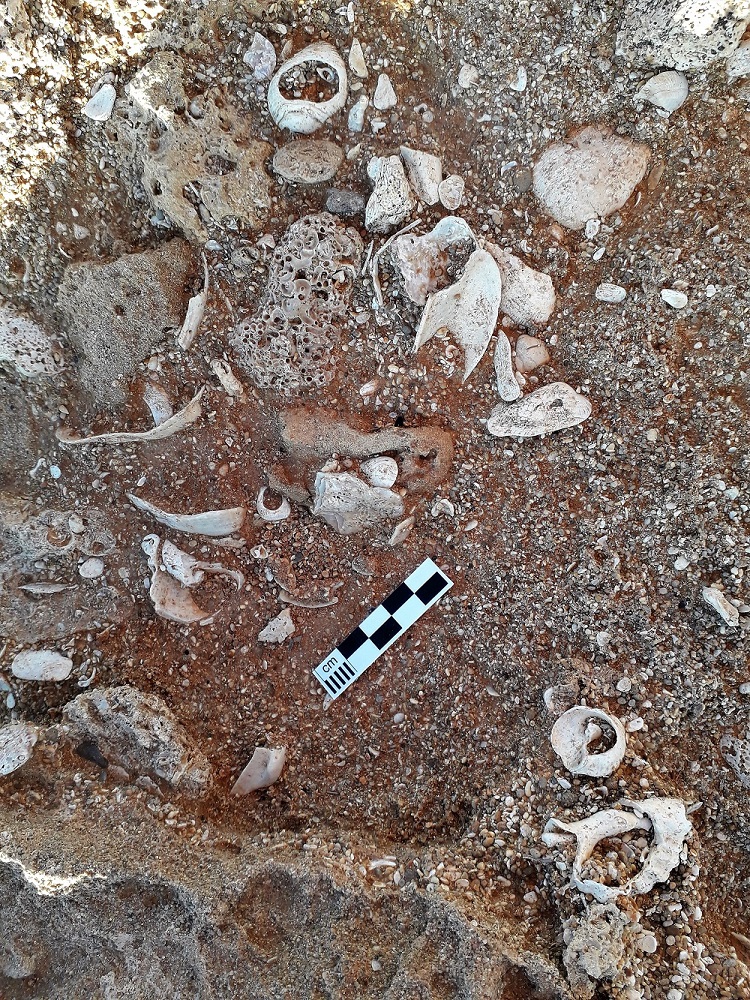
Detail of the Pleistocene beach of Cala Pudent.
The marine fauna found here is very abundant, with over 60 different species of molluscs.
Three sets of species can be differentiated:
The first, and the most abundant, is composed of species which still today are common in the Mediterranean and can even be found alive along the coast of Es Carnatge itself.
The second is a small set of molluscs which, although they still live in the Mediterranean, are much scarcer than they were in the Pleistocene.
The third and most important is a group of species given the label of ‘Senegalese’ due to being extinct in the Mediterranean and now living mainly in the central Atlantic coasts of Africa.
The explanation of these differences with regard to the present-day fauna lies in the subtropical climate Mallorca experienced at the time. Paleoclimatic studies tell us that around 135 Ma the planet underwent intense heating which reached its climax some 125 Ma ago, before a substantial cooling in the millennia after 100 Ma.
This climatic maximum, technically named MIS5 (Marine Isotope Stage 5) caused a temporary but very patent invasion of fauna from Equatorial Africa into the Mediterranean which has left fossil remains dispersed in sites in all of its major coasts.
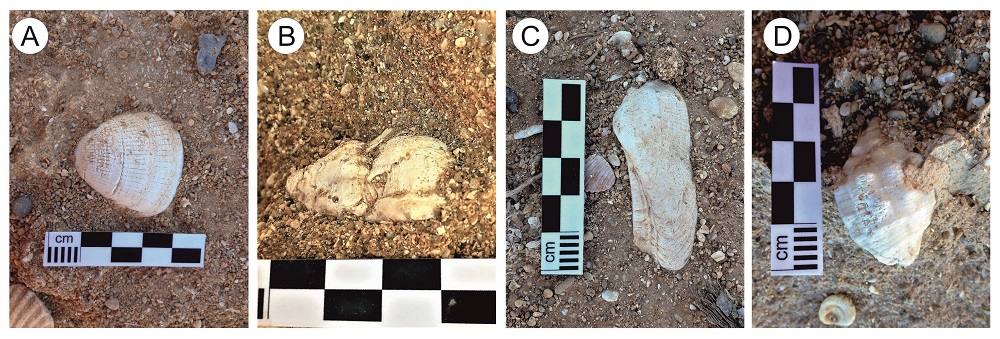
Pleistocene fossils of species still living in Mallorca, in Es Carnatge: A) Glycymeris nummaria, Son Mosson; B) Hexaplex trunculus, Cala Pudent, C) Arca noae, Es Carnatge, D) Stramonita haemastoma, Es Carnatge.
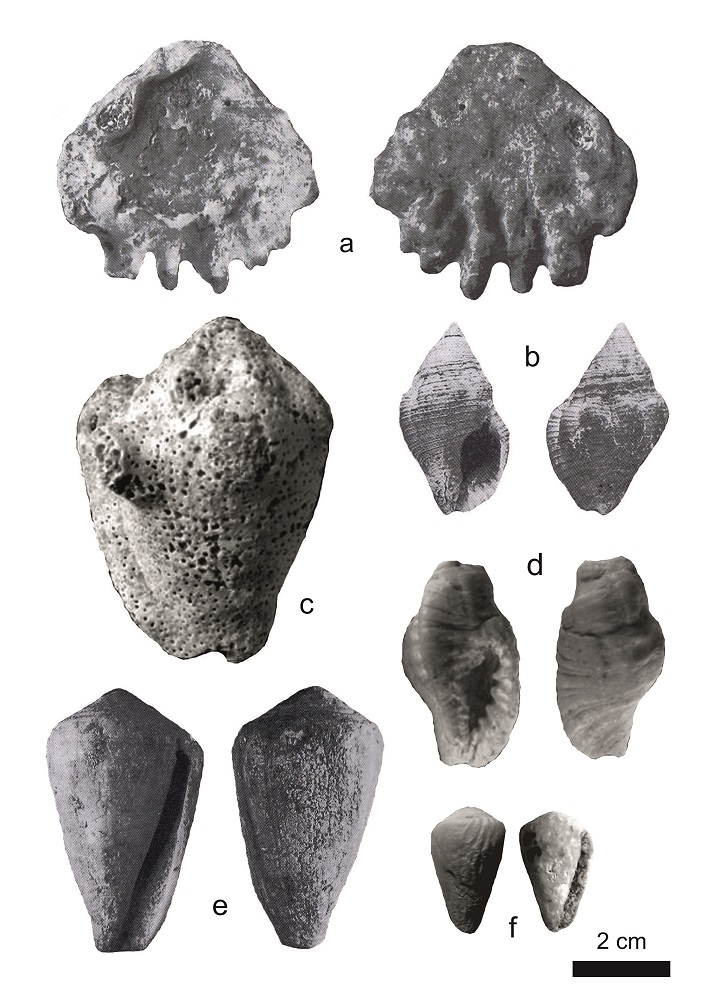
‘Senegalese’ Pleistocene fauna found in Es Carnatge: a) Hyotissa mcgintyi, Cala Pudent; b) Gemophos viverratus, Son Mosson; c) Persististrombus latus, Cala Pudent; d) Monoplex trigonum, Es Carnatge; e) Conus ermineus, Cala Pudent; f) Conus tabidus, Son Mosson. Modified from Cuerda (1987), Juárez & Matamales-Andreu (2016) and Matamales-Andreu et al. (2017).

Quarry of marès rock which cuts through the basal dune and the beach deposit: A) detail of the stratigraphy of one of the walls, B) visit to this same quarry by the 1957 INQUA congress (taken from Galiana, 2015).
In a quarry located in the Son Mosson zone, a very clear cut can be seen showing the superimposition of one of the beach deposits over the dunes that had previously been eroded.
In addition, to the south-east of Son Mosson there is a field of fossilised dunes of more recent age, where we can clearly see a cross-stratification typical of dunar deposits, formed by the action of the wind some 200 thousand years ago during the penultimate glacial episode.
At that time the area was inhabited by an endemic small goat of the Baleares, the Myotragus balearicus, whose hoofprints, fossilised in the dunes, were revealed during the quarrying operations to extract marès rock.
In this same zone of marès quarries, but in the coastal cliffs, special mention can be made of the marine abrasion cave of Sa Gata. Its walls show evidence of how high the sea level reached in the period in which the Pleistocene beaches of Es Carnatge were deposited, thanks to a trace of perforations of lithophagic molluscs (which dissolve the rock to infiltrate it) living in the wave beating zone, then located some two metres above the present-day level.
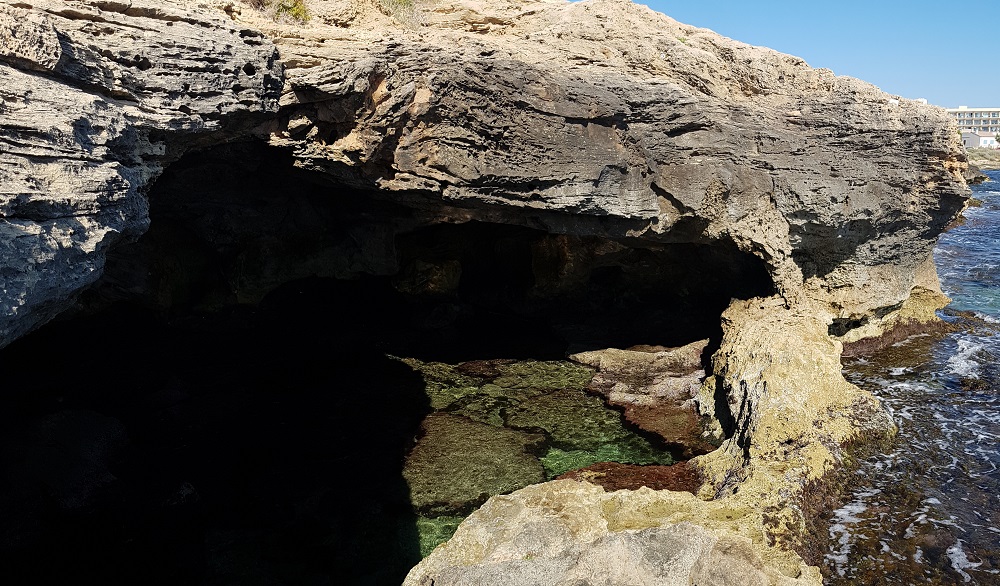
Cave of Sa Gata, a marine abrasion cave excavated into the Pleistocene marès rock with signs of a sea level higher than the present-day level.
All along the coastal fringe of Es Carnatge, but especially in its eastern part, it is possible to observe geomorphological processes typical of Mallorca’s rocky coasts. The most abundant are the cocons, which correspond to shallow, flat-bottomed depressions of rounded shape, of dimensions from decimetric to metric, formed by marine abrasion, in which seawater accumulates.