Of the numerous outcrops of the Jurassic existing in the Balearic Islands, the one located in the vicinity of Sa Cova des Burrí is without doubt one of the most important from both the stratigraphic and paleontological points of view.
In the zone there is representation of both the Lower (200-175 Ma) and Middle Jurassic (175-165 Ma
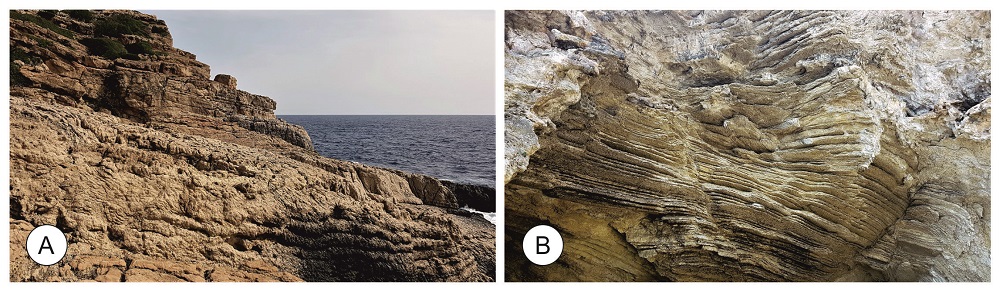
Two views of the outcrop of Sa Cova des Burrí. A) Appearance of the strata of the Lower Jurassic. B) Levels of the Middle Jurassic.
In the early Jurassic, Cabrera bore no similarity with the present-day orography but corresponded to a shallow sea in the western part of the Tethys Ocean. Although initially sedimentation was in general continuous, it progressively diminished until it halted completely. At the same time, fossils were depositing in increasing concentration due to the lower rate of sedimentation.
In this context of little or no sedimentation, the time it takes to form a stratum is so long (hundreds of thousands or even millions of years) that the underlying stratum turns to stone, forming a hard substrate technically named hard ground. One of its most representative traits is the presence of crusts of minerals deriving from iron and manganese, which give it reddish, purple and black colours. However, the aspect that tends to call our attention most is the enormous abundance of fossils.
The apparently most diverse fossils in these levels are the ammonites, a type of cephalopod mollusc (of the same group as the octopuses or squids) with a segmented outer shell normally in the form of a flattened spiral. Their great variety and abundance and fast evolution make them a fundamental feature for dating rocks in marine environments.
Accompanying the ammonites there is another cephalopod mollusc called belemnite, with a similar appearance to the present-day squids but having a bullet-shaped inner shell, of which the distal part, called rostrum, tends to be preserved, although in this site examples can be observed which preserve the proximal part, which is segmented and is called phragmocone.
In truly noteworthy quantities there are also crinoids, an echinoderm (the group that includes sea urchins and starfish) endowed with a stalk and numerous arms which unite in a structure called calyx. Both the fossil species and the present-day examples (less diverse) are mainly constructed on the basis of small segments called phalanxes, which tend to fossilise separately due to the disgregation undergone by the crinoids shortly after dying. However, in Sa Cova des Burrí some sections with several joined beads can be seen.
There is also a residual presence of some species of gastropods and nautiloids (evolutive cousins of the ammonites, with a simpler segmentation of the shell and with species present today in some tropical regions).
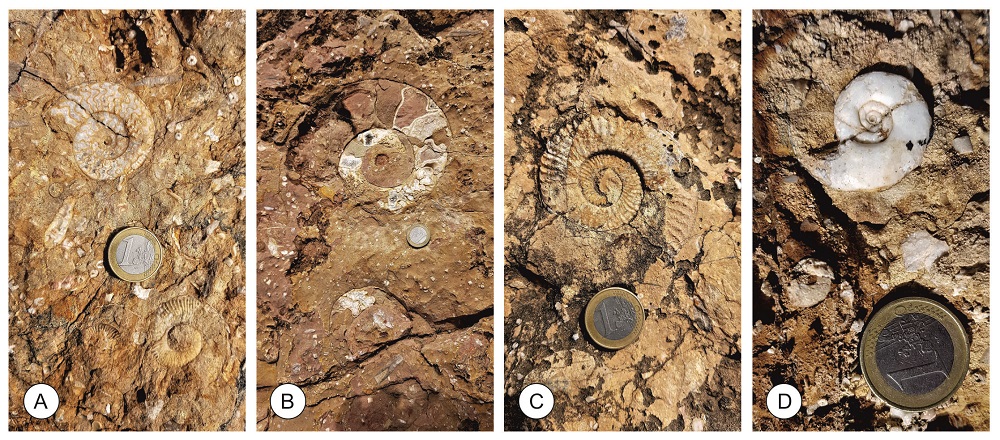
Various ammonites present in the Lower Jurassic of Sa Cova des Burrí.
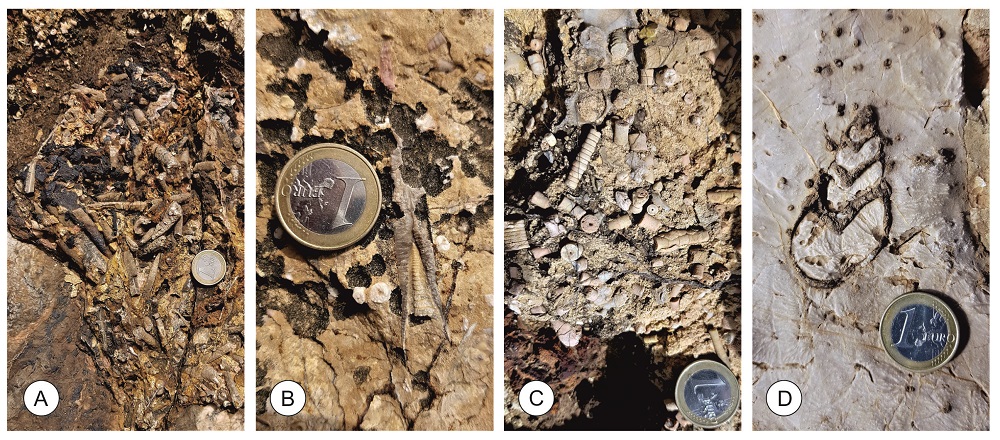
Fossils associated with the ammonites of the Lower Jurassic of Sa Cova des Burrí. A) Accumulation of belemnites in a crust of iron and manganese. B) Sectioned belemnite showing a part of the phragmocone. C) Accumulation of phalanxes of crinoids, some still connected. D) Gastropod.
Following the Lower Jurassic there is a total interruption in the sedimentary record, with a gap of several million years before the start of the Middle Jurassic, whose levels correspond to much greater depths. This sharp contrast is found in the sinking of the sedimentary basin due to the formation of several faults, a product in turn of high geological activity. Judging by the stratigraphic record, this sinking occurred in a relatively short time, some of these faults having been observed at various points of Cabrera.
Once again, the ammonites are prominent items in the fossil record of this stage, accompanied on occasions by belemnites and nautiloids.
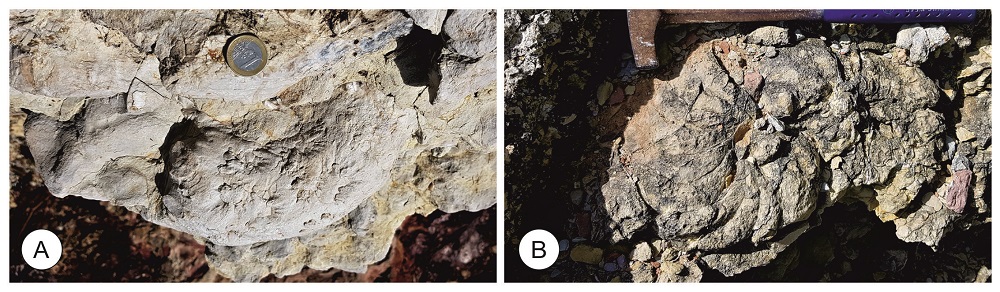
Some fossils of the Middle Jurassic of Sa Cova des Burrí. A) Ammonite partially embedded in the rock. B) Large nautiloid.
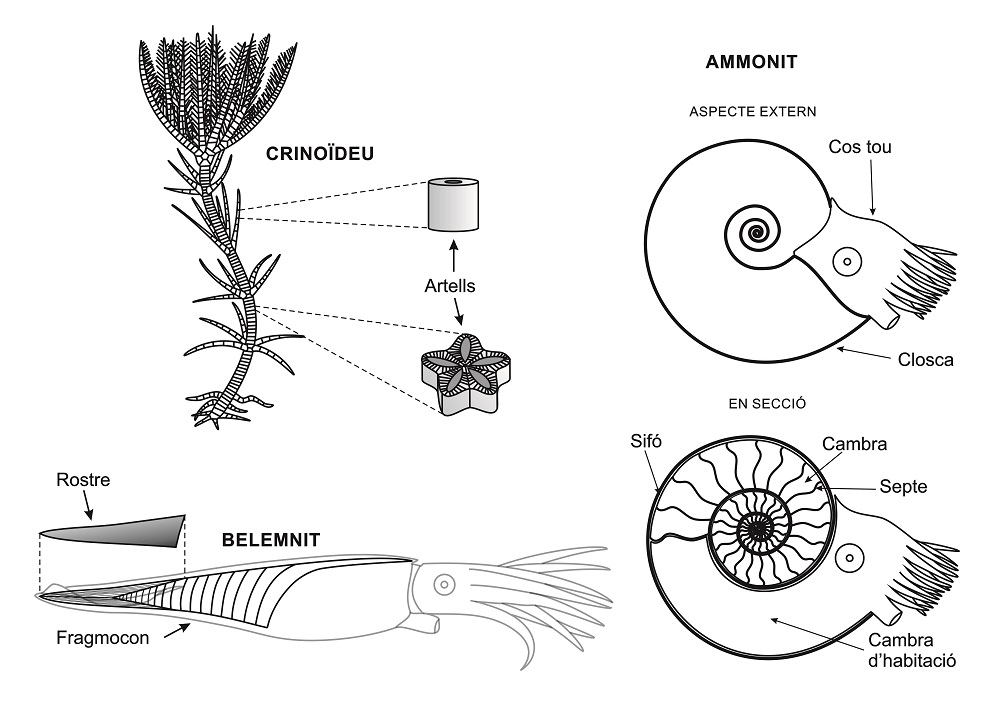
Anatomical diagram of the principal types of fossils observable in the site: crinoid, belemnite and ammonite.
