The geological history of the Balearic Islands present lacks on certain chapters.
The most important absence corresponds to rocks belonging to the Paleocene epoch (65-56 Ma), which have never been found in the region, probably destroyed by erosive processes subsequent to their sedimentation. In the same way, the basal part of the Eocene period (56-34 Ma) is missing.
For this reason, the oldest rocks in the archipelago corresponding to the Cenozoic are from the Middle Eocene, with approximately 45 Ma. In many aspects, the Coll Roig is the best exponent we know of this interval.
Geologically, this is a stratigraphic succession of several dozen metres of yellowish-ochre sediments which were deposited in a medium of shallow waters, some 20 Ma before the formation of the Balearics. Today they form a cliff at the south-west of Cabrera.
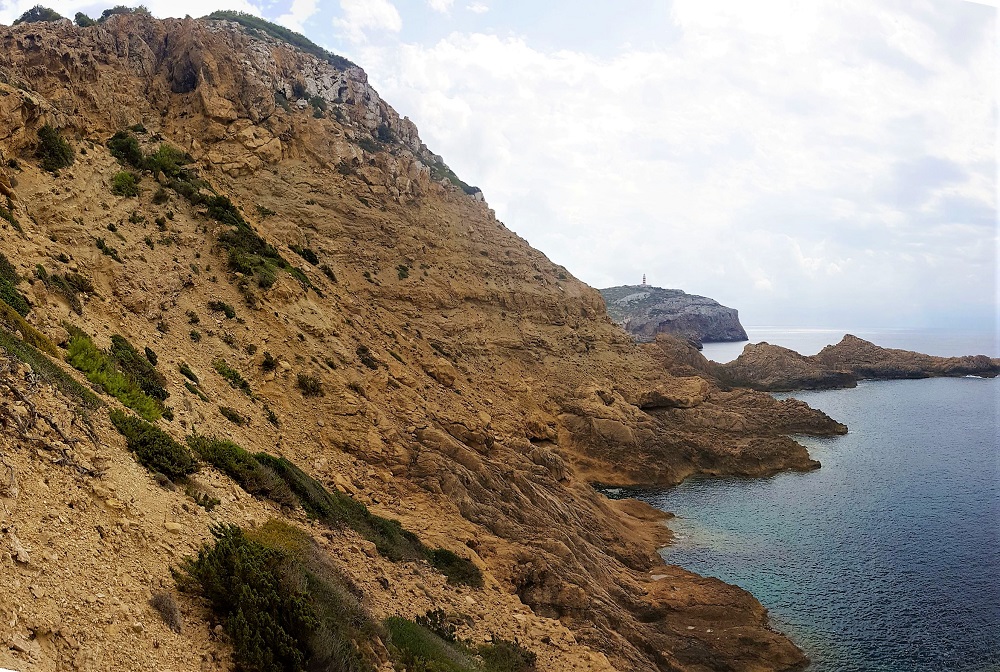
Panoramic view of the Eoceno site of Coll Roig.
Among the many fossils that we can find along this sequence, the most notable are, without doubt, the nummulites (that means stone coins).
Hard as it is to believe considering their size, they are single-cell organisms. In fact, they are one of the largest known single-cells in the history of the planet, with sizes that can exceed 10 cm, although here the largest do not surpass 4 cm.
Nummulites are foraminiferous organisms, a type of protozoon with the cell wall in the form of a shell which inhabits the seas of the whole world, most of the known species being of microscopic size. They have a lens-shaped shell in the form of a segmented spiral. In spite of the widespread distribution of foraminifera in the present day, the family to which these giant fossils belong became extinct more than 30 Ma ago.
During the Eocene they were so abundant that they came to form deposits with countless millions of examples – so much so, that they literally form the rocks of the great pyramids of Egypt or the Cathedral of Girona (to give a national example). Similarly, the cliffs of Coll Roig are formed almost exclusively of nummulites.
At the Coll Roig it is possible to see several species of nummulites. However, within the same species there are large examples similar to coins and small ones similar to lentils.
This because they alternate sexual reproduction, produced by the small individuals, called microspheric, and asexual reproduction, produced by the large individuals, called megalospheric.
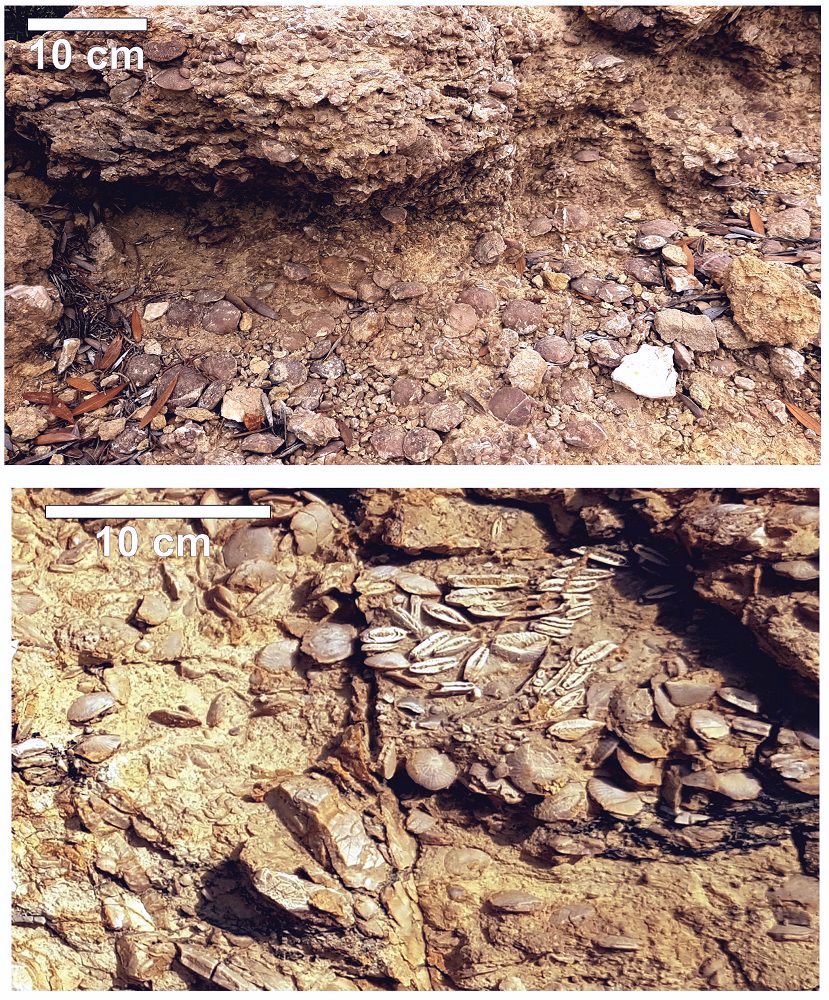
Detail of the deposits of nummulites showing the presence of several species and microspheric and megalospheric forms.
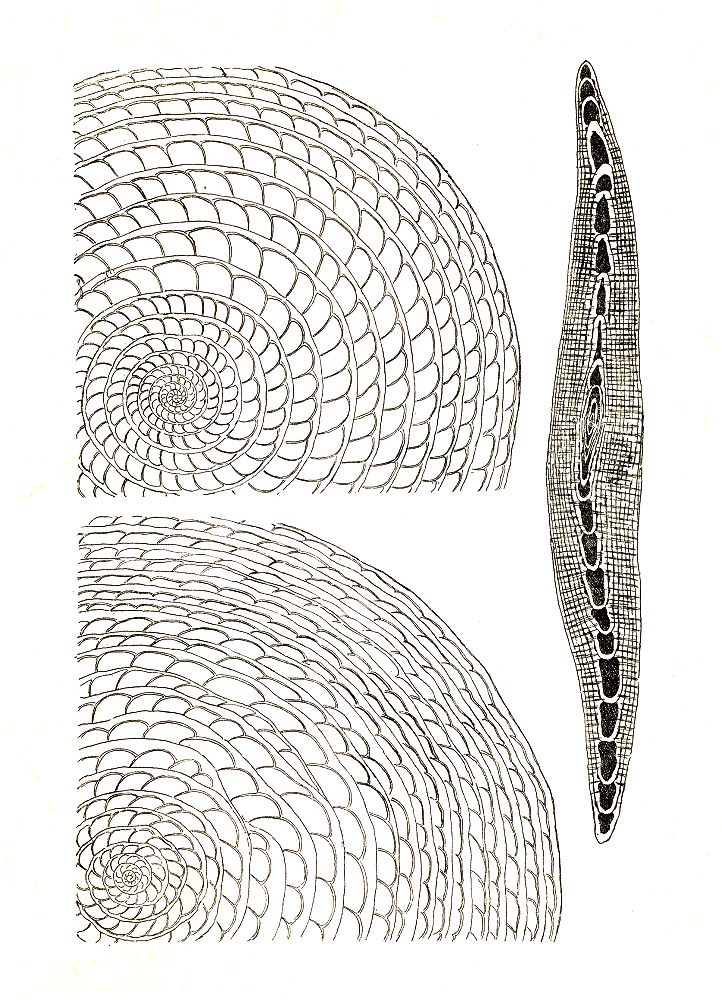
Internal structure of a nummulite (taken from Colom, 1975).
Other relevant fossils of these shallow seabeds are sea urchins, specifically some species which inhabited sandy beds, digging galleries in search of food. These urchins, generically named infaunals, continue to live in many of the world’s seas, although the particular species existing in the Eocene are all extinct.
Much more sporadically it is possible to see solitary corals, mollusc with a body protected laterally by a shell composed of two pieces or valves, generally symmetrical in a bilateral plane<strong>.</strong></p></div>">bivalve molluscs and serpulids (worms which construct Sedimentary rock whose main component is calcium carbonate (CaCO3). Its origin can be chemical, organic or detritic.</p><p><br></p></div>">limestone tubes in which they live).
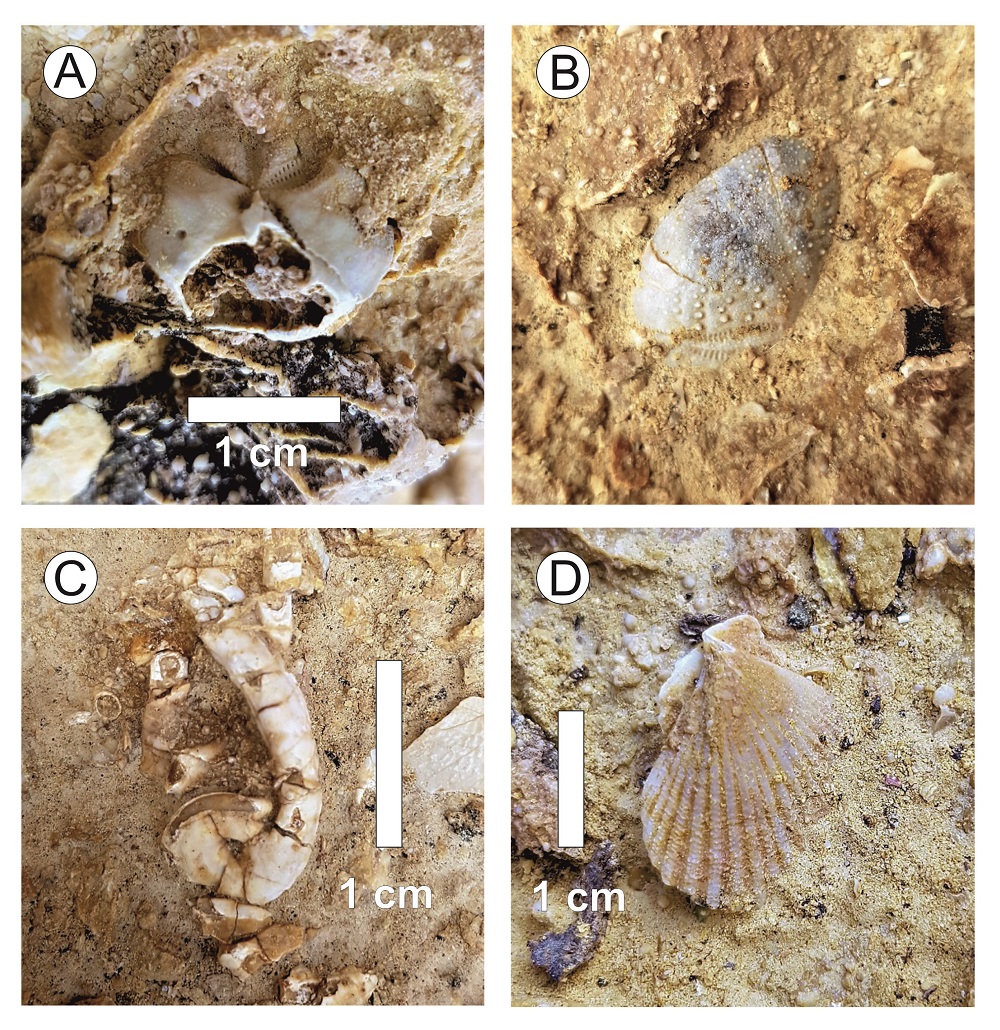
Some of the representative fossils present in Coll Roig. A and B: Infaunal urchins. C: Serpulid. D: Bivalve mollusc.
