The oldest materials present in Cabrera are from some 220 Ma years ago and correspond to the Upper Triassic.
At the time when these sediments were deposited, Cabrera, like many other zones of the Balearic Islands and the Iberian Peninsula, formed part of a large system of ephemeral lakes, in an extremely arid climate. This type of environment, called sebkha (salt flat), corresponds to large flood plains that underwent sporadic invasions of the sea. In this process, which involves intense evaporation, substantial layers of salts are deposited, including gypsums. The geological formations corresponding to the Upper Triassic which represent this context are usually known as Keuper stratigraphic unit and reflect the specific environmental conditions in which they were formed.</p><p><br></p></div>">facies.
Where this is best observed is in the hollow called the Clot des Guix, where there is an old quarry that exploited the clays to extract the abundant gypsum they contain.
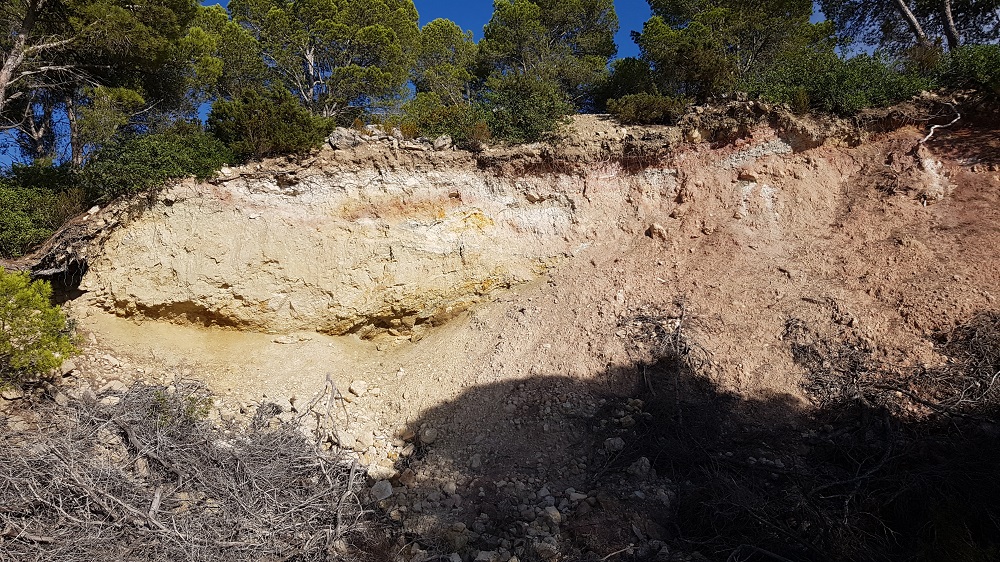
Panoramic view of the front of the old gypsum quarry, showing clays from the Upper Triassic.
It has been a long time since this resource was stopped. However, even today it is possible to see the ruins of the old buildings, above the embankment, or the ponds that were used to decant the extracted material, in the bottom of the valley.
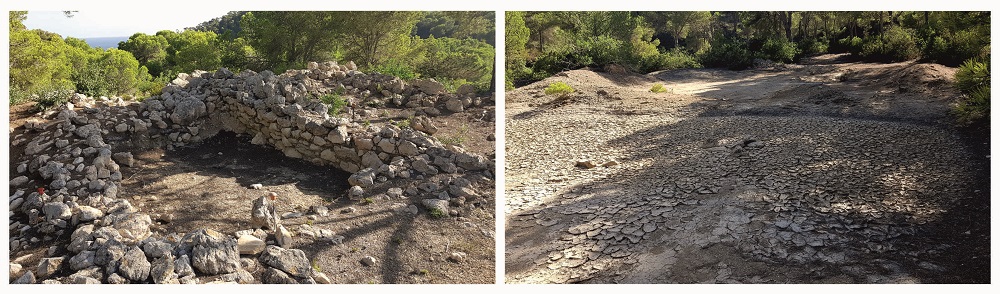
Ruins of the old buildings next to the quarry (left). Decantation ponds (right).
