Although, as is well known, Mallorca is not an island of volcanic origin, it does have some points where rocks of magmatic origin can be found.
The most common material is igneous rock of maphic composition (rich in silicates of magnesium and iron and in silica) composed mainly of plagioclase and pyroxene.</p></div>">basalt, which is present in numerous outcrops, mainly along the Serra de Tramuntana range. Most of them are from the Upper Triassic (237-201 Ma), although there are also some from the Lower Jurassic (201-175 Ma) or even, occasionally, from the Lower Miocene (23-15 Ma).
The island’s magmatic rocks are of two types: volcanic and subvolcanic (also called philonian or hypabyssal). While the former originate on the surface as a product of volcanic activity, the latter do so at great depths due to masses of magma which invade the earth’s crust and solidify inside it.
The volcanic types of rock are the more abundant in the island, although the much scarcer subvolcanic rocks also tectonic, eustatic or antropical processes</span></p></div>">outcrop in the zone of the Rafal d’Ariant, which contains some of the most important outcrops of these subvolcanic rocks in the Balearic Islands.
Subvolcanic rocks are characterised by fitting into the rocks of the earth’s crust by means of dykes which are generally vertical. When the dykes, for various reasons, insert themselves in a horizontal plane, they are called sills.
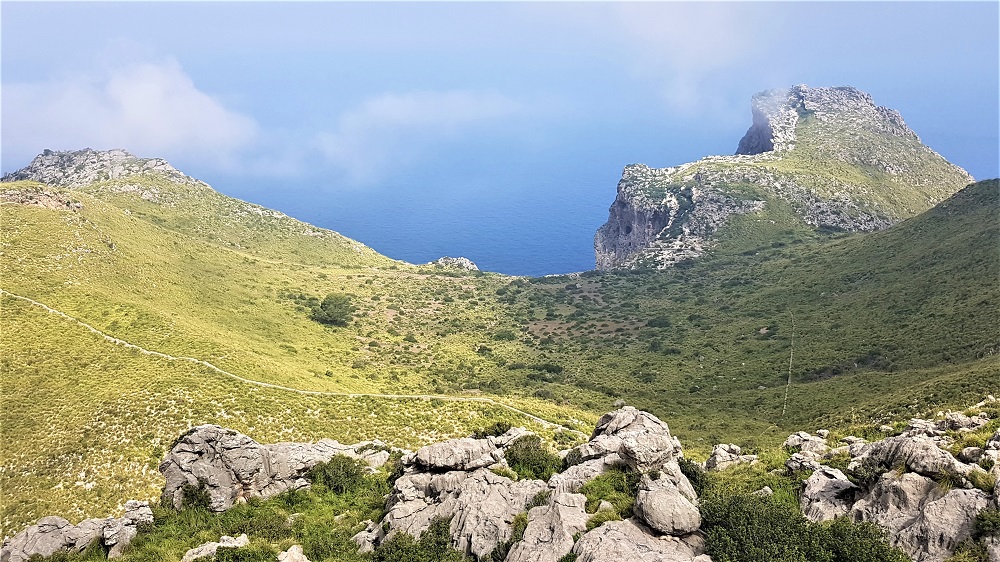
Panoramic view of the valley of Rafal d’Ariant (the central depression in the photograph).
In the Rafal d’Ariant the subvolcanic rocks form sills that affect materials of the Upper Triassic.
The most interesting subvolcanic rocks from the scientific point of view belong to the group of the teschenites, a type of rock related to plutonic rocks. These are rocks with a grainy appearance, with large, lengthy, dark crystals that are easily noticed at first sight. They belong to the amphiboles, a group of silicate minerals. In a secondary manner there appears a diverse range of minerals with microscopic-sized crystals.
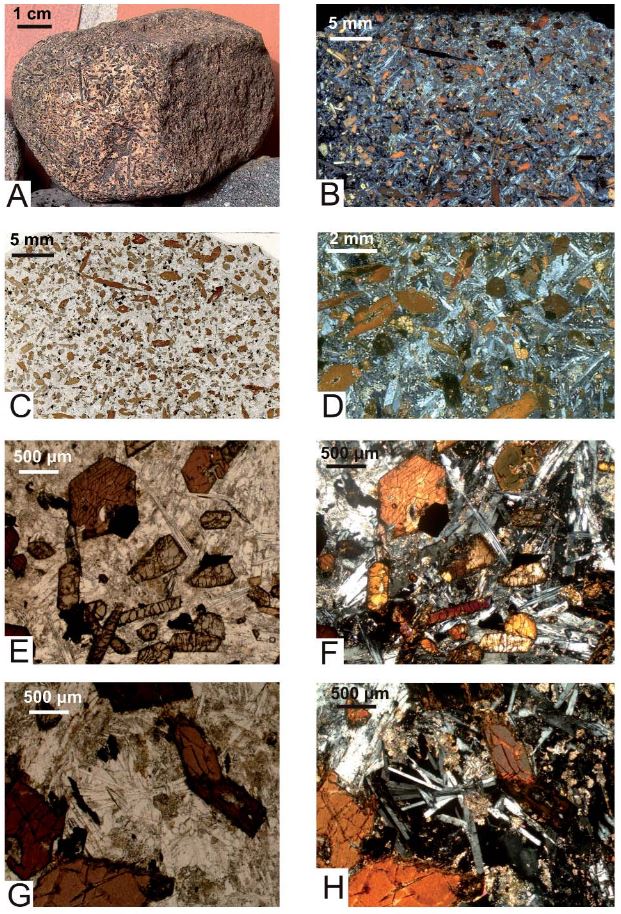
Teschenite–type rock of Rafal d’Ariant and various petrographic microscope views of its minerals in a thin lamina. Taken from Enrique (2012).
In the zone there is also an abundance of reddish, yellow and black volcanic rocks, locally with many vacuoles (rounded cavities formed by the entrapment of gas bubbles in the volcanic material when it cooled), filled with malachite-type copper carbonates, like those that appear in the vicinity of the houses of the Rafal d’Ariant.
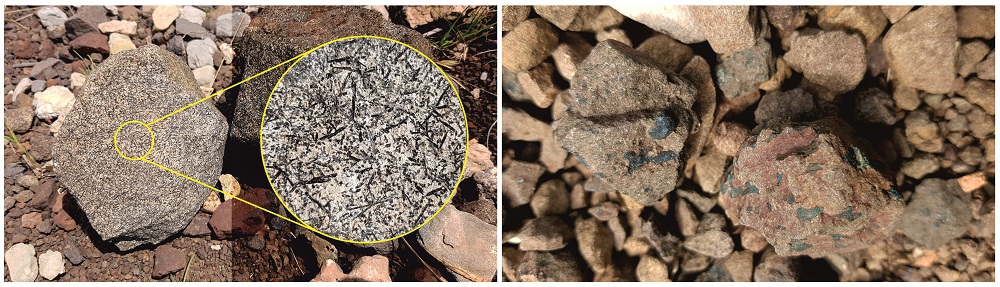
Teschenite-type rock (left) and vacuoles filled with malachite (right).
