As is well known, Mallorca is an island with a great abundance and diversity of caves, due to being formed mainly of Sedimentary rock whose main component is calcium carbonate (CaCO3). Its origin can be chemical, organic or detritic.</p><p><br></p></div>">limestone rocks.
The Avenc de Son Pou is one of the best-known and most popular caves of the Tramuntana range, cause to its grandiosity and easy accessibility.
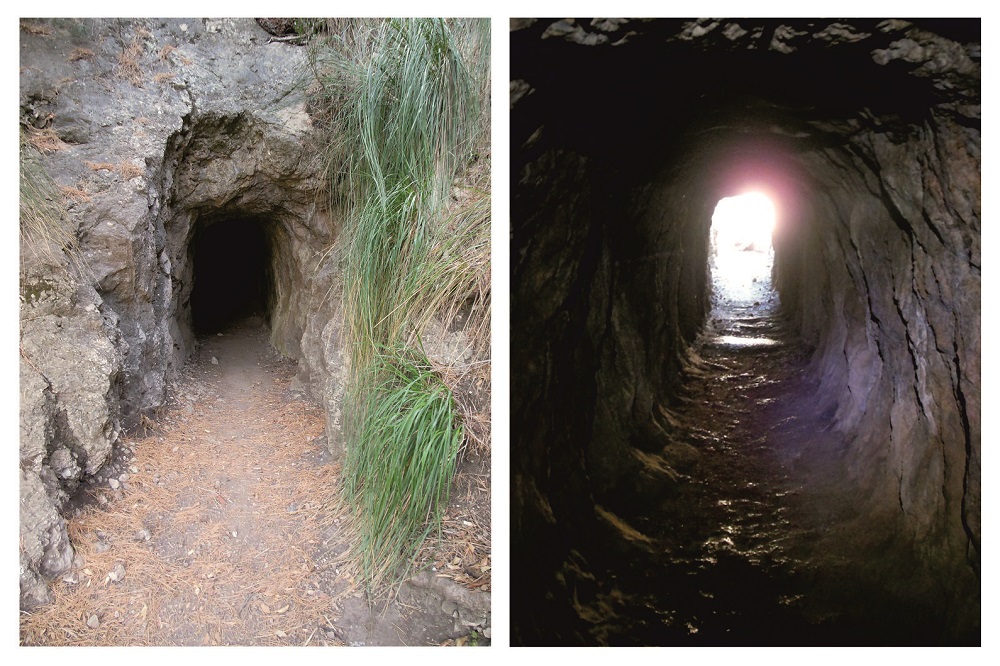
Artificial access tunnel to the cavity.
Although the cavity does not display great development, we can highlight the dome-shaped main hall, 55 m high, 150 m long and some 70 m wide. At its zenith is the natural entrance, a modest hole of some 10 m diameter through which sunlight enters.
The natural opening was the only (and complicated) access to the cavity in its early years of explorations (early 19th century) until the excavation of a tunnel in 1894 to extract the pigeons’ guano, which was highly valued as a fertiliser.
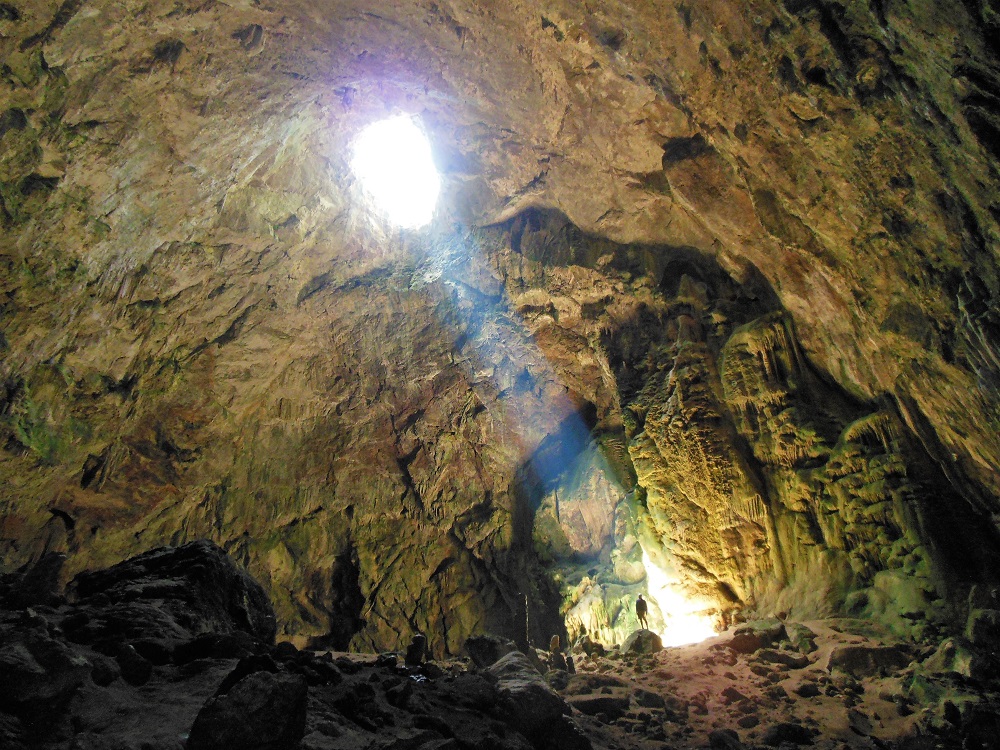
Interior of the main hall, illuminated by the rays of sunlight passing through the natural entrance.
The main hall of the cavity corresponds to a collapse hall: that is to say, it was formed by progressive sinkings of the ceiling due to the existence of an initial void, possibly the result of the dissolution of the rock. The successive rockfalls produced two effects: the subsidence of the roof, acquiring a dome shape, and the accumulation of the fallen materials at its base in the form of a cone of débris. This hall is not notable for its speleothems, of which there are few, but it features a large column in its south-west part (photograph A).
Nearby is the access to two interconnected galleries. The lower one is shorter, some 15 m long, and with few formations, while the upper one, which is accessed by steps, is some 55 m long and contains a great variety of speleothems: stalagmites, stalactites, flows (photograph B), flags, columns (photograph C) and, in the final section, pools.
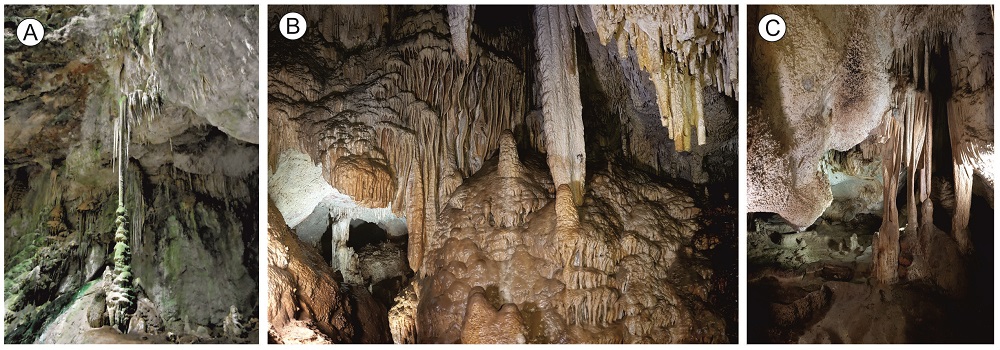
Large column in the central hall (A), parietal flow (B) and columns and pools (C) of the upper gallery.
Descending from the cone of débris in the main hall towards the north-east, we reach the lower part which contains several of the marvels of the cavity.
After passing several very large fallen blocks, we can observe a large extension of pools in the floor, because this zone floods at times of heavy rainfall (photograph D). At the back there are two large cones at the base of two columns (photograph D), the one on the right also having some extremely beautiful pools (photograph F). There is also a notable abundance of immaculate white stalactites surrounded by red clays of the ceiling (photograph E).
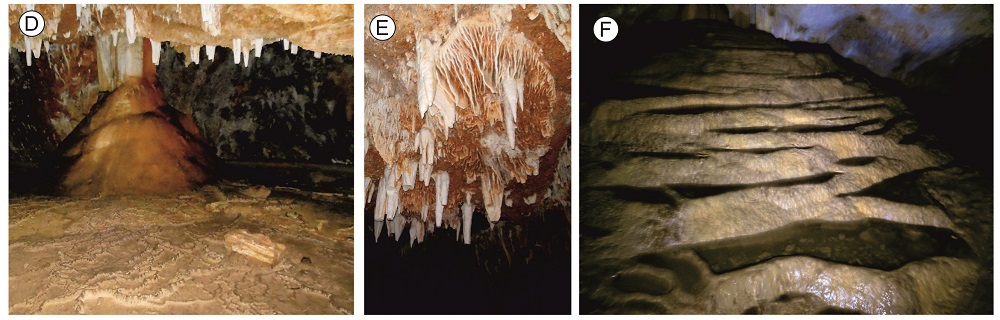
Cones at the base of columns (D), stalactites (E) and pools (F) in the lower part of the main hall.
Among the cones we find a small opening which communicates with a small hall almost 30 m high, 25 m wide and 30 m long. Access is via a series of large pools.
This hall has three notable features: the enormous pools of the entrance zone (photograph G), an enormous parietal flow situated in the east wall (photograph I) and some strange irregular morphologies on the floor reminiscent of the surface of the moon (photograph H), which correspond to craters produced by the recurrent impact of the drops of water in the clayey substrate and constitute an exceptional aragonite and gypsum.</p><p><br></p></div>">speleothem.
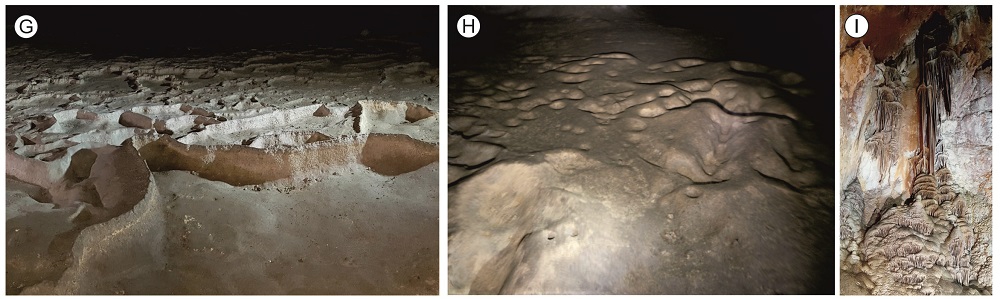
Enormous pools close to the entrance (G), impact craters (H) and parietal flow (I) of the lower hall.
Visits to the Avenc de Son Pou have been frequent, as is testified by the plaques observed in the main hall and the lower hall, and by the numerous graffiti on the columns of the upper gallery. In fact, in the early years of the 20th century the cave was used as a venue for literary competitions by the Mallorcan poetry school, inspiring texts by writers like Miquel Costa i Llobera, Josep Maria Llompart or Francesc de Borja Moll. In the place where the recitals were held there are a number of commemorative plaques.
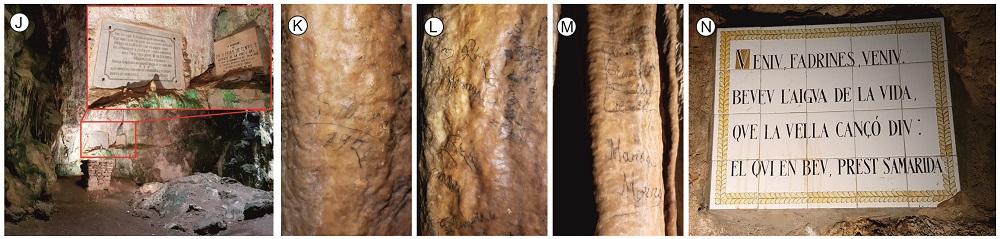
Commemorative plaques (D) and in the lower hall (H) and graffiti in the upper gallery (E, F and G).
Finally, it should be said that the cavities are unstable at the geological scale. The rocky blocks which form the floors adapt with time, which causes the breakage of the speleothems resting on them, which in turn causes the cracks frequently seen in the columns and flows of the cavities.
