As is well known, Mallorca is not a volcanic island, but this does not mean that it has no volcanic rocks in its geological record. In fact, they are very characteristic (although not exclusive) of the Upper Triassic (237-201 Ma).
One of the places where these Triassic volcanic rocks can best be observed, interspersed between sedimentary rocks, is in the slopes of the road that goes down to Cala Tuent, where we can see two clearly differentiated sections:
- A basal section, called “lower red section,” which corresponds to the Keuper stratigraphic unit and reflect the specific environmental conditions in which they were formed.</p><p><br></p></div>">facies of the Upper Triassic and is characterised by a predominance of gypsum and the lutites of varied colours (normally red-maroon). It corresponds to a system of salt lakes in a very arid climate.
- Above this, there appears the so-called Felanitx Formation, consisting of very varied materials (dolomites, breccias, cellular dolomites, marls, etc.) which were mainly deposited in a shallow marine environment.
The Felanitx Formation is the more interesting in scientific terms, been considered as the best tectonic, eustatic or antropical processes</span></p></div>">outcrop to observe the scarce registry of volcanic rocks that this formation contains.
The most abundant volcanic rock in both settings is igneous rock of maphic composition (rich in silicates of magnesium and iron and in silica) composed mainly of plagioclase and pyroxene.</p></div>">basalt, and the most characteristic mineral is olivine.
In this zone we also find pyroclastic deposits, which are a direct product of eruptions of volcanoes. In addition, there are levels with a mixture of volcanic and sedimentary rocks, named volcano-sedimentary rocks. Materials belonging to this latter category are tuffite, formed by the erosion of the pyroclastic deposits and their subsequent mixing with sediments, and sedimentary rock which is formed when lava comes into contact with wet sediments, cooling abruptly. The result is similar to that of breccias, in which the fragments correspond to igneous rocks and the matrix to sedimentary rocks. </p></div>">peperite, originated by the contact of lava with moist sediments.
Chemical analyses show that the vulcanism present at Cala Tuent is of a basic nature (it contains a low percentage of silica) and is of the intra-plate type: that is to say, the magma proceeds from the fusion of the stratum below a tectonic plate
<div class="ql-editor"><p>Individualised fragment of the lithosphere, limited by active zones (plate margins) which move over the asthenosphere, also named lithospheric plate.</p></div>">tectonic plate. It was formed during a phase of high geological activity which preceded the formation of the Tethys Sea due to the fragmentation of the super-continent Pangaea.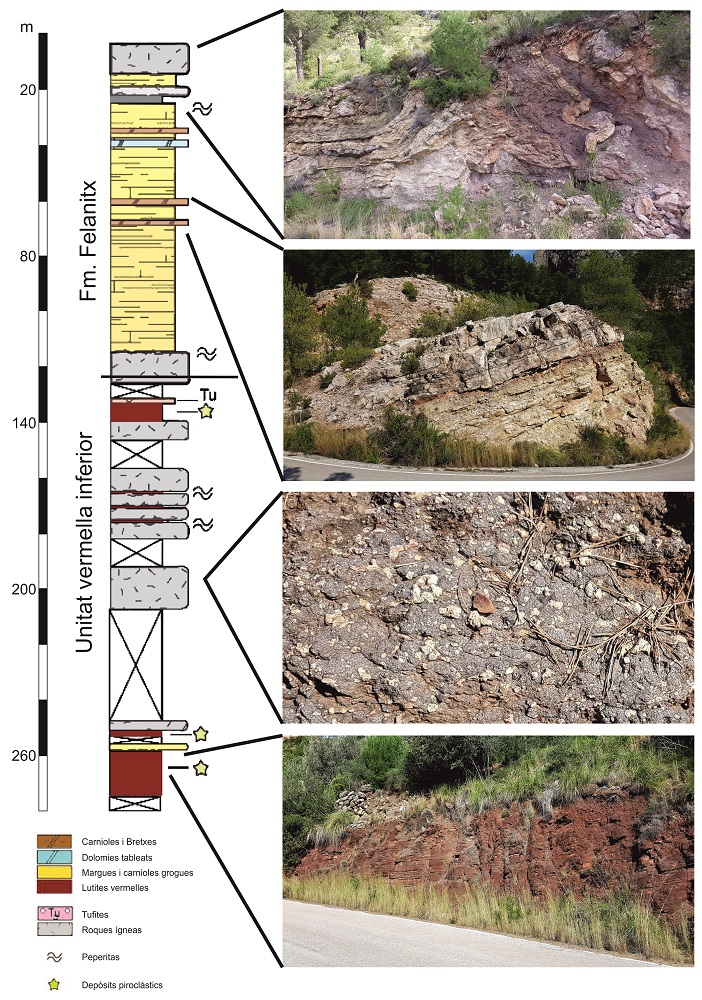
Stratigraphic column of Cala Tuent (modified from Sanz et al., 2013) with some of its different lithologies.
