The coastal zone between Cala Torta and Cala Mesquida is formed almost entirely by a powerful series of the Lower Cretaceous, and it is the best place in Mallorca for studying its stratigraphy.
The strata of this sector are between 135 and 125 Ma old, approximately, and represent very deep seabeds.
One of their most visible characteristics is the alternation of hard levels formed by limestones and soft levels consisting of marls. The origin of the limestones is primarily biological, with accumulations of countless microfossils with calcareous shells.
The eastern edge of the cove features a typical geological structure of this type of deposits: a slump.
A slump occurs when an episode of instability (for instance an earthquake) causes a movement of a large mass of unconsolidated sediment. The result is a local deformation of the strata, producing chaotic undulating forms, which stand out in relation with the surrounding strata which are perfectly ordered.
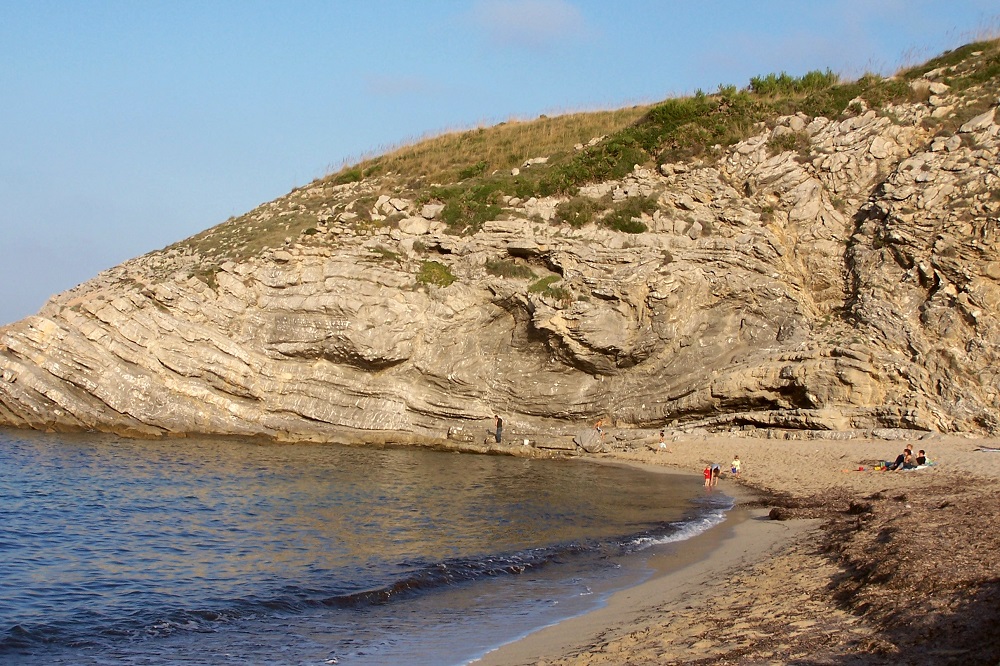
Appearance of the large folds of the slump in the Cretaceous rocks of Cala Torta. Note the contrast between the chaotic appearance of the centre of the mass and the ordered stratification to the left.
