Cala Fornells represents one of the island’s best outcrops of the Middle and Upper Jurassic, for both its clarity and its scientific interest. It includes Cala Fornells, Caló de Ses Llisses, Punta de s’Estaca and S’Aigua Verda.
This zone displays a succession of well-defined layers of calcareous rocks: limestones, margo-limestones and marls, with colours ranging from light grey to intense red, the sector of Caló de Ses Llisses-S’Aigua Verda having the most distinctive outcrops.
Some of these rocks belong to the stratigraphic unit and reflect the specific environmental conditions in which they were formed.</p><p><br></p></div>">facies named Ammonitico-rosso, an Italian term that defines a type of nodular limestones which tend to contain an abundance of ammonites and are often of reddish colours.
Ammonites are a type of extinct cephalopod molluscs which had a segmented external shell that allowed them to float in the water column. They resembled their modern-day relatives, the nautiluses.
They are among the most characteristic fossils of marine environments. Their abundance and variability gives them great importance in scientific terms. Many of their species are considered guide fossils, that is, fossils that help to date the levels where they are found.
The shell of ammonites is composed of aragonite, which dissolves during the fossilisation process, meaning that only internal moulds are conserved. However, in these internal moulds it is possible to distinguish the walls of the successive chambers (septa), which can form beautiful patterns with sinuous shapes. Passing through all the chambers there is a duct (siphon) which regulates the gas contained in the chambers to control the mollusc’s floatability. The last section of the spiral is not segmented, and this is where the soft body is housed (body chamber).
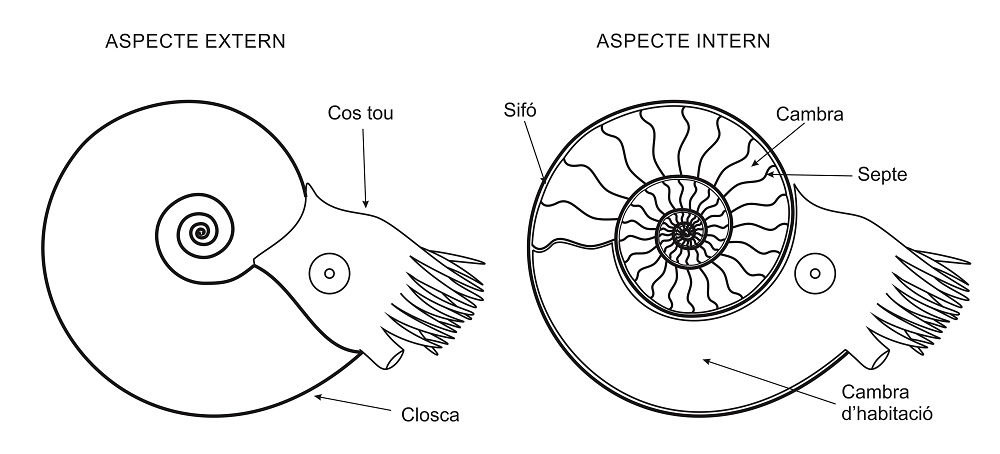
Diagram of the exterior and interior of an ammonite.
In the northern cliff of Es Caló de Ses Llisses, four formations are represented along its stratigraphic series: the Cúber Formation (Middle Jurassic), the Alfàbia Formation, the Aumedrà Formation (Upper Jurassic) and the Son Torrelles Formation (Terminal Jurassic - Basal Cretaceous). The stratigraphic sequence embraces both the Middle and Upper Jurassic up to its limit with the Cretaceous, with ages between 170 and 145 Ma
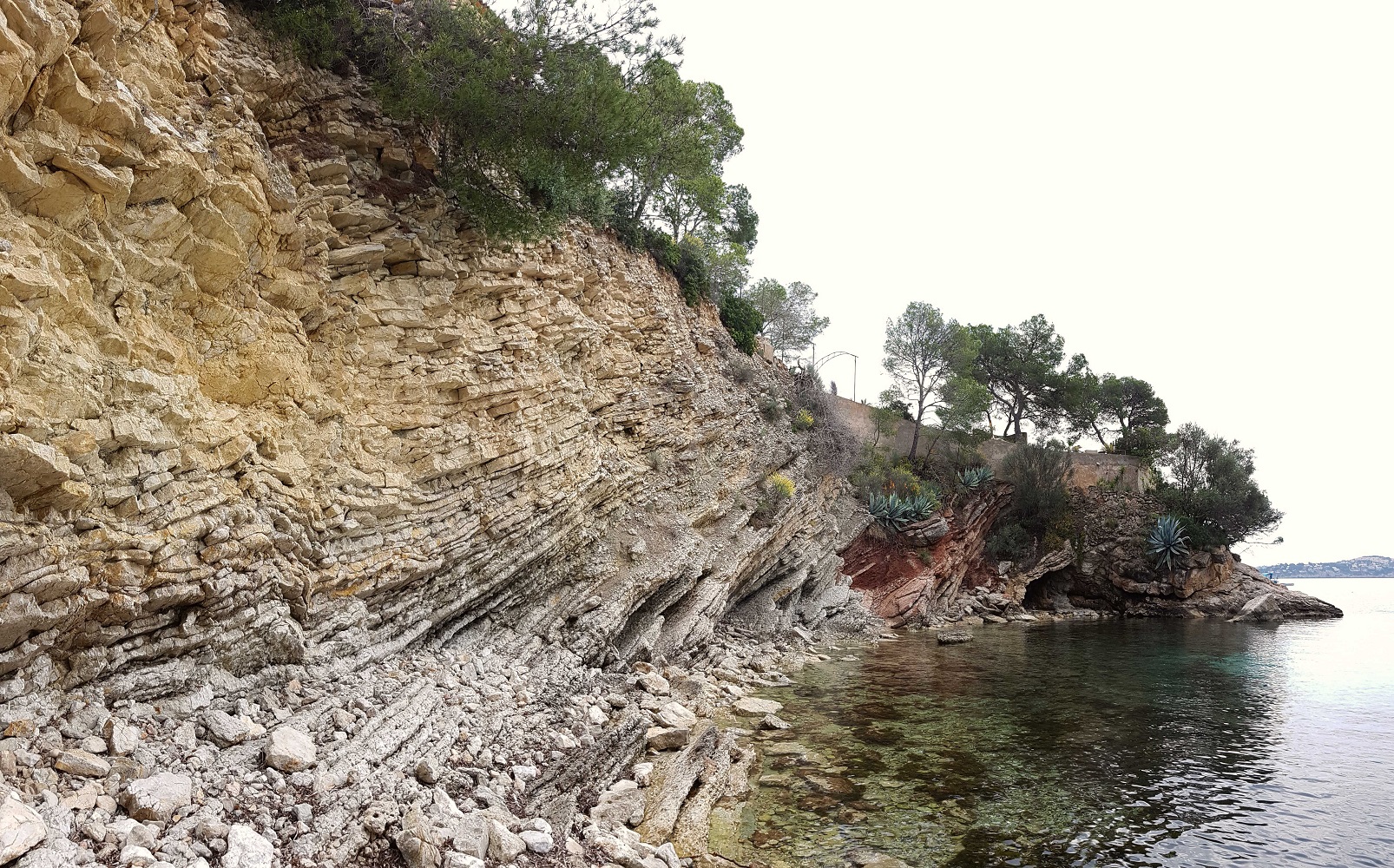
Ammonitico-rosso facies in Caló de Ses Llisses.
This stratigraphic series represents, to a greater or lesser extent, seabeds with a very low sedimentation rate. Thus, there was a successive repetition of episodes of carbonates precipitation, which formed nodular structures followed by deposition of clays, which formed marly layers. The resulting red colour is due to the presence of oxidised iron in the sediment. The formation of a few millimetres of deposit in these conditions requires several thousand years, which gives an idea of the enormous length of time it took to deposit the sequence we see today in the zone of Cala Fornells, which has a top of a stratigraphical unit or stratigraphical sequence. </p></div>">thickness of dozens of metres.
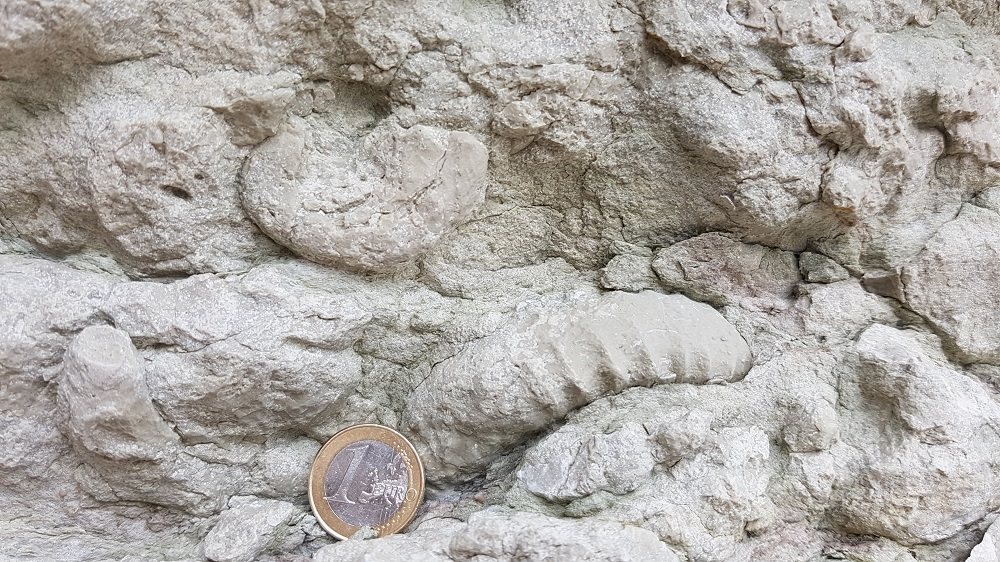
Upper Jurassic Ammonites in one of the roofs of the strata of Es Caló de Ses Llisses.
The north-east end of Es Caló de Ses Llises is closed by the Punta de S’Estaca, formed by materials of the Lower Jurassic. The limit between the materials of the Lower and Middle Jurassic is a contact
<div class="ql-editor"><p class="ql-align-justify">This occurs when the contact between two stratigraphic series is due to a fault.</p><p><br></p></div>">mechanical contact, by means of a fault.A fault is a breakage surface of the rocks where displacement has occurred, and it constitutes a zone of weakness of the rocky substrate since the tectonic efforts that originate it fragment the rock, favouring its subsequent erosion. This has allowed the erosive action of the sea to affect this zone more (differential erosion), creating a marine abrasion cave which permits communication between Es Caló de Ses Llisses and S’Aigua Verda.
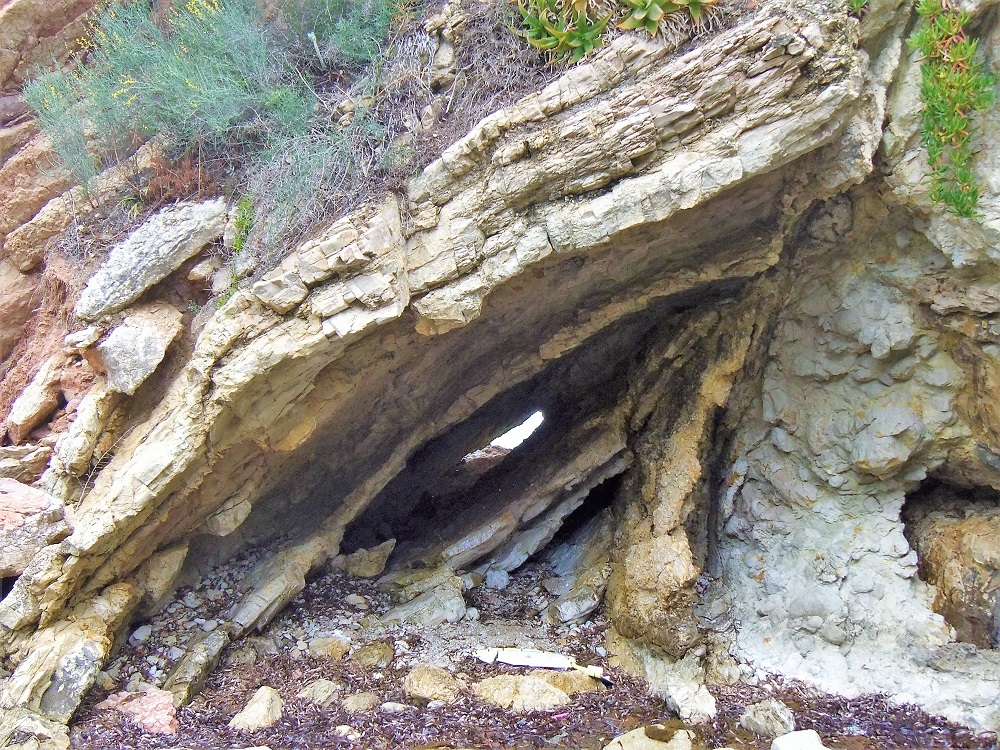
Marine abrasion cave associated with a fault in Es Caló de Ses Llisses.
At S’Aigua Verda we can observe the same materials as in Es Caló de Ses Llisses, although they are less altered by marine erosion, and rocky blocks with inclusions of ammonites are abundant, even under the water.
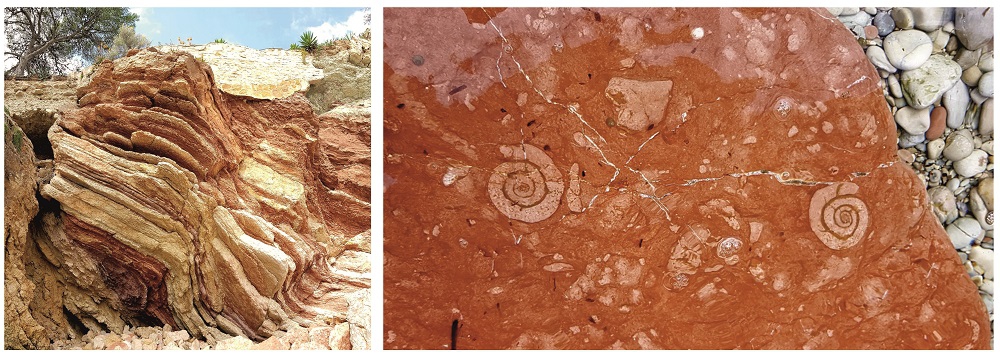
Strata of the Middle Jurassic and fossils of ammonites in a block under the water in S’Aigua Verda.
