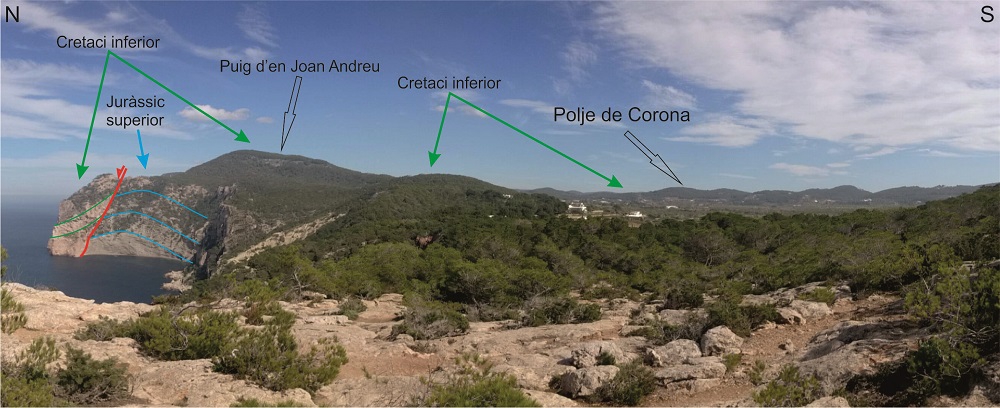
Panoramic view from Sa Penya Esbarrada, with the most important geological features marked.
The panoramic view to the west from Sa Penya Esbarrada contains various very interesting elements of the geology of Eivissa. It reveals two different materials, one of pinkish tonalities and the other of grey colorations, separated by a fracture that can be followed practically all along the cliff.
The unit of grey colorations, located in the zone of Ses Balandres, is the older (Upper Jurassic, 160 - 145 Ma). The lower part is constituted by limestones with strata of dimensions between 10 and 50 cm, with abundant fossil fauna. The higher part of the unit corresponds to a rhythmic alternation of limestones and marls with strata of thicknesses between 20 and 40 cm, without fossil fauna.
Close observation shows that the strata are not in their original horizontal position, but folded forming a gentle fold in which the oldest materials are situated in its core.</p><p><br></p></div>">anticline (A-shaped fold).
The sedimentation of the Jurassic unit began in a marine environment of clear, shallow waters populated by a multitude of organisms that eventually fossilised, particularly ammonites. Later the environment became restricted, with a relatively continued contribution of detritic sediments which caused turbidity in the water and prevented the colonisation of the sea bottom by the organisms.
The unit of pinkish colorations which outcrops at the Punta des Castellar is the most modern (Lower Cretaceous, 125-115 Ma). It is formed by dolomites and stratified limestones in thick layers or forming banks.
Its origin is also marine, from a shallow platform, with clear and well-oxygenated waters. The sea bottom was populated by an abundance of organisms, with a notable presence of rudists (colonial bivalves).
The contact between the two formations is throught a large normal fault. The materials of the Cretaceous, harder than those of the Jurassic, have better resisted the erosion of the sea. This is why the Punta des Castellar is a crag and Ses Balandres is in the form of a cove.
Looking beyond Ses Balandres we see the Puig d’en Joan Andreu, a hill formed by the same Lower Cretaceous materials as Sa Punta des Castellar, but this time the contact with the Jurassic is due to a thrust which is the cause of the hill’s relief.
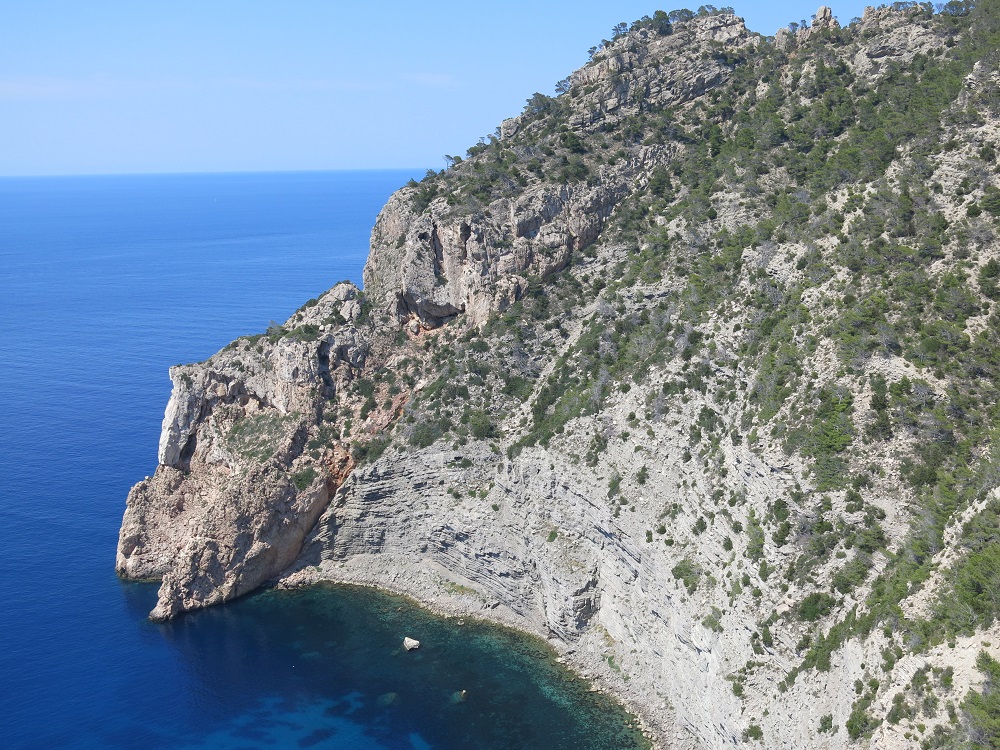
Geology of the zone of Punta des Castellar and Ses Balandres.
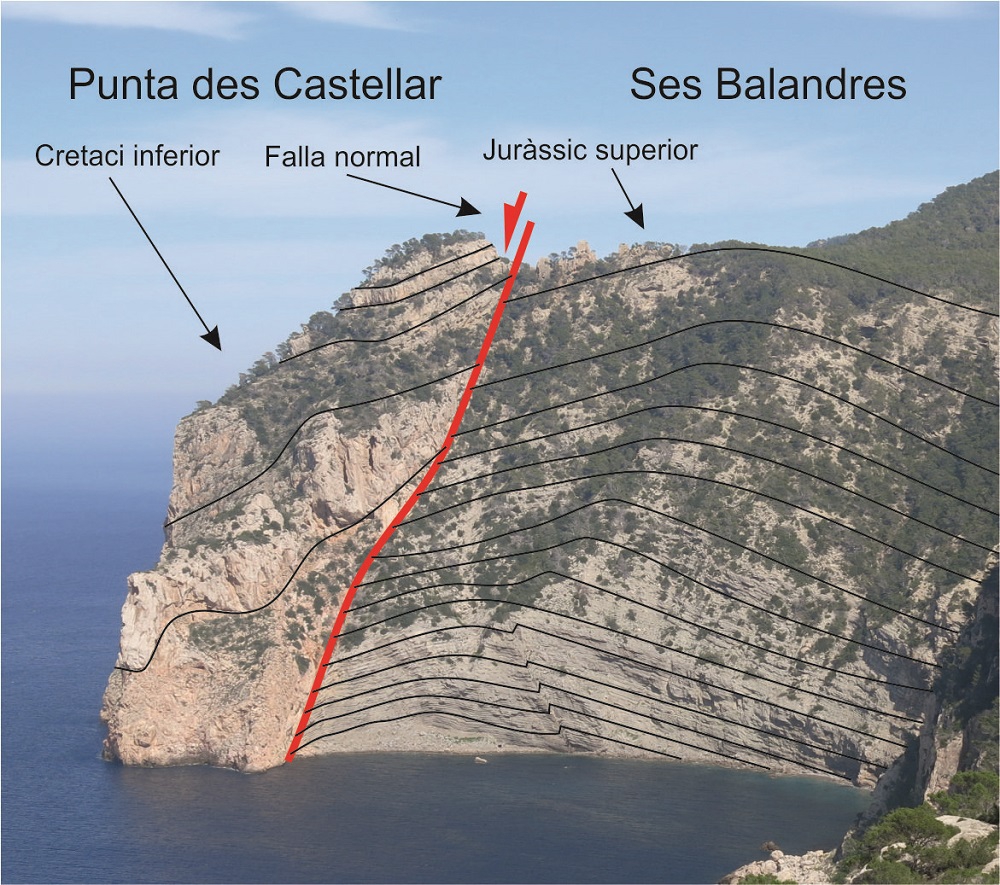
All of these large fractures are products of the Alpine Orogeny which raised the present-day reliefs of the island.
To the south of the Puig d’en Joan Andreu a large depression can be seen: the Pla de Corona, a valley with a relatively recent karstic origin corresponding to a polje.
Specifically, its formation is due to the dissolution of the Cretaceous dolomites which predominate in the sector. These materials gradually developed cavities, and over time became more and more unstable until they collapsed. This process, aggravated and prolonged in time, caused a large surface area to collapse. In parallel, the sediments transported by the watercourses silted up the valley and gave it its present-day aspect.
