Lunar and volcanic landscape are just two of the descriptions given to this part of Menorca, although, as you may remember, these descriptions bear no resemblance to reality, because this geological landscape was not formed by volcanoes, but by avalanches of sediments that came from the continents and reached the great sea depths some 350 million years ago, and that over time have formed primarily two types of rock: sandstones and lloselles.
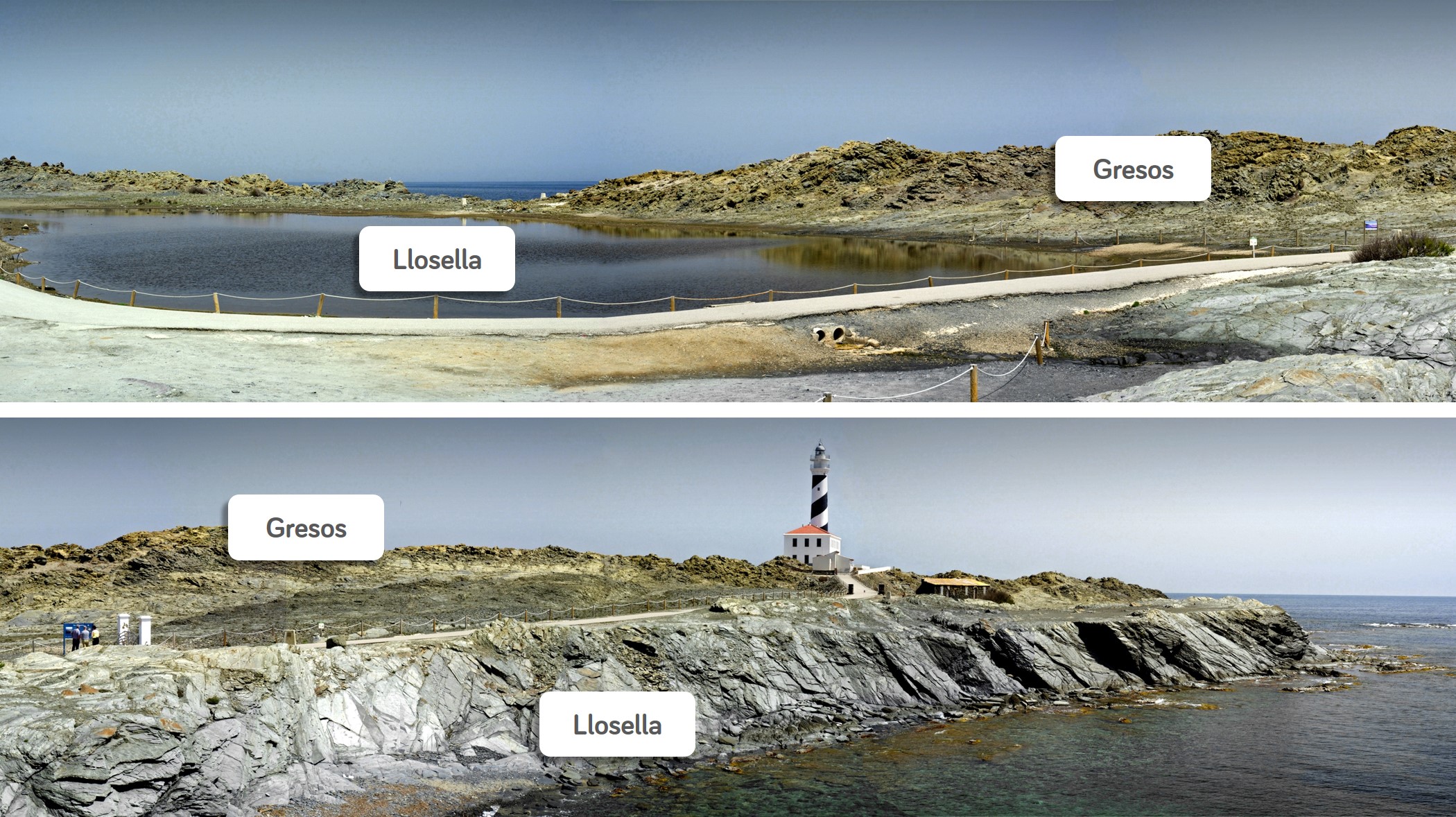
General view of Cap de Favàritx headland at the temporary pool of És Cos des Síndic, with the sea in the background. To its left, are the thick-grained, hard-wearing sandstones; to the right, at the water’s edge, the softer llosella presents a flatter relief.
The seabed comprises a shelf (the shallower part), a talus (a steeply sloping area) and the great sea depths, with depths up to a few kilometres and that are known as abyssal plains. The rocks at Favàritx were formed from sediments that fell from the continental shelf down the talus as a current of dirty water or turbulence caused by an event such as a small earthquake.
As the figure below the text shows, the turbulence fell down the talus at great speed (1). It decelerated when it reached the abyssal plain, causing sedimentation of the thicker particles first (sand and cobbles, with the finer particles still in suspension: clay and silts) (2). Subsequently, sedimentation of the fine particles occurred (3). Over time, the thick particles formed conglomerates and sandstones, while the fine particles formed lloselles.
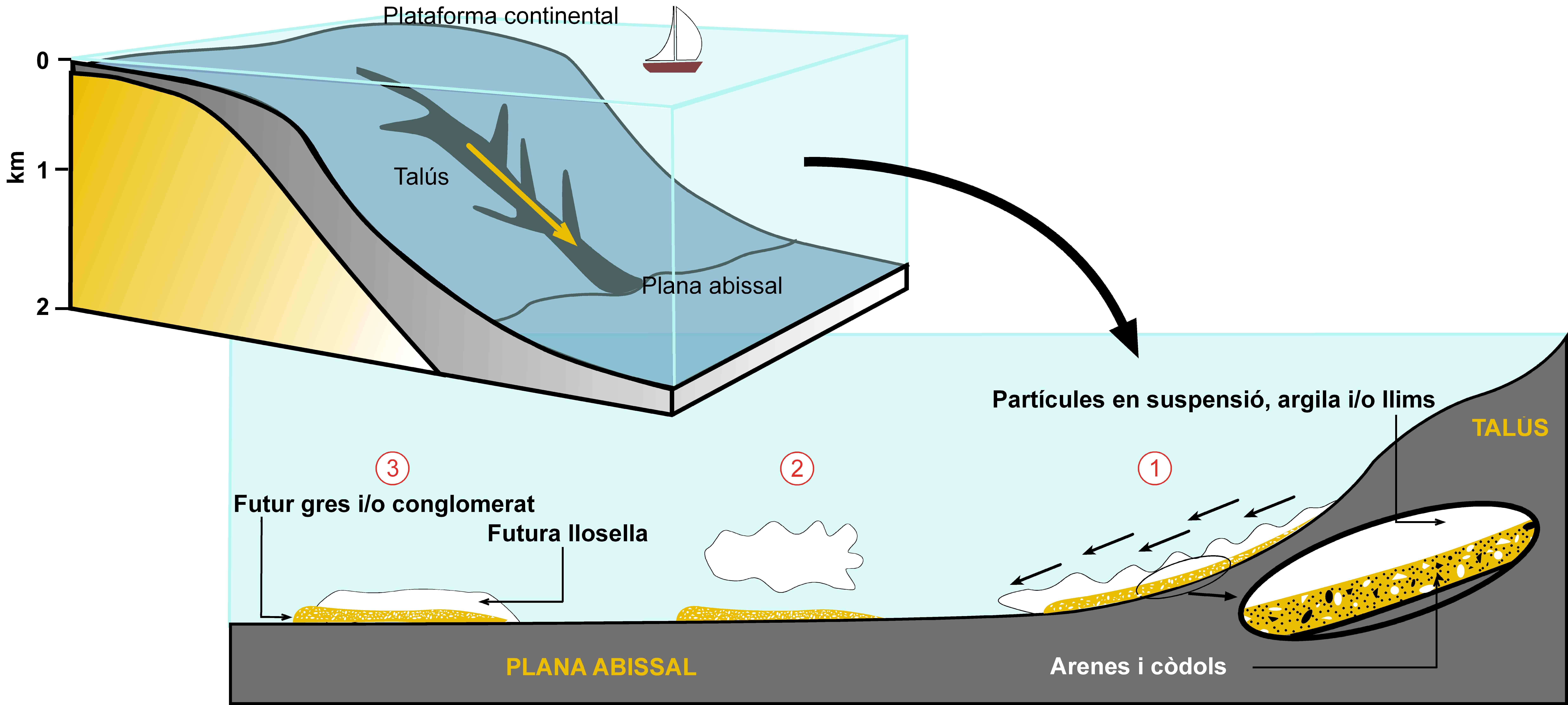
Diagram showing the structure of the ocean bed and the formation of the turbidite strata.
Conglomerates and sandstones are hard rocks with thick particles that are resistant to erosion and form the tip of Cap de Favàritx. Since sedimentary rock which tends to exfoliate in small flakes, similar to sedimentary rock formed by clay.</p></div>">pelite. </p></div>">llosella is a rock formed of very small grains, it is softer and erodes easily, creating depressed areas, such the És Cos des Síndic temporary pool.
