| UTM-X | UTM-Y | ||
|---|---|---|---|
| STOP 1: LITTORAL DUNE CORDON OF ES CAVALLET | |||
| STOP 2: SES SALINES POOLS | |||
| STOP 3: ES CODOLAR LITTORAL CORDON |
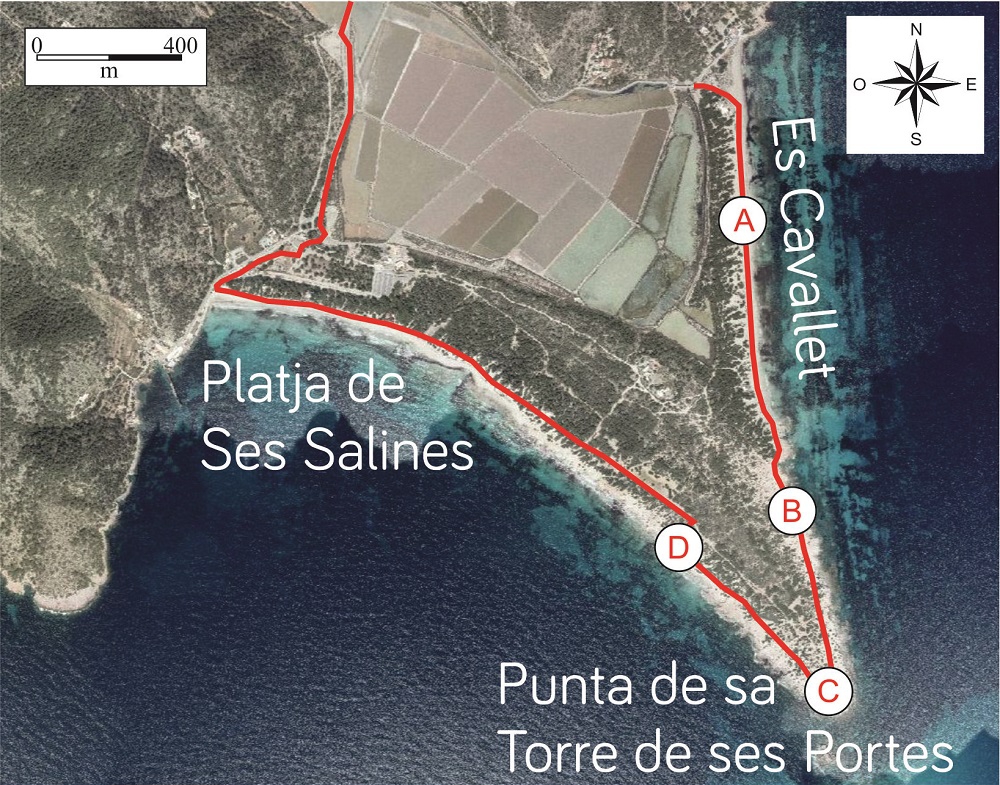
Recommended route around Es Cavallet and Punta de sa Torre de ses Portes.
At the beach of Es Cavallet, which has a surface area of 22,700 m2 and a width varying between 15 m and 40 m, therein lies one of Eivissa’s most representative beach-dune systems, closing to the sea the eastern sector of the island’s saline pools. The other dune system is that of Ses Salines.
This coastal barrier is formed by a narrower, flattened initial fringe of bioclastic sands that compose the beach, followed by a series of dune cordons lying in parallel with the coastline. These are mobile dunes dating from the Holocene age to the present day, also constituted by bioclastic sands.
The constant passage of people creates paths without vegetation which lead to the destabilisation of the dunes. The zone is now protected and in process of regeneration.
The sands comprising the current beach-dune system are deposited over a fossilized beach-dune system of the Pleistocene age (Marès).
One of the best outcrops of fossil dunes and beaches (Marès) of Eivissa, and one of the largest, is found along the coast between Es Cavallet and Ses Salines.
Marès is formed by soft-toned calcarenites with large spherical shapes measuring between 0.5 and 1.0mm in diameter. Cross stratification can be clearly seen on fossil dunes.
From Punta de sa Torre de ses Portes the various islands and islets of the remains of the dune cordon that joined Eivissa and Formentera can be seen. These are mainly sandy sediments, from old beaches and dunes that are partially submerged.
The highest point of this archipelago is the island of S’Espardell, 4 km to the east of the boundary and with a highest point of 30 m.
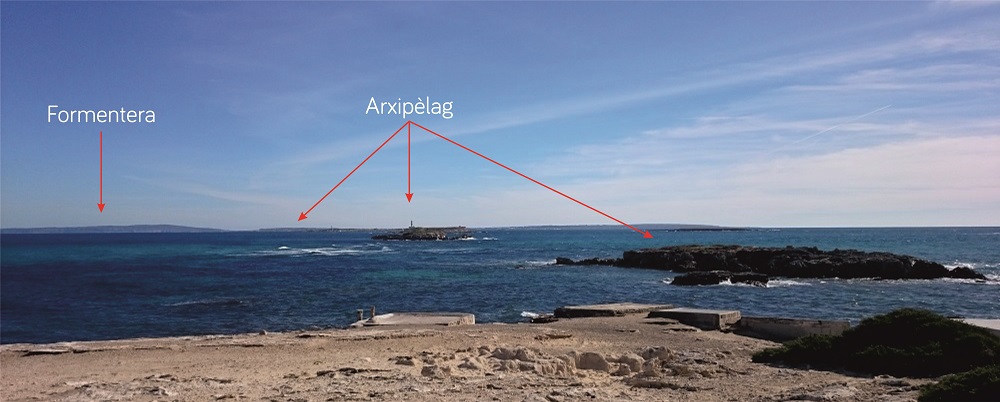
View of the archipelago that joins Eivissa and Formentera from Punta de sa Torre de ses Portes (point C).
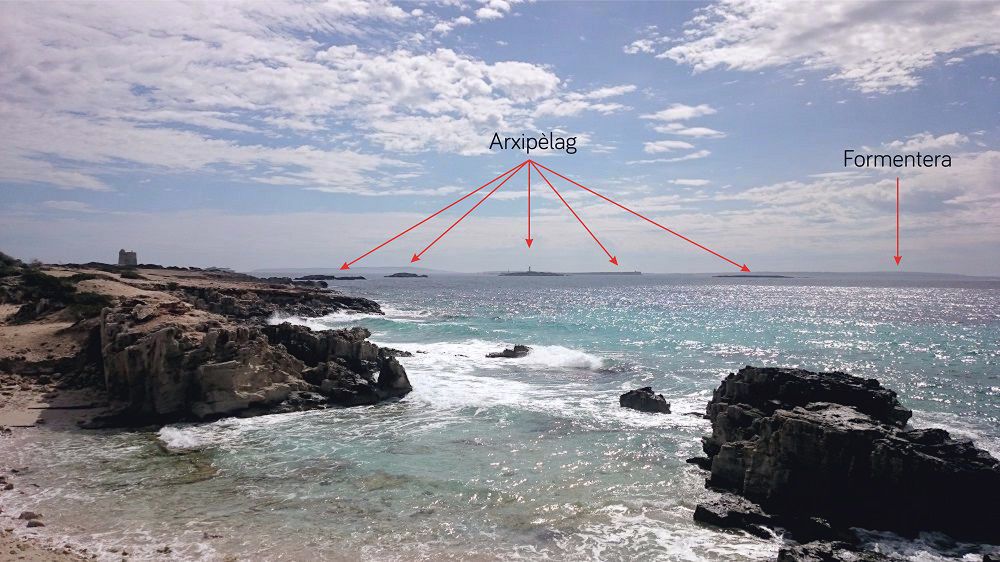
Lateral view of the archipelago that joins Eivissa and Formentera (point C).
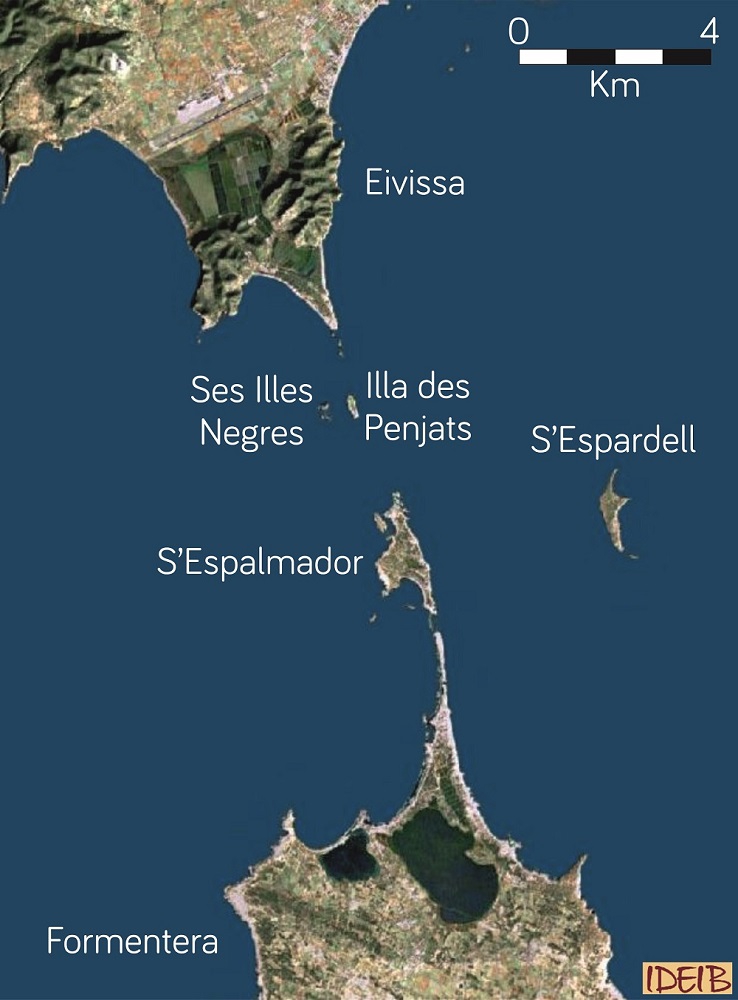
Aerial photograph of the beaches and dunes cordon that joins Eivissa with Formentera.
Around Punta de sa Torre de ses Portes up to Ses Salines beach an extensive Marès tectonic, eustatic or antropical processes</span></p></div>">outcrop can be seen with significant cross stratification.
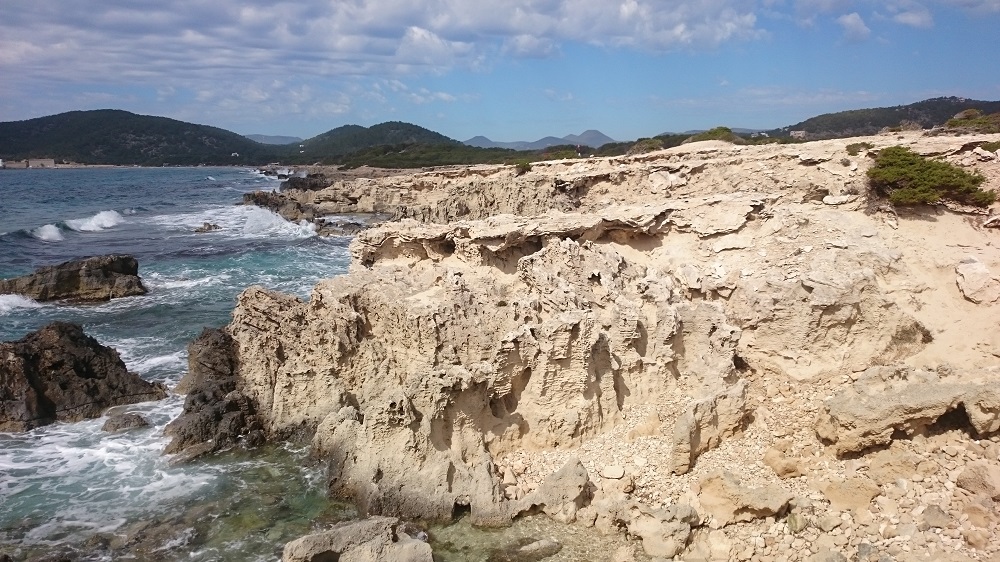
Extensive Marès outcrop between Punta de sa Torre de ses Portes and Ses Salines beach (point D).
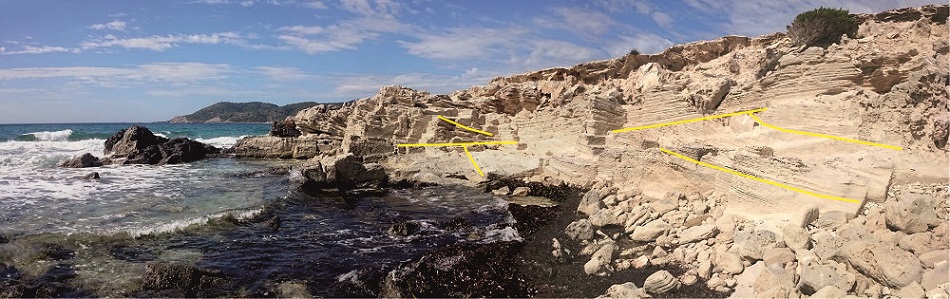
Outcrop of Marès close to Punta de sa Torre de ses Portes. The yellow lines mark the cross stratification (point D).
