In Formentera the oldest materials, which form a large part of the outcrops, are from the Late Miocene period. These are coral reef deposits that are closely related with the rest of the Balearic Islands.
However, unlike the rest of the Balearic Islands, in Formentera it is possible to find another type of material from the same era. These are a series of layers of silts, reddish breccias and yellow calcarenites formed in coastal environments, above sea level, which represent the firm ground behind the mentioned reefs
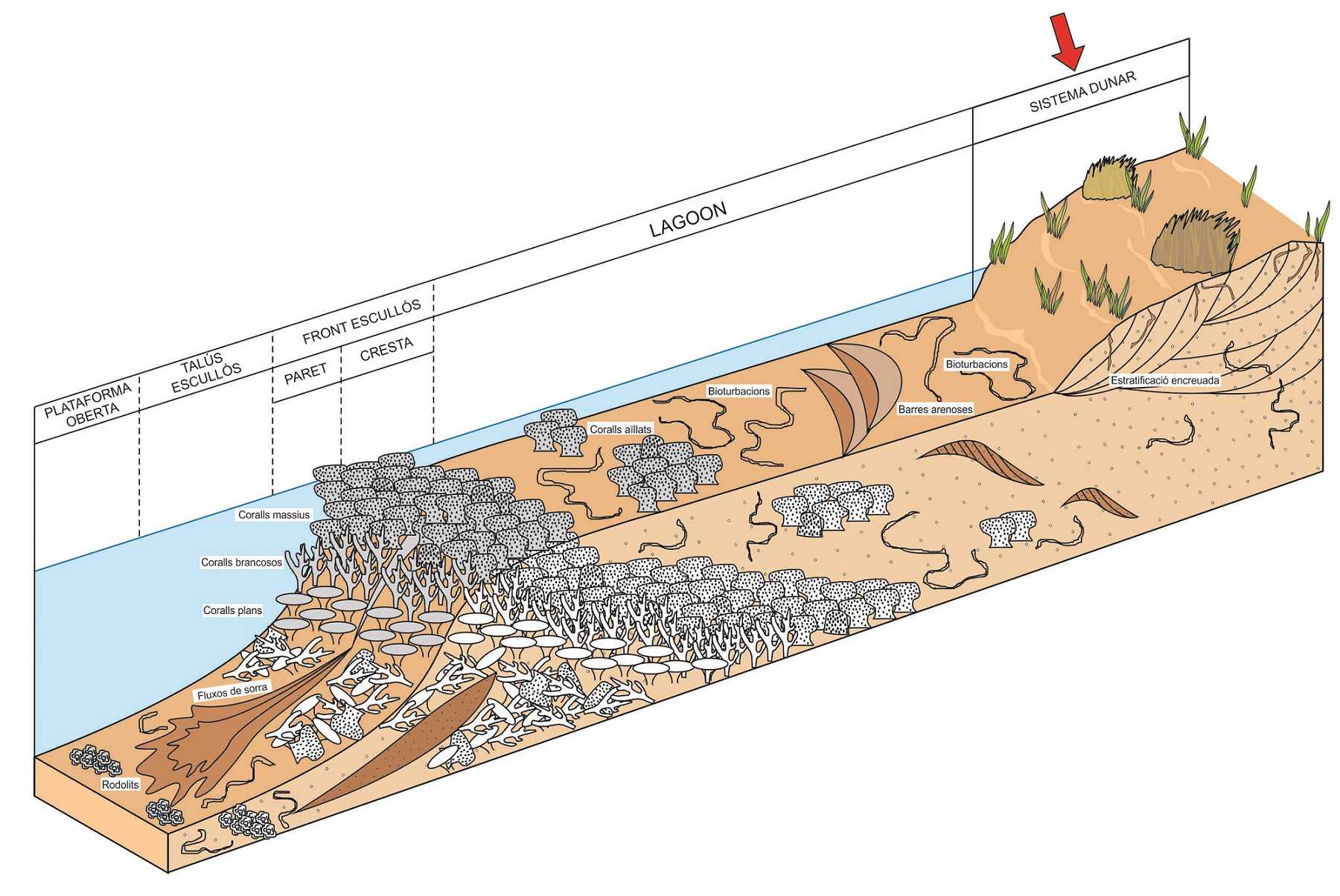
Diagram representing the dunar area and coral reef environment to which the levels of silt, breccias and calcarenites correspond that uniquely appear in Formentera.
The islet of S’Espalmador, specifically the central and west sector, is one of the places where these deposits can best be seen. The west sector cliffs are easily observable from the sea.
It is possible to see a complete succession of fossil dunes (formed by calcarenites of an eolic origin) with their typical stratification crossed with intercalations of paleosols (formed by silts and breccias). The latter usually contain rhizocretions, which are the remaining structures previously occupied by roots of vegetation that populated the area.
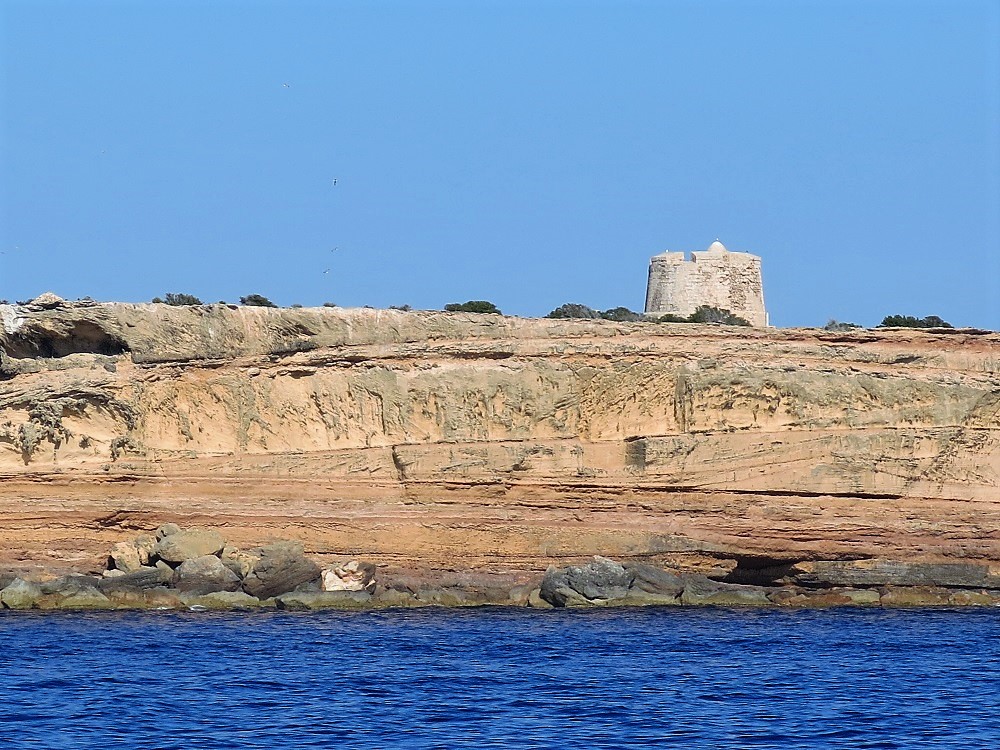
View from the western cliffs of S’Espalmador with the Late Miocene dunes and paleosols. In the upper right corner, the Tower of Sa Guardiola.
In the Pleistocene period (Quarternary) this kind of stratigraphic situation is very common throughout the Balearic Islands. This means that the mentioned Miocene fossil dunes can be easily confused with these more modern ones.
However, the north, east and south sector of S’Espalmador are found to be completely formed by Quarternary materials: old dunes and beach sands (sand-sized clasts.</p><p><br></p></div>">sandstone), current dunes and beach sands that form part of the northern cordon and deposits of lagoons and valley beds.
One possible explanation to this well-delimited lithological contrast could be the existence of a fault that is shown in current cartographies and which would have caused the rising of Miocene materials causing the reliefs of the west sector of S’Espalmador and maintaining the rest of the islet at sea level.
