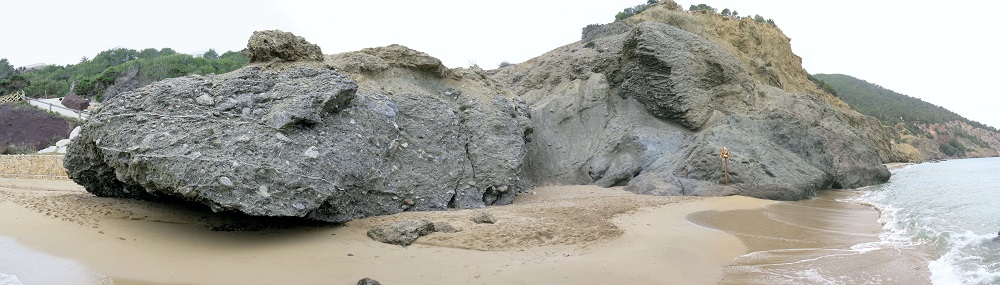
Part of the olistostrome on the beach of S’Aigua Blanca.
The beach of S’Aigua Blanca is an excellent place for observing one of the most difficult geological formations to study: olistostromes.
An olistostrome is a chaotic mass of materials of different lithology which are enveloped in a muddy matrix. It is older than the sedimentary series in which it is located. It occurs due to the large submarine slumps that take place on the continental slope due to tectonic activity.
The heterogeneous material which lithologically defines the olistostrome is known as megabreccia or tectonic slides, etc. </p></div>">mélange and includes from small clasts to enormous blocks several metres in length known as olistoliths. At S’Aigua Blanca it is possible to find folded fragments of layers of heterogeneous materials.
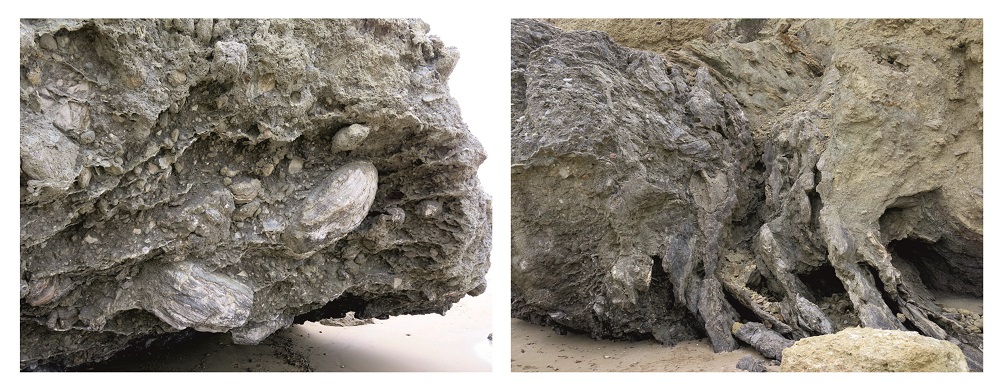
Left: detail of the appearance of the olistostrome. Right: fragment of folded layers.
In regard to the tectonic, eustatic or antropical processes</span></p></div>">outcrop of S’Aigua Blanca, like the rest of the olistostromes present in the Balearics and the Baetics, its origin resides in the large folds caused during the Alpine Orogeny. In fact, it has been dated as Langhian (Middle Miocene), a geological stage which corresponds to the high point of this Orogeny.
Because olistostromes are related with moments of tectonic activity, they can often be found associated with a fault. In this case, it has been considered that in the centre of the beach of S’Aigua Blanca there is a fault
<div class="ql-editor"><p class="ql-align-justify">Inverse fault in which the stratification plane.</p><p><br></p></div>">dip of the fault plane is at a low angle (generally less than 45<sup> o</sup>). It tends to refer to large-scale (regional) structures.</p><p><br></p></div>">thrust fault that brings the materials of the Keuper (Upper Triassic) into contact with the olistostrome.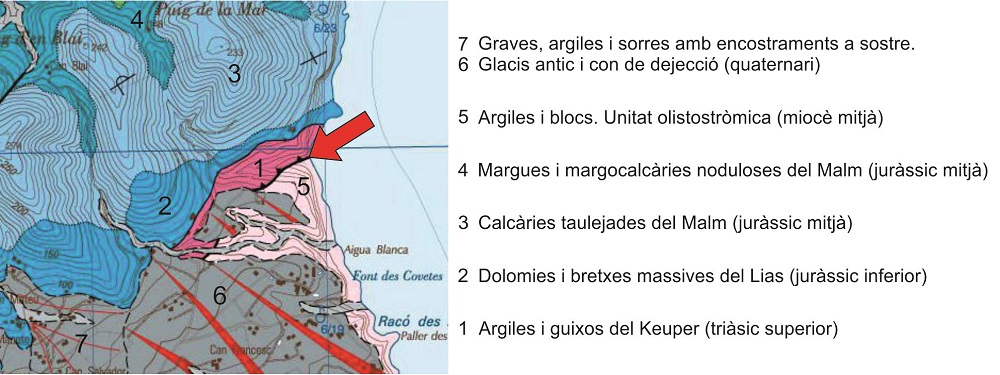
Geological cartography showing the representation of the thrust fault which affects the Keuper Facies and the olistostromic unit. Extracted from Sheet 773 35-30 of the Geological Map of Spain (E 1:25.000) published by the ITGE (2009).
Another interesting aspect is the high susceptibility of this zone to experiencing rockfalls. This is due to the predominantly clayey composition of the materials which form the embankments and the presence of rocky blocks enclosed in this matrix. This propitiates differential erosion, causing the rocky blocks to be isolated and without support due to the erosion of their matrix.
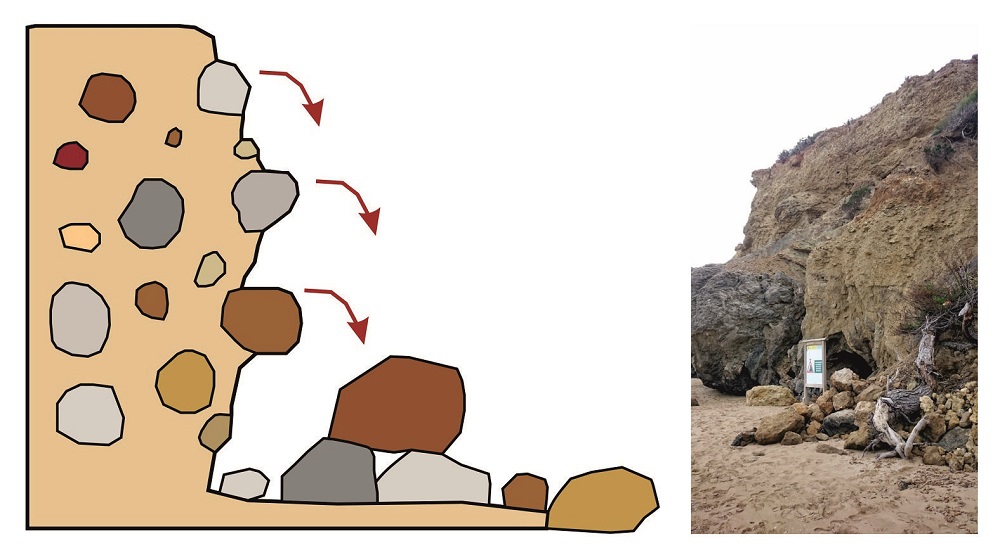
Diagram: illustration of the production of the differential erosion which gives rise to rockfalls. Right: example of a rockfall.
