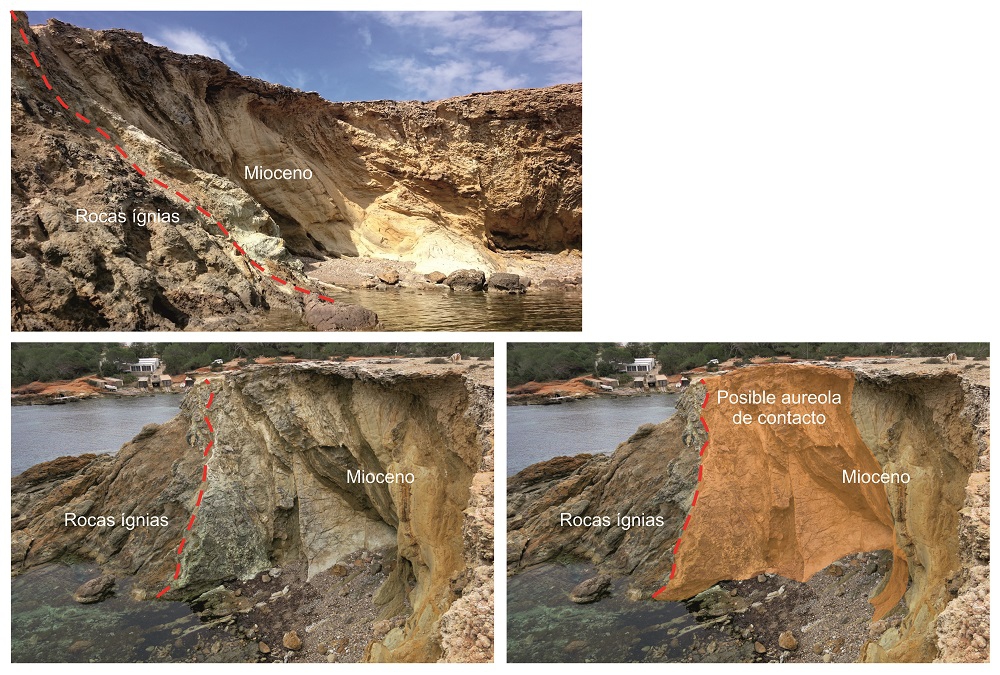
Part of the Triassic outcrop of igneous rocks of Canal d’en Martí.
Between Canal d’en Martí and Punta Llagosta there is an tectonic, eustatic or antropical processes</span></p></div>">outcrop of rocks that differ from the sedimentological normality of the island of Eivissa: They are igneous rocks.
This type of rocks are formed from the cooling and solidification (crystallisation) of melted rocky material (magma). Depending on the depth within the Earth at which the magma crystallises and the time it takes to do so, igneous rocks can be classified into:
• Plutonic rocks: This type of rocks are those formed from magma that has cooled and solidified at a certain depth inside the Earth, giving rise to igneous bodies with relatively perfect and complete crystallisation because the cooling time is long. This type of rocks would never tectonic, eustatic or antropical processes</span></p></div>">outcrop on the surface if it were not for tectonic and erosive processes. They are also known as intrusive rocks.
• Hypabyssal rocks: These rocks are formed in the tubes that drive the magma from the interior of the Earth to the surface. They tend to display medium grade minerals but often show similar characteristics as plutonic or volcanic rocks. They are also known as subvolcanic or filonian rocks.
• Volcanic rocks: These are the rocks that crystallise on the surface of the Earth, in subaerial conditions and with fast cooling. They are formed from igneous bodies with very deficient crystallisation, even reaching the point of not presenting a crystalline structure, giving as a result a vitreous material. They are also known as extrusive rocks.
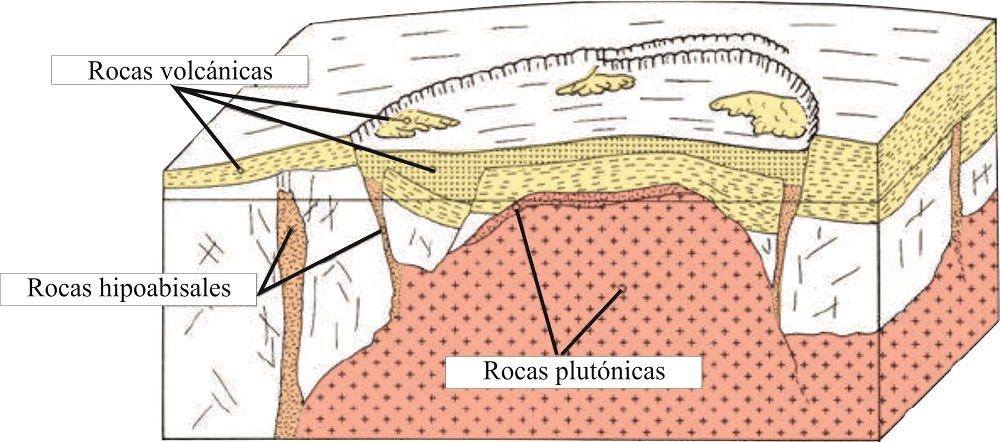
Diagram modified from Turner & Bowden, 1979, situating the different types of igneous rocks.
The igneous rocks found between Canal d’en Martí and Punta Llagosta have been classified like plutonic rocks by the authors Spiker and Haanstra in 1935 and Beauseigneur and Rangheard In 1968.
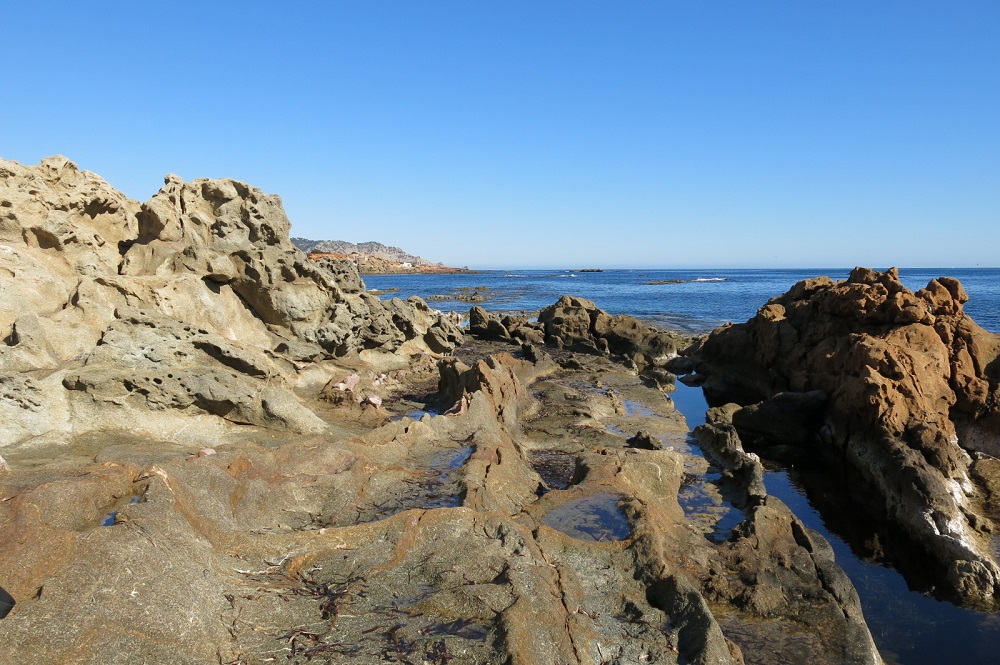
These rocks have a massive fabric and a dark grey-green colour. They have numerous fractures along which magmas of different compositions have circulated and crystallised (dykes). As a result of the intense weathering they have suffered, they present alveoli, popularly known as beehives.
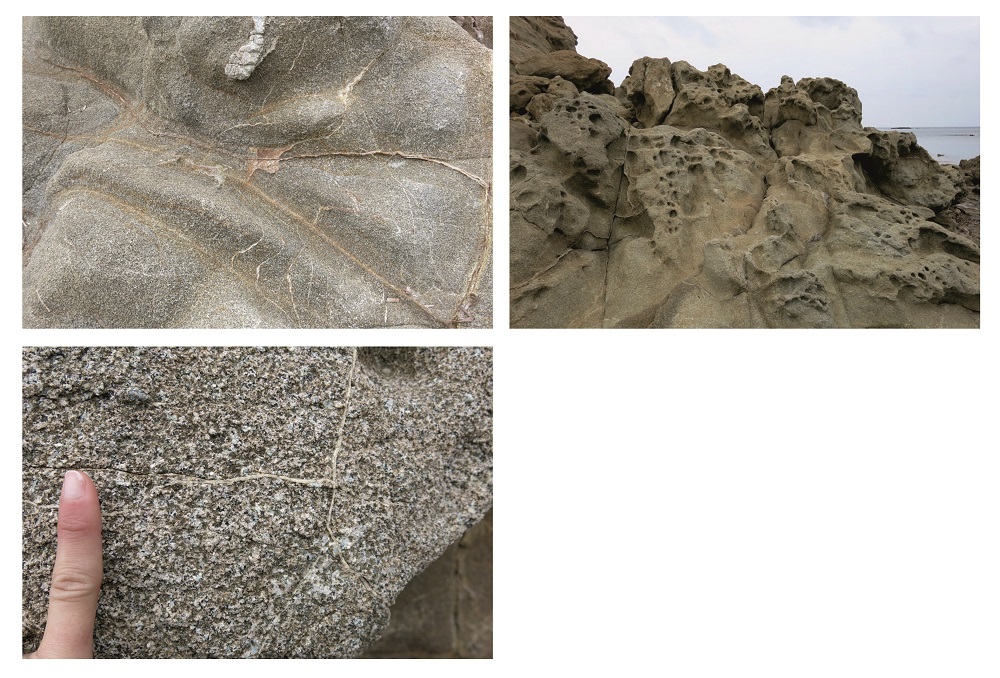
The magma that has crystallised in the fractures presents a different composition from that of the rock in which it inserts itself. Sometimes, due to its chemical properties, the resulted rock is easier to erode and it forms channels which, when filled by the sea, resemble artificial man-made structures that provide access for fishing boats.

Eroded dyke formed by the low resistance of the magma that entered through the fracture.
It is not known for certain at when these igneous rocks originated, but in this tectonic, eustatic or antropical processes</span></p></div>">outcrop it seems that this occurred during the Miocene, because the materials of this period seem to be affected by the contact aureole of igneous rocks.