Menorca has around thirty dune systems in different states of conservation. These dune systems are accumulations of sand that have been dragged inland on many beaches. They should be seen as part of a complex system known as beach-dune systems, where the beach is divided into a submerged part and a subaerial part. Any changes to the marine dynamics, which control the submerged part, or to the aeolian dynamics, which determine the subaerial part, may upset the balance of the whole system and affect both the beach and the dune system.
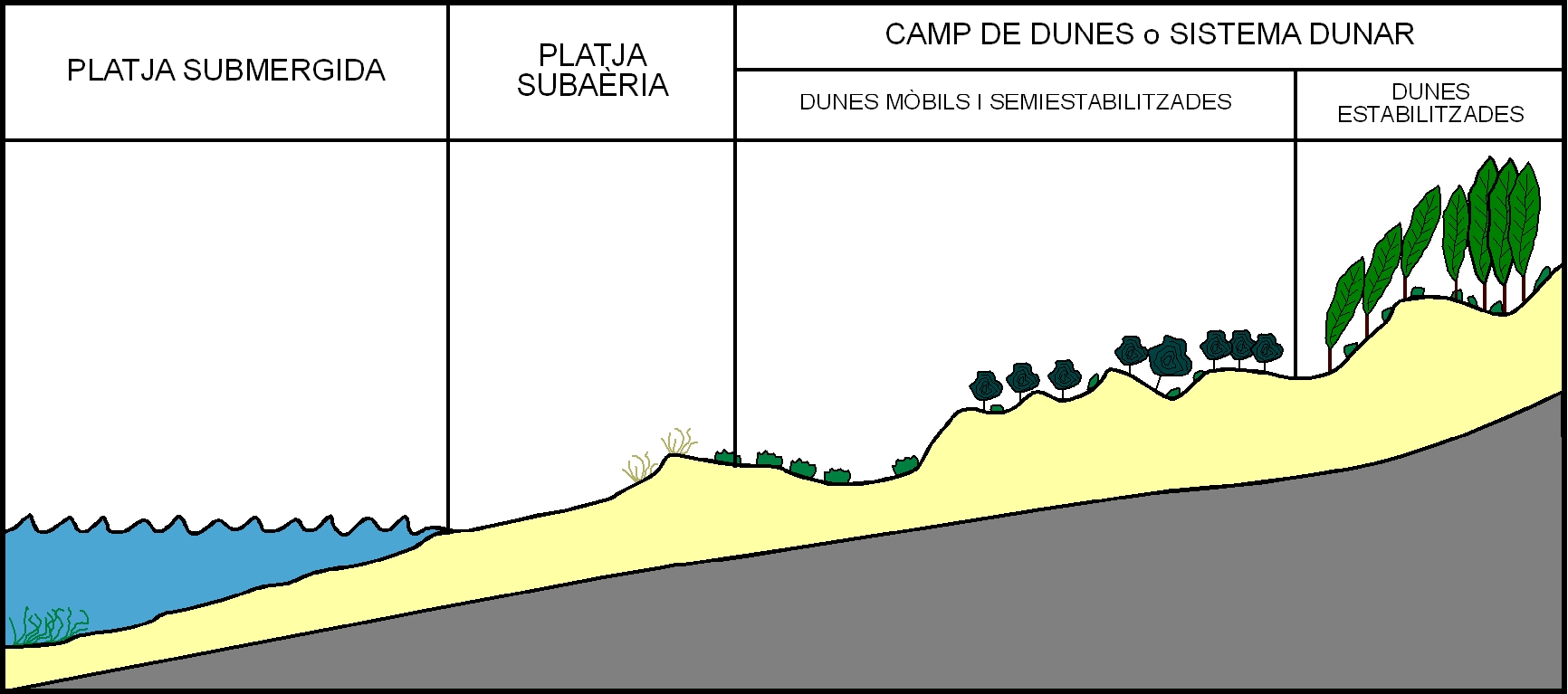
Profile of a beach-dune system. The beach acts as an area where the sand is transferred towards the dunes. Posidonia oceanica plays a very important role in the submerged beach as it is a key element in the generation of sand (adapted from Rodríguez-Perea, et al., 2000).
The interest of the Site of Geological Interest centres on the dune system which covers Mongofra or Es Sivinar beach, primarily on its northeastern edge. The morphology of the dunes is essentially climbing dunes. This type of dune occurs where the sand has risen along one slope due to the action of the wind. In the case of Mongofra-Nou, the sand has “climbed” up to a 50-m cliff modelled on sandstones from the Carboniferous (Paleozoic).
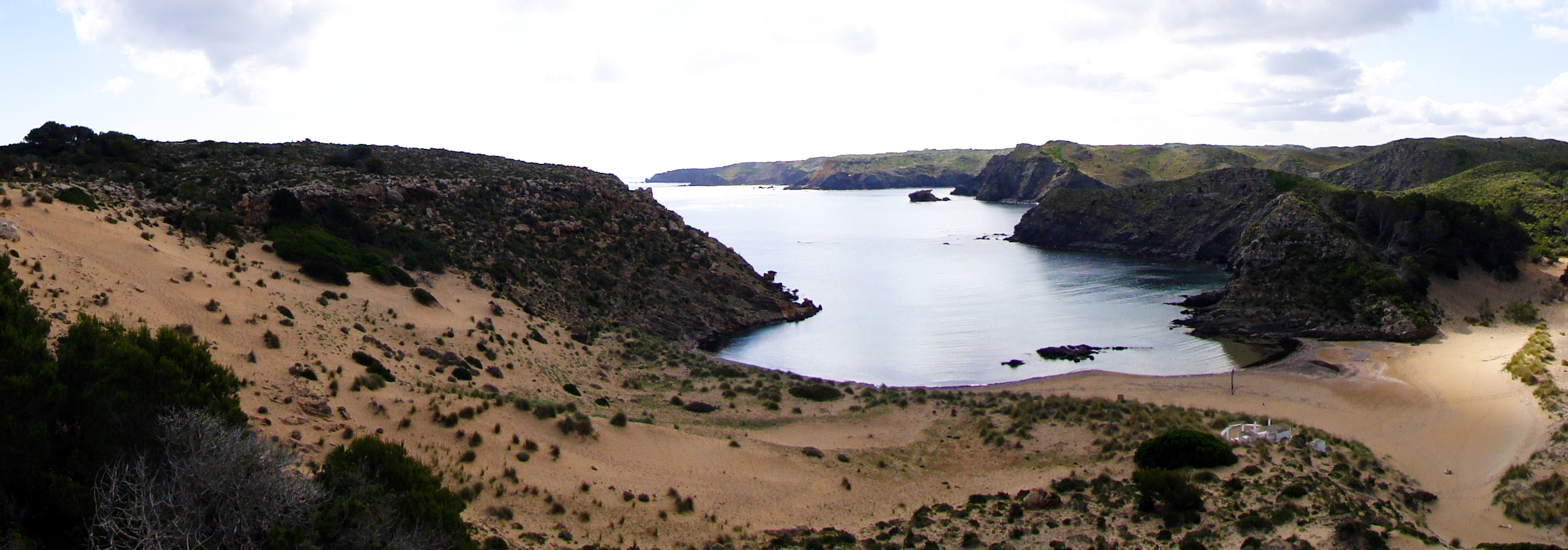
General view of Mongofra or Es Sivinar beach. In the foreground, you can see how the sand, dragged by the strength of the wind, has built the slope containing paleozoic rocks along the northern edge of the cove.
The location makes it easy for visitors to appreciate the different ways the dunes have evolved. So, at the edge of the beach we see small mobile or embryo dunes with marram grass (Ammophila arenaria), a species of plant that traps the moving sand and creates significant accumulations around it. In the background, we see dunes that have been stabilised by pine and tamarind trees. We should point out that numerous dune systems have been observed in Menorca that were created by human activity through the planting of trees, particularly pine trees, designed to stop the dunes from advancing inland and the sand from invading crop fields. Between both, we see a series of semi-stabilised dunes, characterised primarily by bush-type vegetation, which enables more significant support of the sand than the vegetation of the mobile dunes, but logically still far from the stabilised dunes.
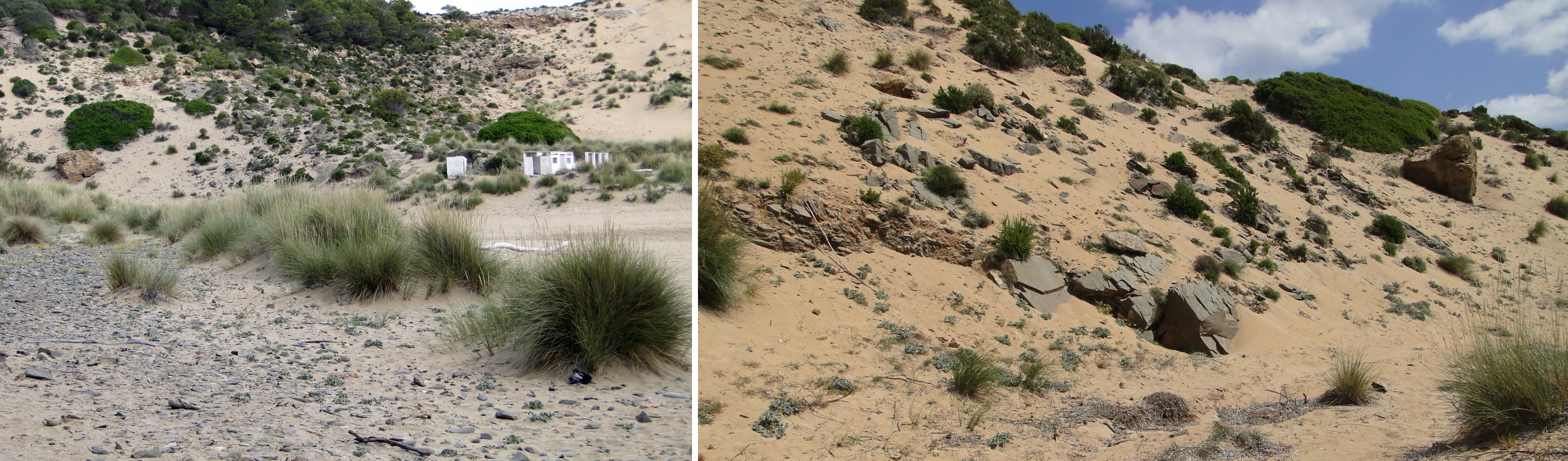
Mobile dunes with marram grass that stops the speed of the wind and therefore displaced sand, so helping it accumulate (left) and creating semi-stabilised dunes from which the rock stands out on which the climbing dune (right) developed.
The dune is topped by an eolianite, a rock that was formed by the consolidation of sediment, such as the sand on the beach, which was accumulated by the wind, in other words, a dune that has been fossilised. Fossil dunes are quite common on the north coast of Menorca. They were formed over the last 2 million years as a consequence of successive climate changes that have affected the Earth. During the extremely cold periods of glaciation, the water on Earth accumulated in the form of large glaciers at the geographical poles and on mountains, leading to a drop in sea level. This process meant that huge extensions of sand were left to the mercy of the wind, which, if it blew from the sea inland, could drag the sand towards the coast creating a line of dunes, which, when it came up against an obstacle, such as the cliff along the edge of Es Sivinar beach, would deposit sand at the foot of it. The fossil dunes on Es Sivinar are the second-oldest series of dunes in Menorca after the ones at Cap de Cavalleria, Mola de Fornells and Maó and the l’Illa de l’Aire islet.
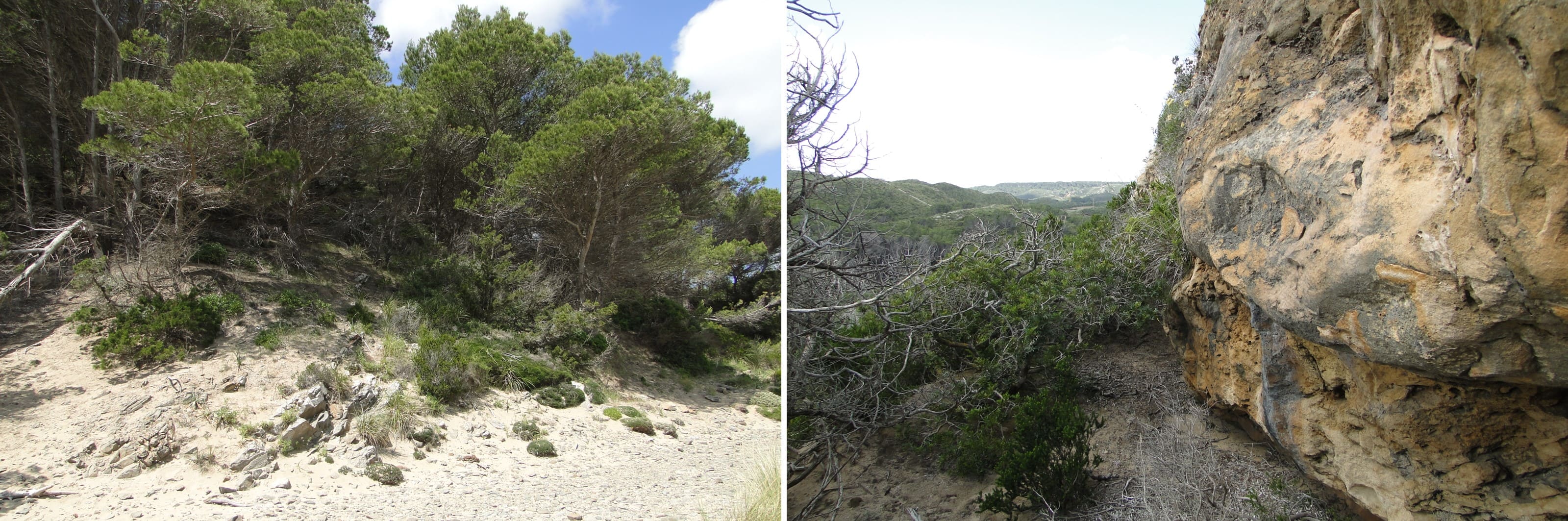
Stabilised dune with the development of a pine grove and fossil dune that now form a rock on the stabilised dune.
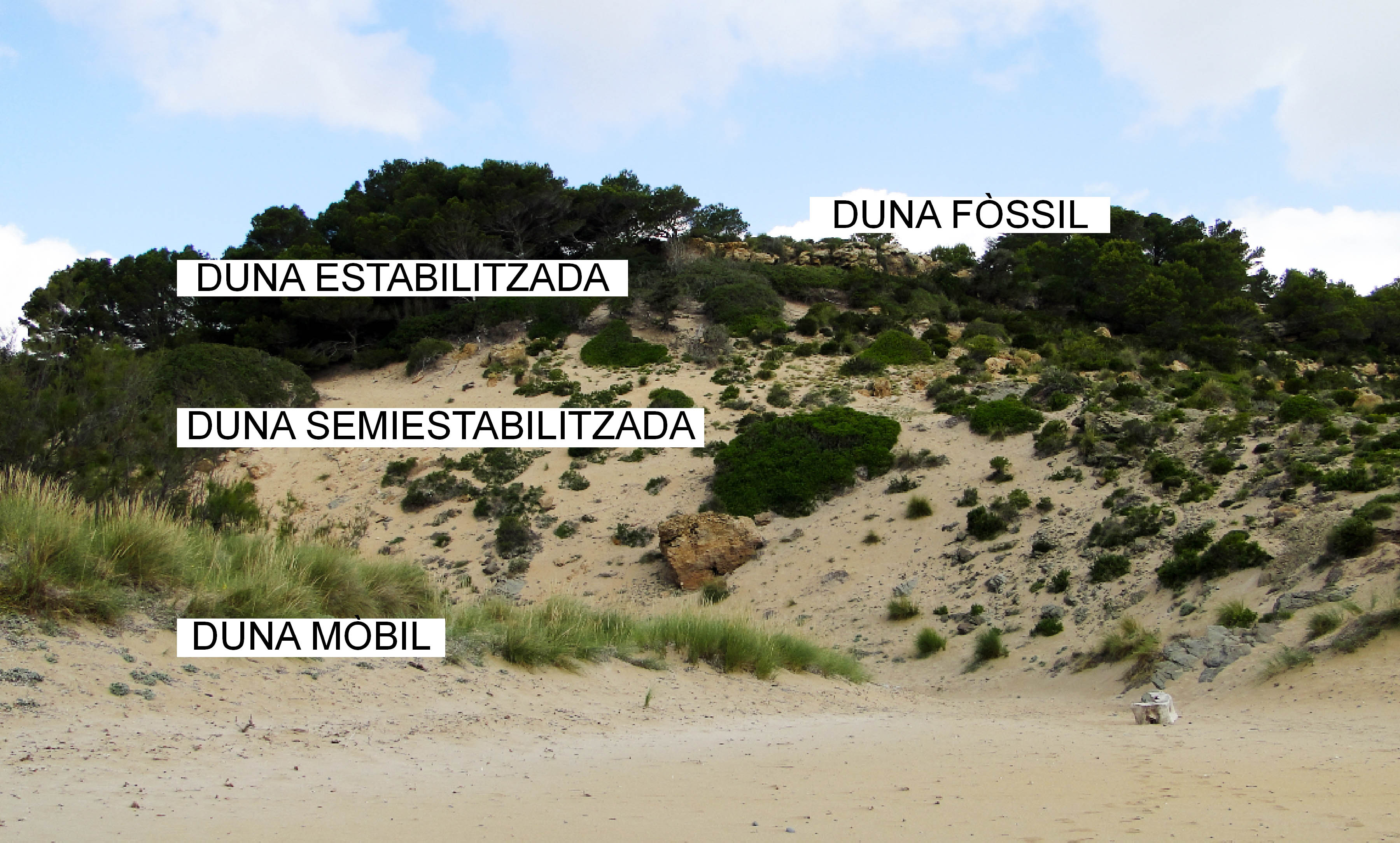
Parts of the dune system at Mongofra-Nou, topped by an ochre-coloured fossil dune from which a number of blocks have fallen off. In the lower part at the edge of the subaerial beach, we can see mobile dunes with marram grass, on top of the semi-stabilised dunes with bush-like vegetation, that then becomes a forest in the area where the dunes have evolved into the stabilised dune.
