Apart from being a very attractive spot, the shoreline of Betlem (Artà) is notable for being one of the places where we can observe one of the most representative geomorphological processes in mountain areas: alluvial fans.
Alluvial fans are essentially deposits of sediments carried by river currents which are deposited or accumulated in the base of a hillside due to an abrupt change of slope. They take their name from morphology that they present: fan or cone shape (they are also named dejection cones).
In the Betlem area, each of the torrents that descend from the mountain range has developed an alluvial fan
<div class="ql-editor"><p>Detritic deposit in the form of a fan or cone deposited by water due to an abrupt reduction in the slope of the surface over which it flows, also named dejection cone.</p></div>">alluvial fan, so we can observe several of them located consecutively. In this case, the fans were originated during the Pleistocene, a little more than 100,000 years ago. Some of them remain active today.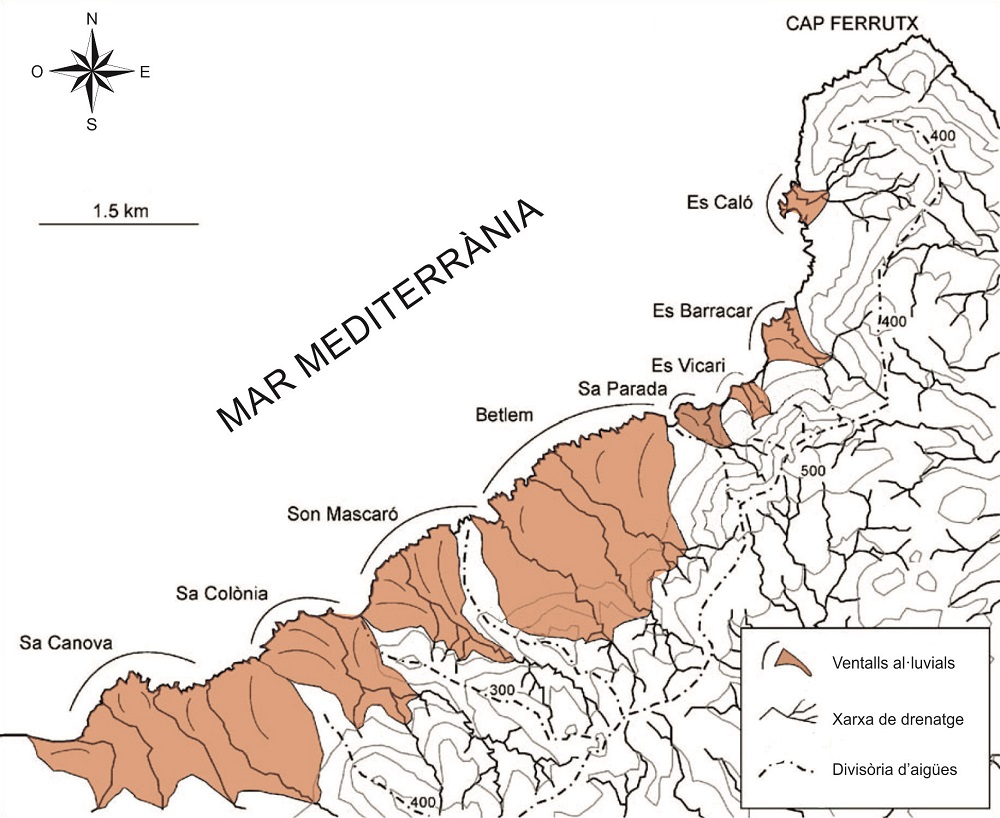
Distribution of the alluvial fans of the Betlem area (modified from Gelabert et al., 2003).
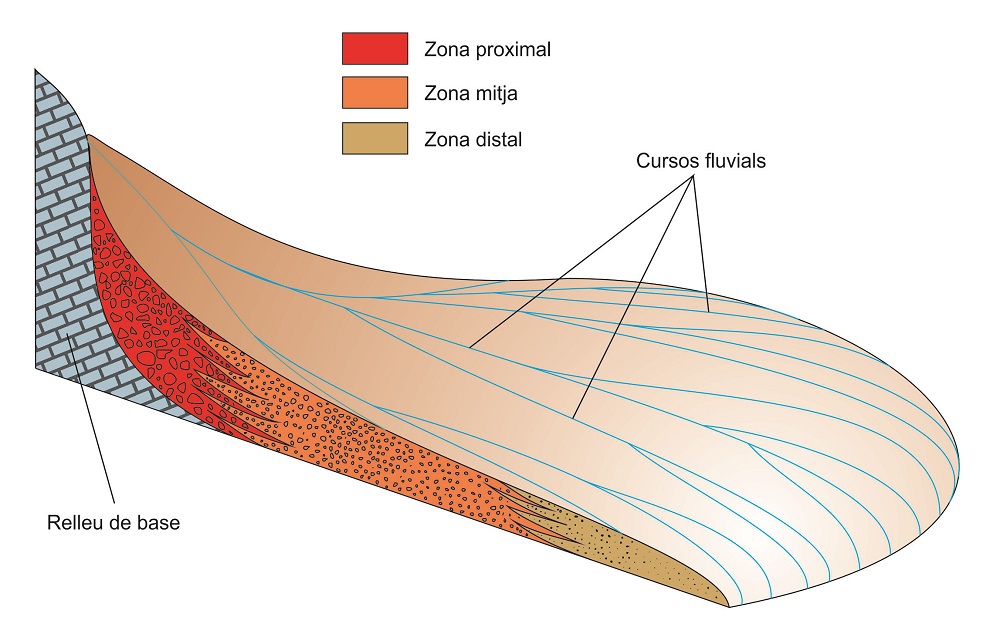
General diagram of an alluvial fan, showing its principal parts.
One common characteristic of the fans is a graduation in the size of sediments. The coarse sediments are deposited in the closest zone to the change of slope (proximal zone) while in the farthest area (distal zone) the sediments are finer. This is because the energy of the currents decreases during their course.
The proximity of the Betlem fans to the sea gives them a characteristic that is uncommon in this type of deposits: the presence of interspersed sediments of beach and dunes, as can be observed in the coastal cliffs.
The beach deposits contain marine and terrestrial fauna, displaying relevant paleontological sites.
Contrary to what may appear at first sight, this variety in the geology of the region is not a chance occurrence but is intimately linked to the evolution of the climate over thousands of years.
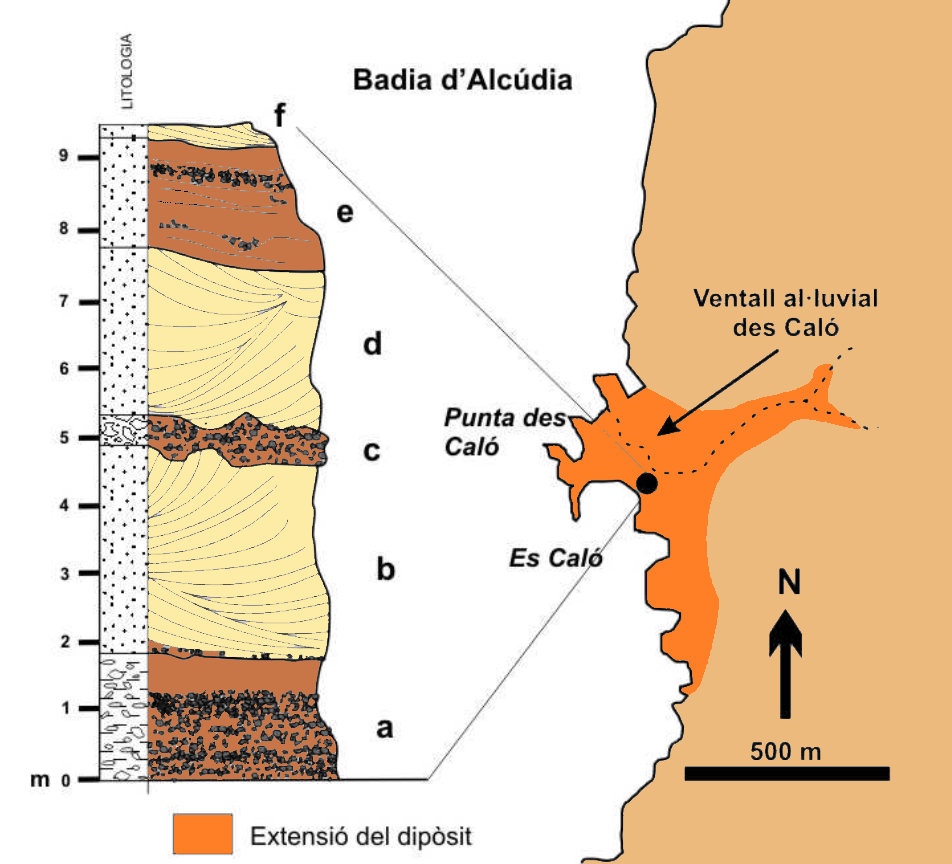
Stratigraphic column of Es Caló fan, showing the alternation of dune levels, in yellow colour, and fluvial, in brown colour (modified from Pomar et al., 2016).
In this respect, during the low-temperature periods, the sea level fell and exposed large extensions of sand on the seabed, which was carried by the wind to the coast, forming dunes. In contrast, in the warm and humid periods, the abundant rains reactivated the alluvial fans, which invaded the dunes. In brief, the present-day morphology of the Betlem shore is a consequence of the evolution of its climate.
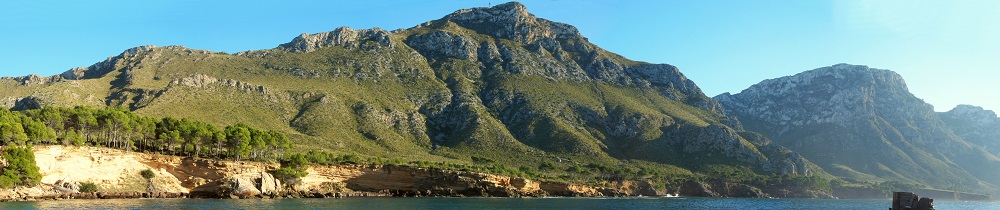
General view of the Betlem shore, showing the abrupt change of slope between the mountain and the coastline.
