The landscape of Cala Morell is strongly influenced by the different types of rocks that make up the cove. In fact, the lithological characteristics of Cala Morell imbue it with highly peculiar traits that set it apart from the other coves in Menorca.
It is here that we find the oldest Miocene sediments in Menorca. These were carried from the high mountains that existed at that time on Menorca by streams, which proved to be catastrophic. At times of severe storms, these fairly short but very steep streams eroded the mountains and could wash away huge boulders that would finally be deposited in Cala Morell and other places around 15 million years ago. They probably came from an area near the present-day Algaiarens and Pilar coves, which not only formed a much more imposing relief but comprised a much more extensive area than the present one.
Of these sediments, a spectacular example has been preserved at Cala Morell. Here, the sediments are in the form of rocks called sedimentary rock of detritic origin (clasts larger than 2 mm).</p></div>">conglomerate, usually formed of large, rounded cobbles of red sand-sized clasts.</p><p><br></p></div>">sandstone and grey dolomites. The energetic action of these streams would be cancelled out by a rise in sea level (some 11 million years ago) which would see an end to the sedimentation of the conglomerates and the start of what is today the island’s most characteristic rock, Miocene sand-sized clasts.</p><p><br></p></div>">sandstone or marès. Looking to the eastern side of the cove, from Punta de s’Elefant, we can see how, on top of the red rocks, other white rocks – marès – can be identified. This observation is much more evident towards the west, in the area known as Cul de sa Ferrada, where we identify the three principal units that make up the Menorcan Miocene series, the sedimentary rock of detritic origin (clasts larger than 2 mm).</p></div>">conglomerate lower, the predominantly calcarenitic middle and the top of reef origin.
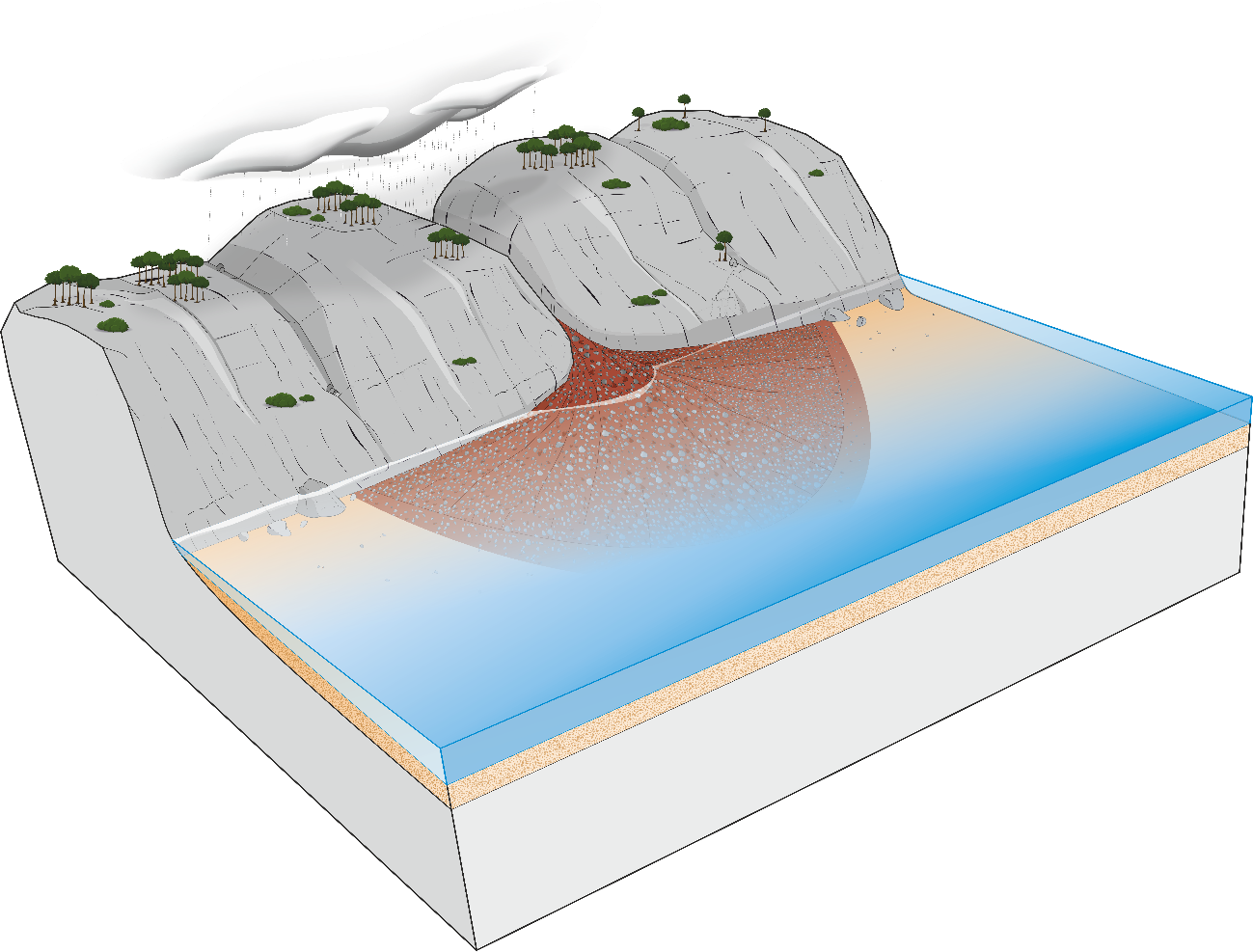
Block diagram representing the area now occupied by Cala Morell during the sedimentation of the conglomerates in the early Miocene. Their accumulation would have occurred in the form of alluvial fans in the distal part of the streams that were set into the mountains of the Tramuntana region. Many of them would flow directly into the sea where they were affected by the waves, as can be seen in the sedimentary structures and the holed cobbles typical of signs of biological erosion.
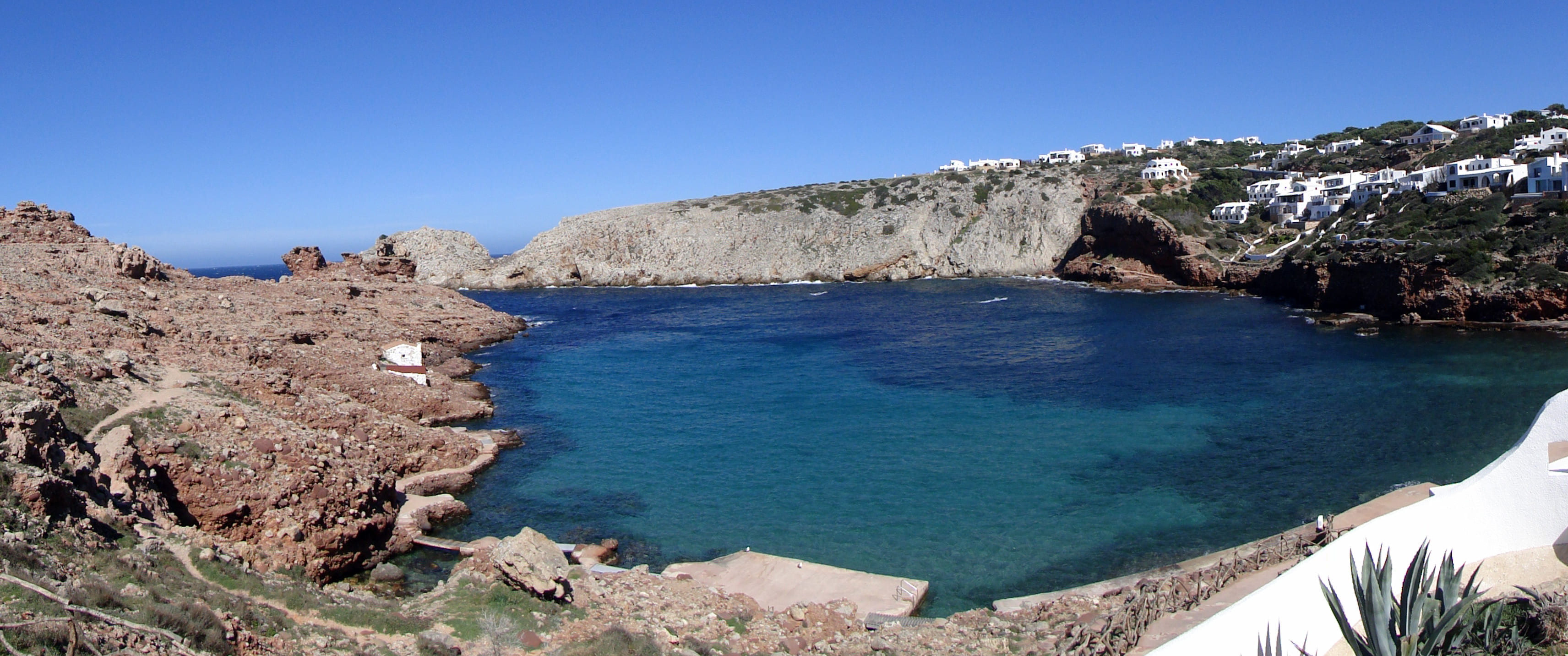
Panoramic view of Cala Morell: Miocene conglomerates, predominantly red on the left (Punta Campanar or de s’Elefant) and Jurassic dolomites on the right, abruptly cut by the conglomerates that we find on Punta Campanar. Above these, where we can see a number of villas, is the Miocene sandstone or marès.
Some of the grey cobbles are significantly holed. These holes were made by marine animals, such as sponges or date mussels, which indicates that these rocks must have been deposited in Cala Morell, on the seabed at a shallow depth. Also, we should remember that when they reached Cala Morell, the cobbles were not round, instead it was the force of the sea that rounded them. Consequently, the tumbling of the cobbles caused by the action of the waves eroded them and gave them the characteristic shapes we see today.
The composition of the conglomerates enables us to deduce clearly two areas of different provenance: Permian-Triassic (dominant red cobbles) and Jurassic (grey). Depending on their provenance, the conglomerates display different degrees of roundness and size (the largest red cobbles can reach around 4 m in maximum diameter).
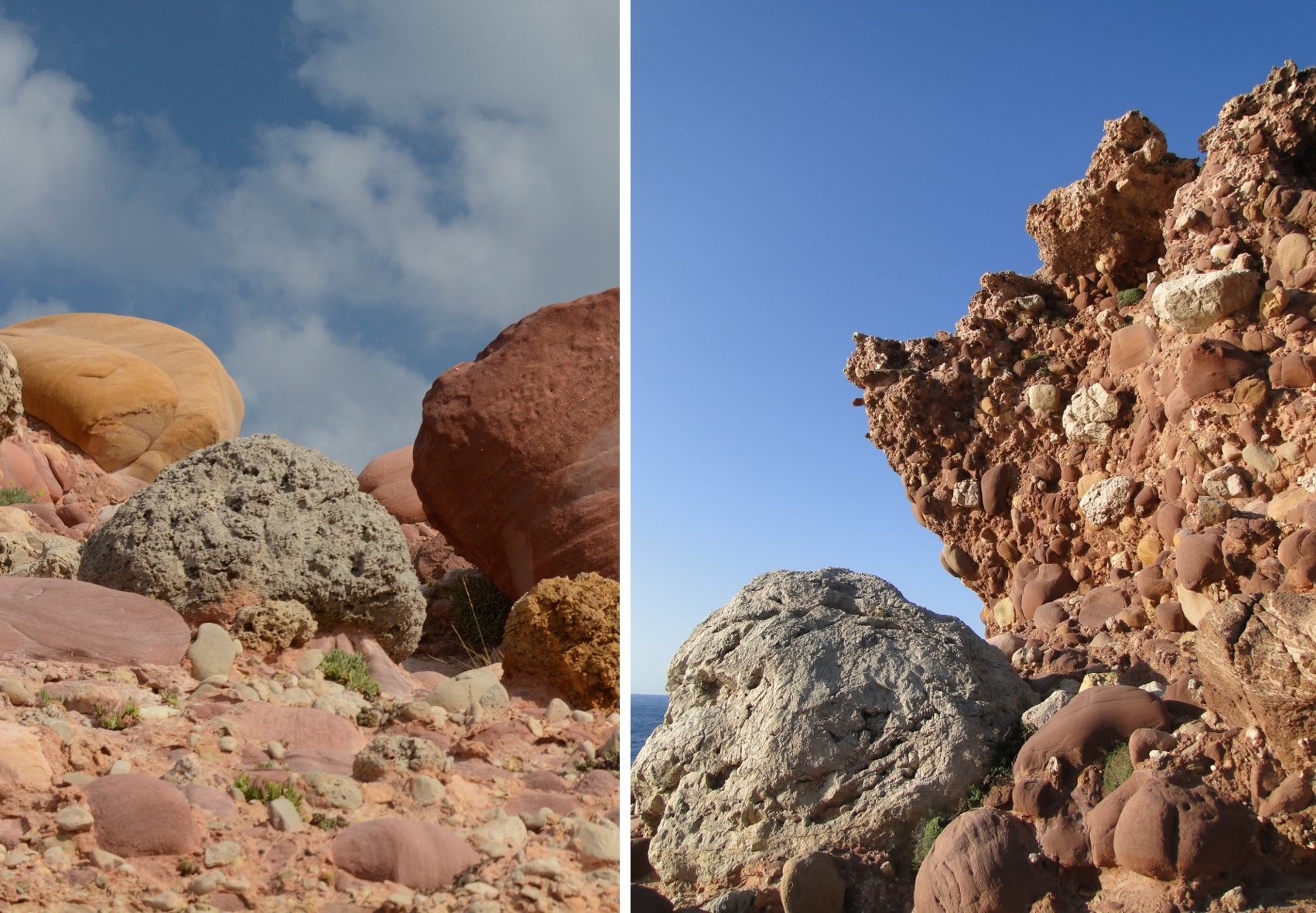
The cobbles that make up the conglomerates in Cala Morell display different colourations even though they come from the erosion of two types of rock: sandstone (red) and dolomites (grey). Close up, we see that dolomite cobbles are frequently holed by the action of marine organisms that lived in Menorca millions of years ago.
In the east of the cove, the red conglomerates are abruptly cut by older grey rocks called dolomites. They represent the contact between the two geological regions into which the island is divided, the grey dolomites of the Jurassic (Tramuntana) come into contact with the conglomerates and the marès of the Miocene (Migjorn). It is interpreted that these rocks are together due to the action of a fault and mean a leap in time of some 165 million years.
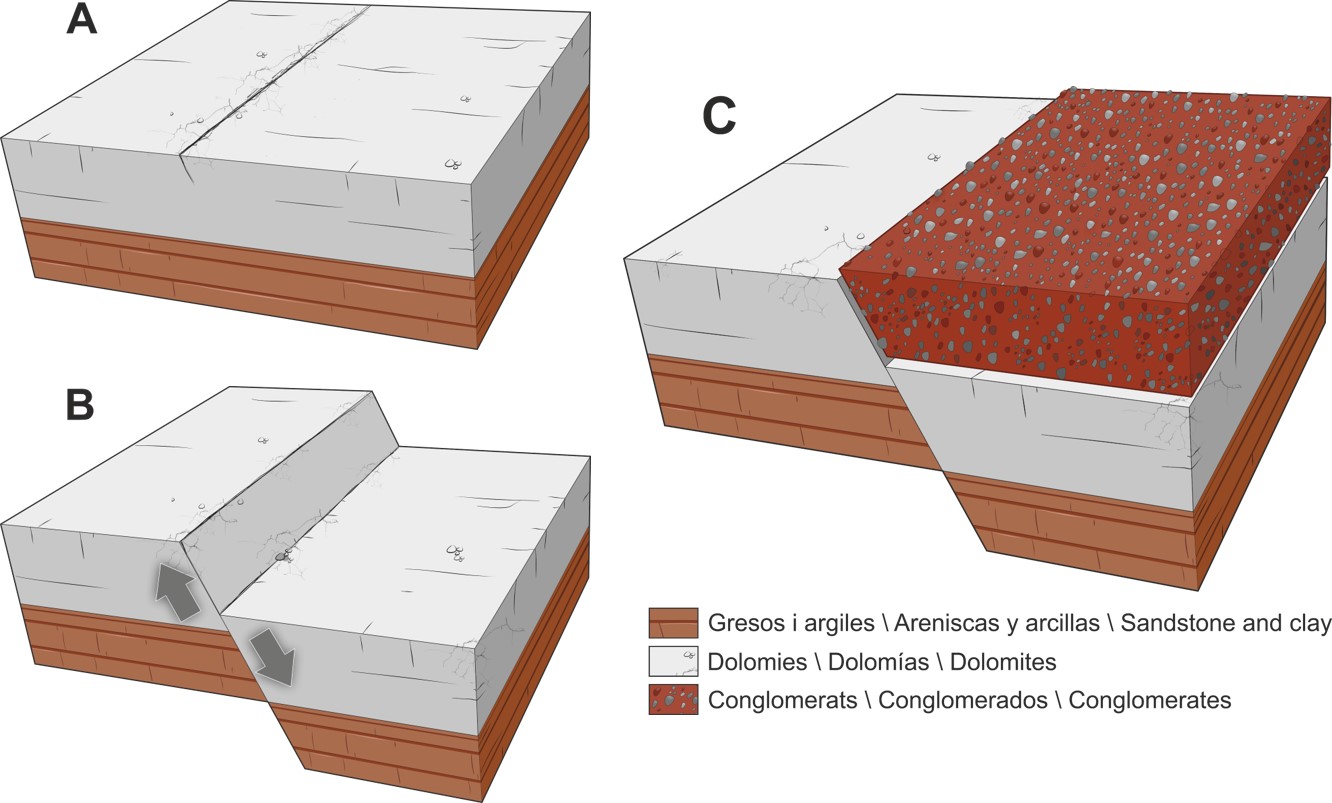
The presence of a large fracture in the dolomites (A) caused part of these grey rocks to sink (B). Subsequently, the gap resulting from this sinking would be filled by sediments washed here by streams and, over time, would lead to the conglomerates of Cala Morell (C).
Finally, we should also highlight that near the fault contact, on the eastern side of the cove, are outcrops of the remains of an old Quaternary age beach (around 130,000 years old).
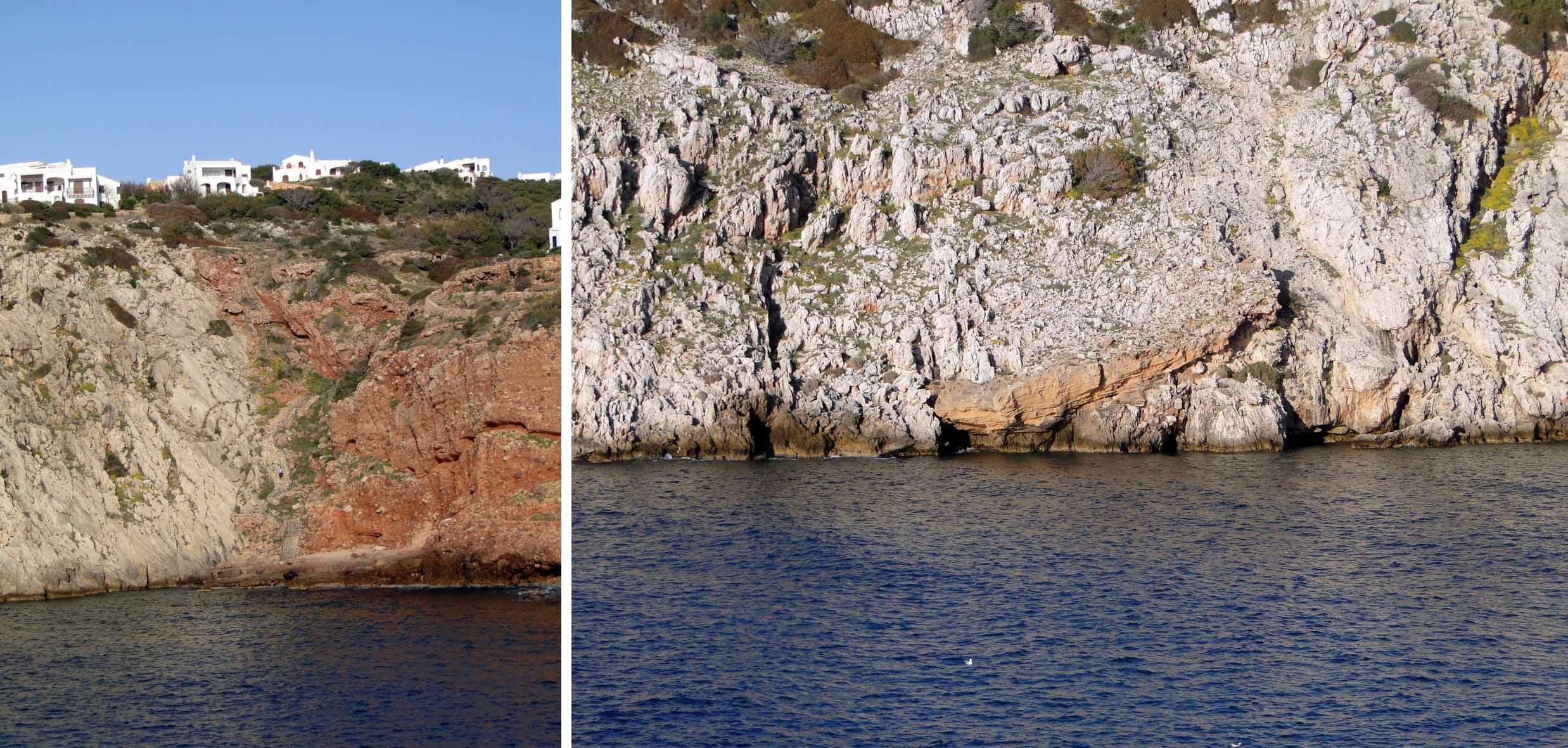
Close-up of the Cala Morell fault and the old beach sedimented during the Quaternary with ochre colourations, today forming a rock that we also know by the name of marès.
