Most of Mallorca’s mountains are formed by carbonated rocks. This type of rocks undergo a process of dissolution due to the action of rainwater which gives rise to a special type of landscape, with a predominance of caves, sinkholes and dolines, named Karst.
One of the most spectacular karsts in the Balearics can be seen in the vicinity of the Sanctuary of Lluc, developed in conglomerates of the Lower Miocene (23-16 Ma).
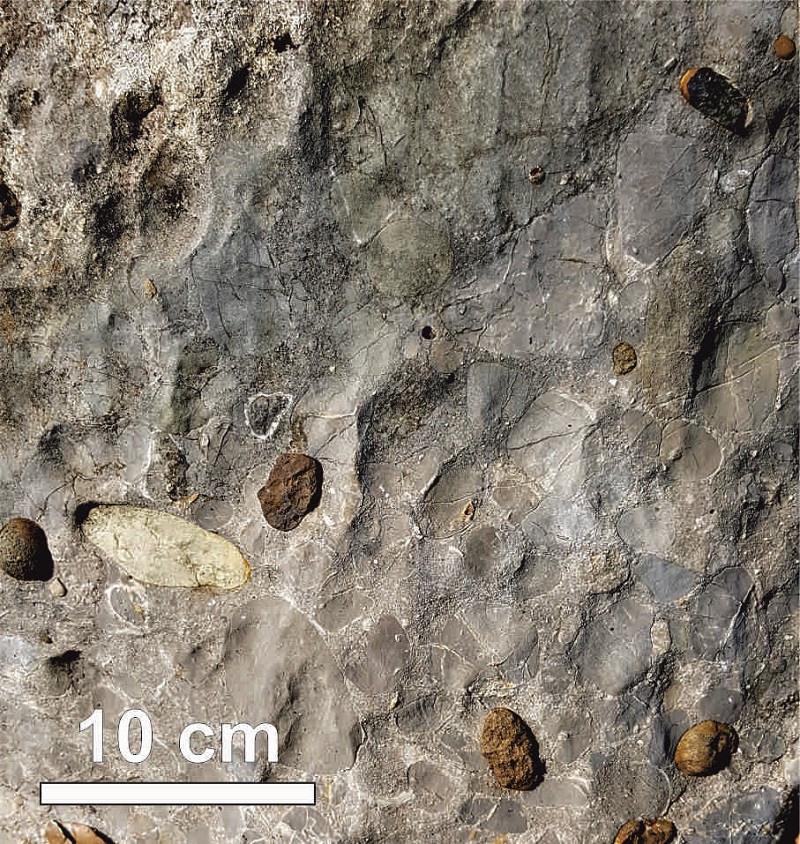
Detail of the Lower Miocene conglomerates of Lluc. Note how the non-carbonatic clasts barely dissolve and therefore maintain their relief in the rock.
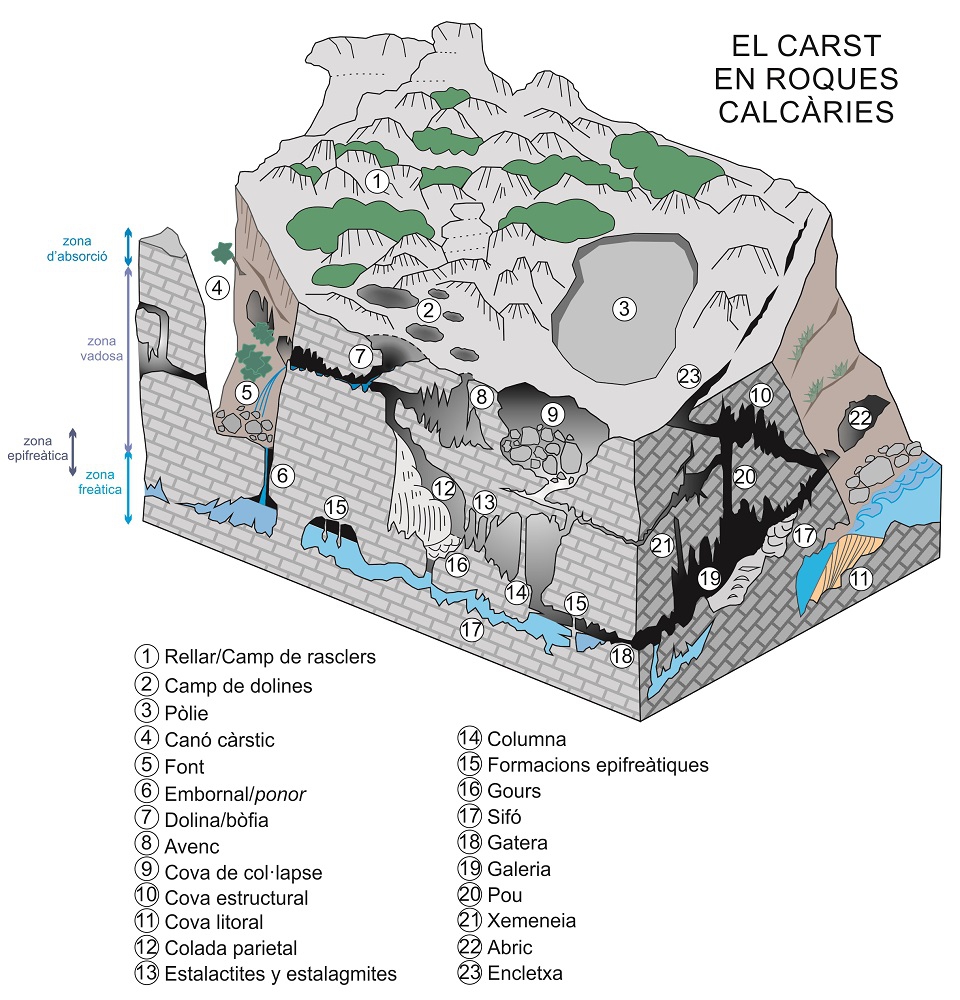
Within the karst it is possible to distinguish between the exokarst, developed on the surface, and the endokarst, developed underground. The exokarst includes the pinnacles, pavements, dolines, poljes and karstic canyons, while the endokarst contains the sinkholes, caves and all the speleothems.
In the vicinity of Lluc the exokarst is very developed, with abundant and varied forms of superficial dissolution, that receive the name of karren. These usually appear associated, forming what are called karren fields.
Although water is the principal active agent in the development of the karren, the factors which delimit it are very complex and depend closely on the local ecological and climatic conditions. In the Serra de Tramuntana, the karren generally appears between 200 and 600 metres of altitude.
We can see several types of karren in the Bosc de ses Monges, close to the monastery.
The largest channels are called rinnenkarren, and associated with them are rillenkarren, which are also dissolution channels but at a smaller scale and are commonly excavated in the elevations situated between the rinnenkarren. If the dissolution is in a meander form, the channels are called mäanderkarren..
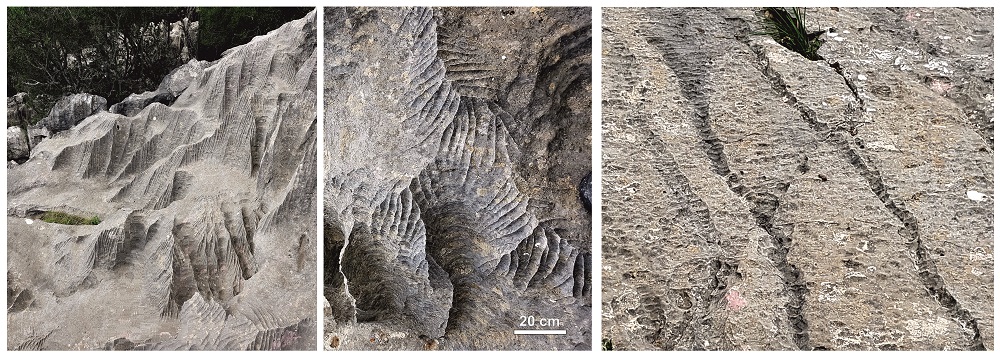
Panoramic view of a series of rinnenkarren (left). Detail of these, showing the rillenkarren developed from the elevations of the rinnankarren (centre). Channels with meander form or mäanderkarren (right).
Other characteristic morphologies in Lluc are the trittkarren, which the rock affected by karstification present a scaled cross-section. When the rocky substrate displays fractures, around them develops a weakness zone which is much more prone to dissolution, with the result that the crack widens and its edges become rounded. This type of pattern is called kluftkarren.
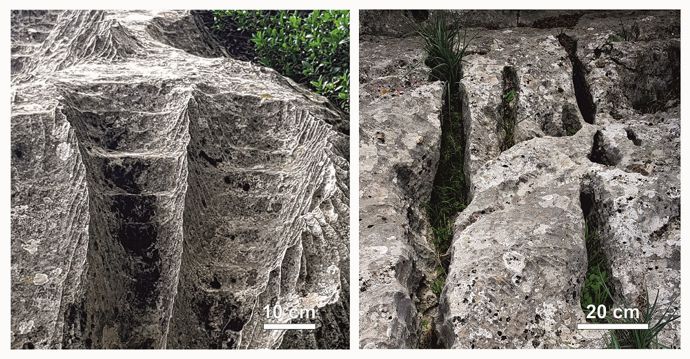
Left, scaled shapes typical of trittkarren. Right, kluftkarren developed in a system of parallel fractures.
With time, the dissolution of the rock generates large isolated forms called spitzkarren. Pinnacles correspond to this type of form. When these are very abundant, as in the case of the Lluc area, we speak of karst o pinnacles.
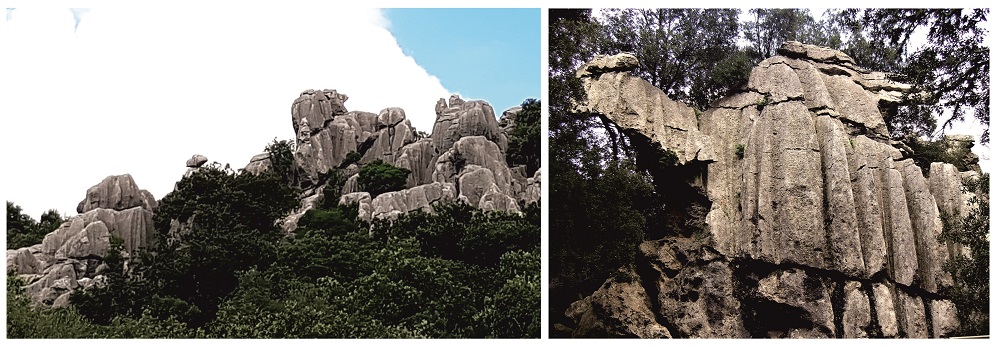
Series of karstic pinnacles in the zone of the Bosc de ses Monges (left). The most emblematic pinnacle of all: Es Camell (right).
In this zone it is also possible to see larger karstic forms like chasm, vertical cavities generally developed through fractures in the rock, and dolines, round or oval depressions of the land.
A good example of a subsidence doline).</p><p><br></p></div>">doline is Sa Cometa des Morts. Its sinkhole (ponor) corresponds to a cavity developed from the union of two large fractures in the rock, perpendicular to each other, called Cave of Sa Cometa des Morts. In addition to being a structural cave, is an archaeological site where prehistoric burial traces were found.
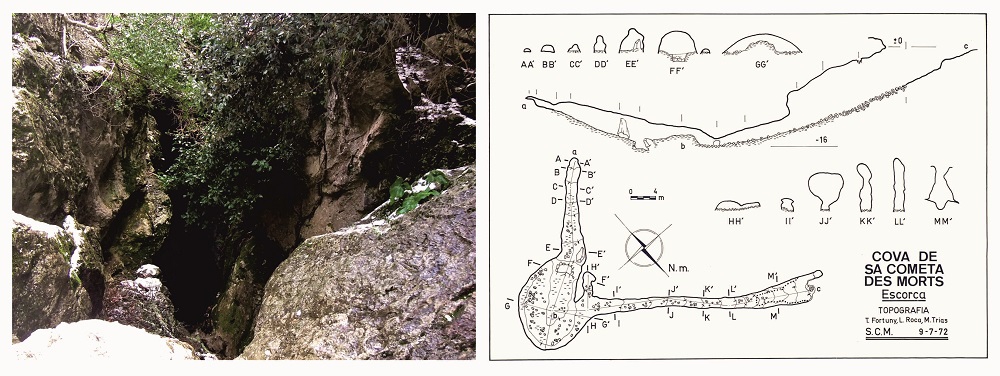
View of the entrance to the cave of Sa Cometa des Morts (left) and its topography (right).
Sometimes the dissolution processes give rise to a closed depression of large dimensions (usually kilometric) with a flat bottom and steep walls, called a polje. A good example is the Clot d’Aubarca, which can be viewed from the cross of Lluc.
The morphology of this type of structures, in the form of a basin, favours the accumulation of sediments and water inside them, thus facilitating agricultural exploitation of the land.
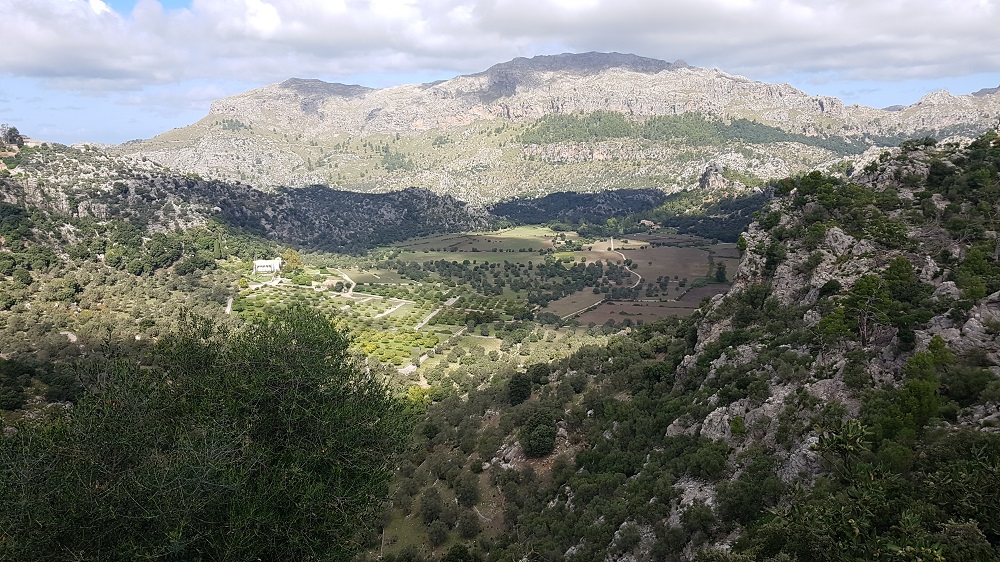
View of the Clot d’Aubarca from the cross of the sanctuary of Lluc.
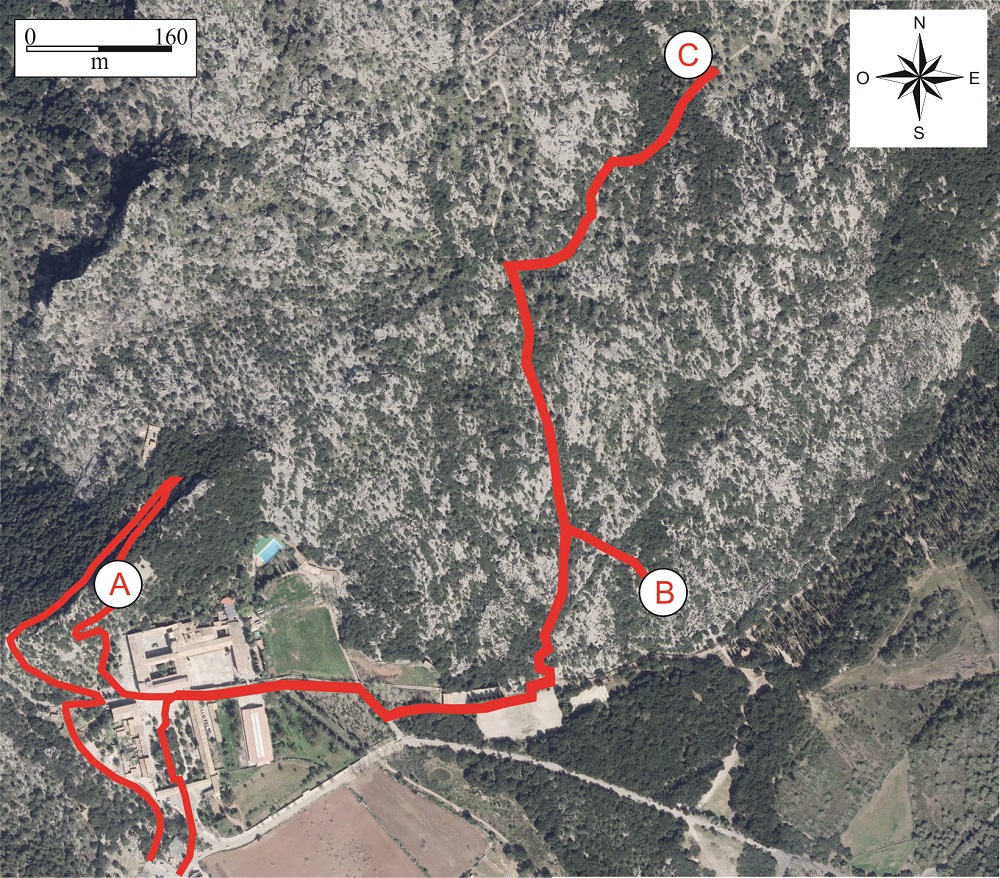
Orthophoto with the proposed itinerary for observing the geological features explained above. A) Viewpoint at the Clot d’Aubarca, visible to the north-east. B) Es Camell, the most emblematic element of the Bosc de ses Bruixes. C) The Cometa des Morts.
