| UTM-X | UTM-Y | ||
|---|---|---|---|
| STOP 1: THE QUATERNARY OF CALA SALADA | |||
| STOP 2: FOSSILIFEROUS LIMESTONE OF THE CRETACEOUS PERIOD | |||
| STOP 3: SA FORADADA ROCK BRIDGE | |||
| STOP 4: COVA ESTRUCTURAL DES VI | |||
| STOP 5: PUIG NUNÓ |
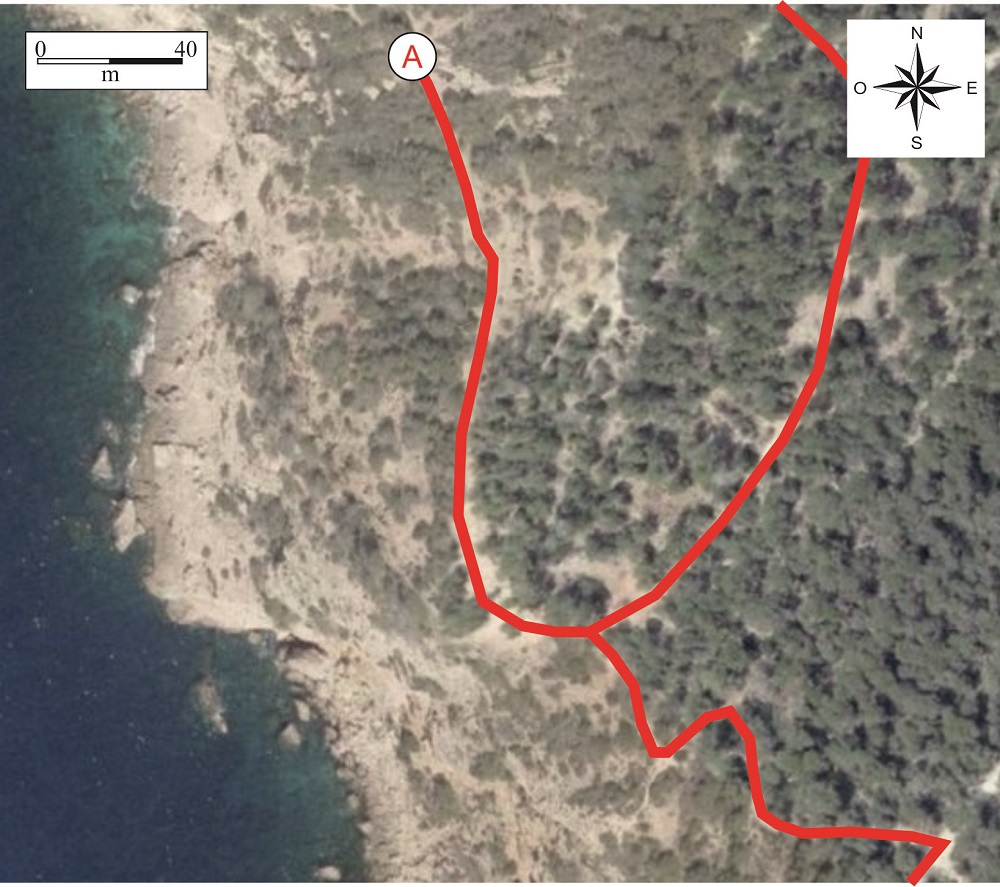
Recommended route in the Ses Fontanelles area.
In the Ses Fontanelles area we find the well-known “Cova des Vi”, or “de Ses Fontanelles” as it is named on the area. Geologically, it is a cave located just on the contact point between a carbonated unit which provides steep reliefs and an easily eroded Sedimentary rock composed of clay rich in calcium carbonate. </p></div>">marl unit forming the more gentle morphology.
The ceiling of the cave is formed by a smooth rocky surface that, according to the IGME geological cartographies, it corresponds to a thrust that makes the carbonated rocky substrate slide over the Sedimentary rock composed of clay rich in calcium carbonate. </p></div>">marl (1).
Later the rainwater, little by little, eliminates the Sedimentary rock composed of clay rich in calcium carbonate. </p></div>">marl existing between the two materials and leaves the fault plane of the rocky, more resistant substrate exposed (2).
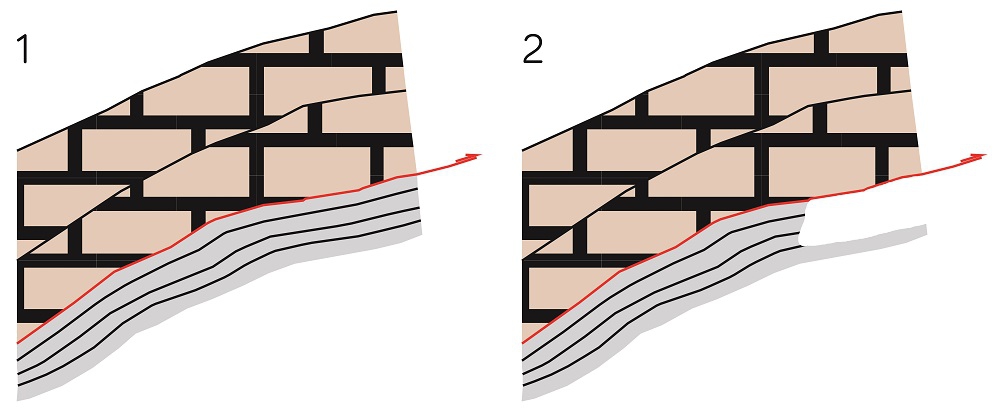
Reconstruction of the formation of the Des Vi structural cave.
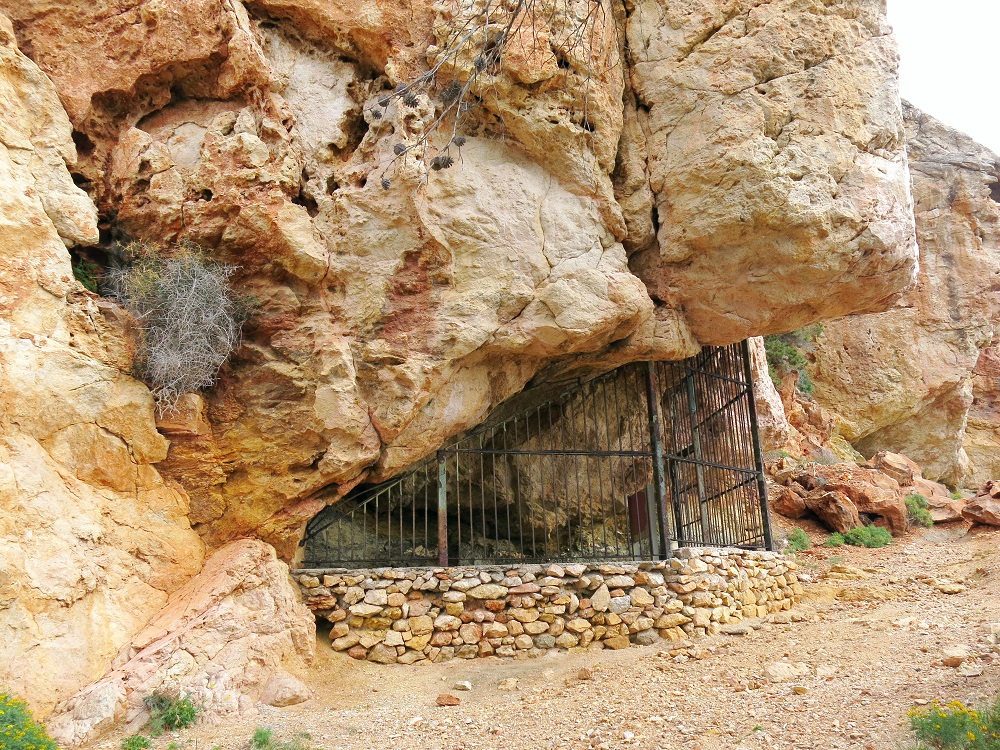
Cova des Vi where the fault plane corresponds with the cave ceiling.
As well as being geologically interesting, Cova des Vi also has an archaeological past worth mentioning. If you look carefully at the ceiling of the cave you can observe rock paintings dated from the Bronze age (1000 years BC) according to the archaeologist Henri Breuil, who discovered them in 1917. They are representations of rowing boats.
The name “Cova des Vi” comes from its use as a cellar to store wine.
