In Cala Bóquer there are outcrops of materials of the Lower Miocene (25-16 Ma) folded by the formation of the Tramuntana Range during the Alpine Orogeny. They give rise a type of tectonic structure named overturned syncline, very common in the Tramuntana Range, of which one of the best examples is Cala Bóquer.
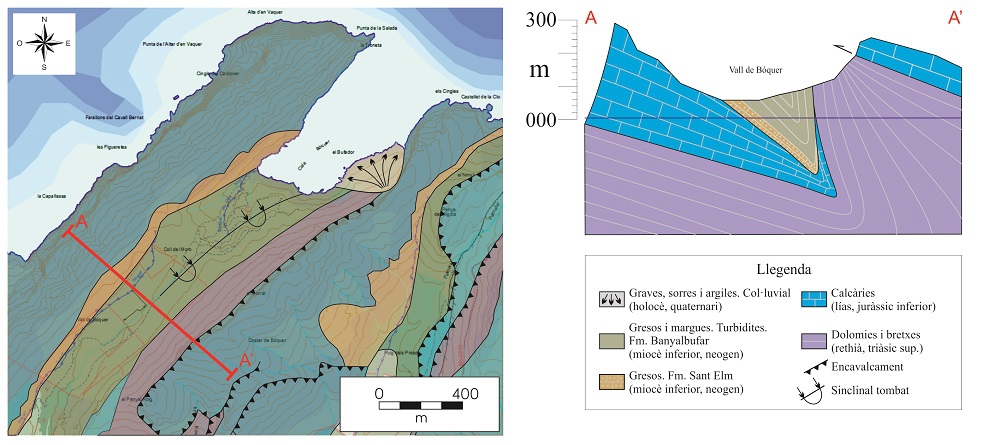
Map and geological cross-section of Cala Bóquer (modified from Gelabert, 1998).
A syncline is a type of fold in which the most modern materials are in its nucleus while the oldest materials appear in its periphery. As can be seen in the geological cross-section, in this case the axial plane (which divides the fold into two symmetrical parts) is inclined, so the syncline is called “overturned”.
At Cala Bóquer we can go through the syncline almost entirety.
As we reach the cove, we see on the left some large rocky plaques of laminated appearance. They correspond to rocks formed by cemented sands, called calcarenites, and they show ripples on the surface.
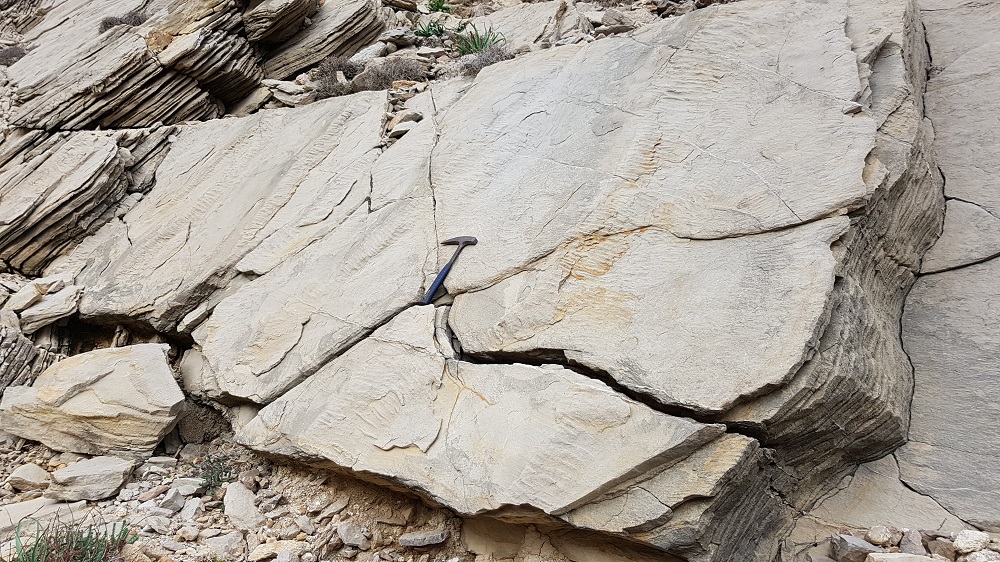
Detail of the ripples showed on calcarenites surface (Sant Elm Formation).
This sandy sediments were deposited due to a rise of the sea level during the Lower Miocene and correspond to the Sant Elm Formation. They are materials originating from the emerged zones that were deposited in shallow coastal areas (origin of ripples).
If we continue southwards along the shore (to the right), we will observe an alternation of rocky layers of yellowish-ochre colour and dark grey clayey layers. This is the Banyalbufar Formation, composed of an alternation of layers of light brown calcarenites, with ondulated laminations, and dark grey marls. These correspond to a type of deposit called turbidites.
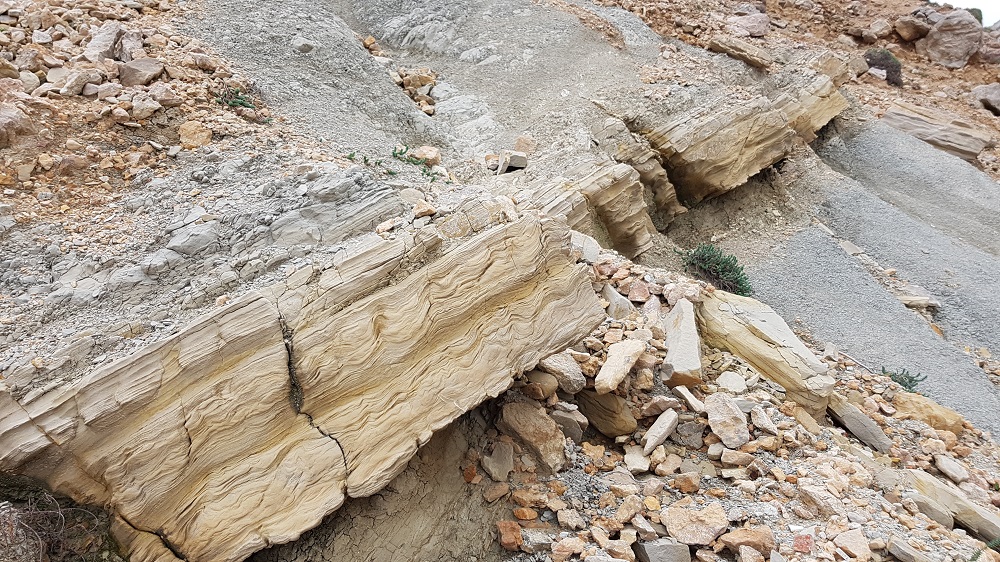
Detail of the ondulated lamination of the turbiditic calcarenites of the Banyalbufar Formation.
These materials were deposited in the Middle Miocene, approximately 16 Ma ago, when a general sinking of the zone occurred and the sedimentation takes place at great depth.
Turbidites are a type of deposit formed by successive avalanches of materials in underwater canyons, usually caused by tectonic activity.
They generally correspond to rhythmic deposits with an abundance of fine materials (marls) which alternate with coarse materials (sandstones).

Structure of the limit of the continental shelf, where turbidites originate.
The layers of a fold can often present, in turn, deformations at a lower scale and small faults and joints. A good example of this is the famous box-shaped fold and the vertical layers that can be observed at the south-east end of the cove.
These layers, which appear to be piled up, do not correspond to the stratification but are due to a system of fractures perpendicular to it. Due to the circulation of water through the fractures in their surface, a fine layer of crystallised calcite has formed.
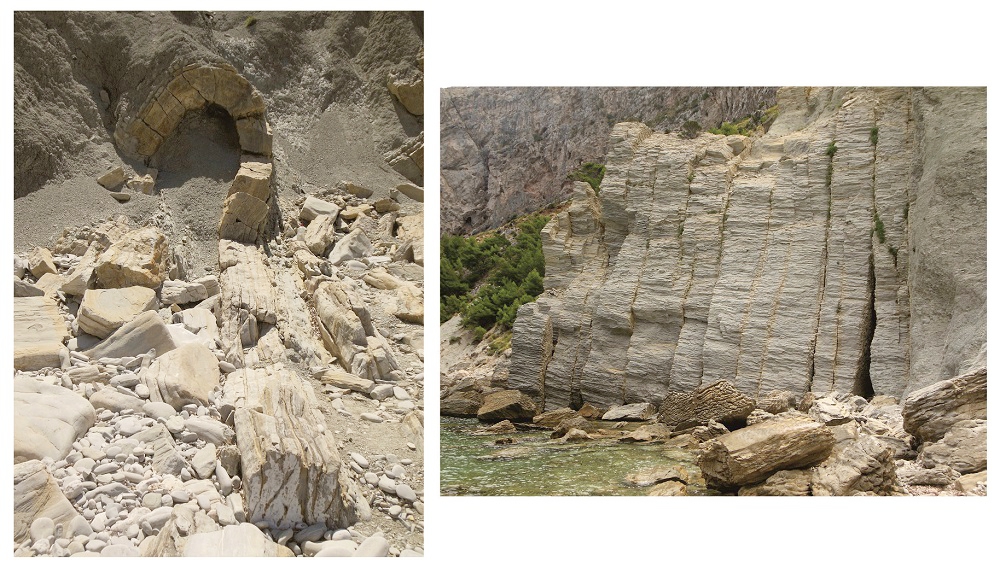
Box-shaped fold and series of vertical layers in the southern flank of the syncline.
In this same area, on the surface of some vertical strata, it is possible to observe bioturbations due to the activity of organisms that lived in the turbiditic sediments.
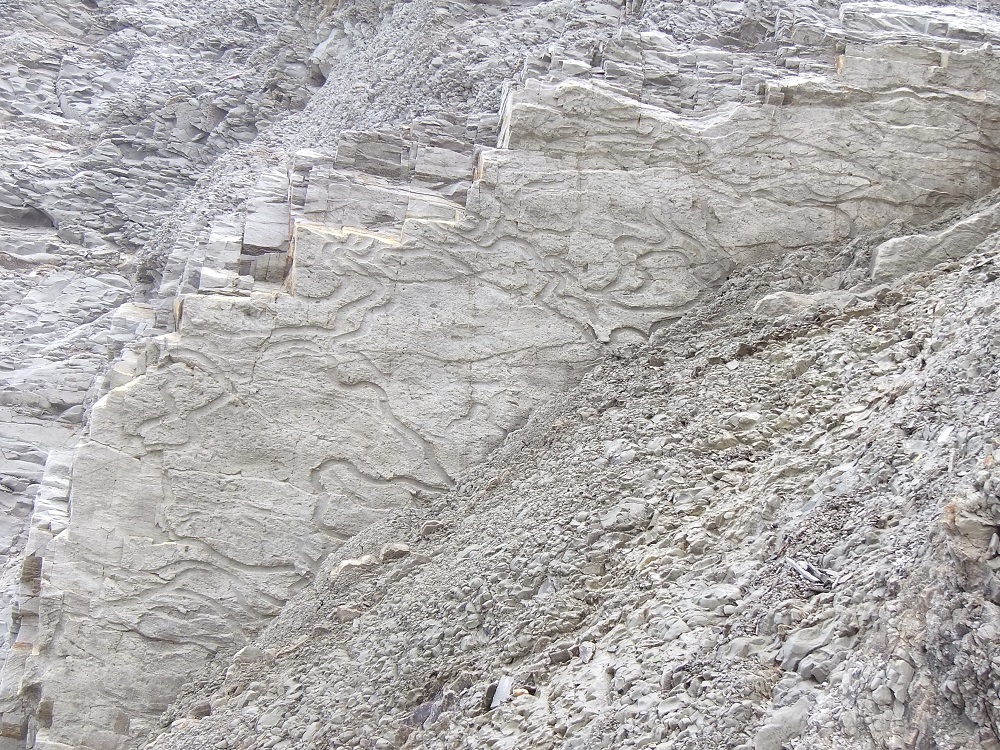
Detail of traces left by the activity of organisms in the turbidites.
