Cap de Favàritx headland is one of the sites of geological interest that lie within the S’Albufera des Grau Natural Park. It is a unique area due to the quality of the outcrops, there is no cover of any type and the salinization of the surface of the rocks does not allow any noteworthy vegetation to grow, allowing the rock to shine in all its splendour.
Cap de Favàritx comprises layers of thick-grained sandstones and microconglomerates, which measure in excess of 5 metres thick and are interleaved with other slate-like rocks, known locally as lloselles. The thicker and consequently more resistant sandstones and conglomerates have prevailed over erosion, leading to the formation of an overhang that is the headland.

General view towards Cap de Favàritx with the lighthouse in the distance. To its left, are the thick-grained, hard-wearing sandstones; to the right, at the water’s edge, and also at the Cos des Síndic temporary pool, the softer llosella presents a flatter relief.
The materials that comprise the headland belong to the lowest part of the powerful Carboniferous series, which outcrops at the northeastern tip of the island and which is made up of turbidites:
A great avenue of a river whose mouth is close to the start of an underwater canyon may cause sediments to drop suddenly to the great sea depths. Even a slight earthquake may cause a mass fall of sediments deposited originally on the continental shelf near the talus and some instability. In both cases, the sediments fall very quickly taking advantage of the slope of the underwater canyon or of the talus in the form of a turbulent current, creating an avalanche of different types of sediments and water that accelerate as they fall downwards while separating from the seawater as a current of turbulent water.
When the sediments reach the abyssal plain, they start to slow down and the turbulent current gradually releases the sedimentary fractions as it no longer has the strength to keep them in suspension, in other words, it can no longer transport them. Consequently, it will first deposit the thicker particles and then the finer ones. Repetition of the event leads to a turbidite series. Over time, the thicker particles will form a rock that we call sedimentary rock of detritic origin (clasts larger than 2 mm).</p></div>">conglomerate (or if the cobbles are small, we call it ‘microconglomerate’), the intermediary particles will form another type of rock that we call sand-sized clasts.</p><p><br></p></div>">sandstone and the finer particles will form the sedimentary rock which tends to exfoliate in small flakes, similar to sedimentary rock formed by clay.</p></div>">pelite. </p></div>">llosella.
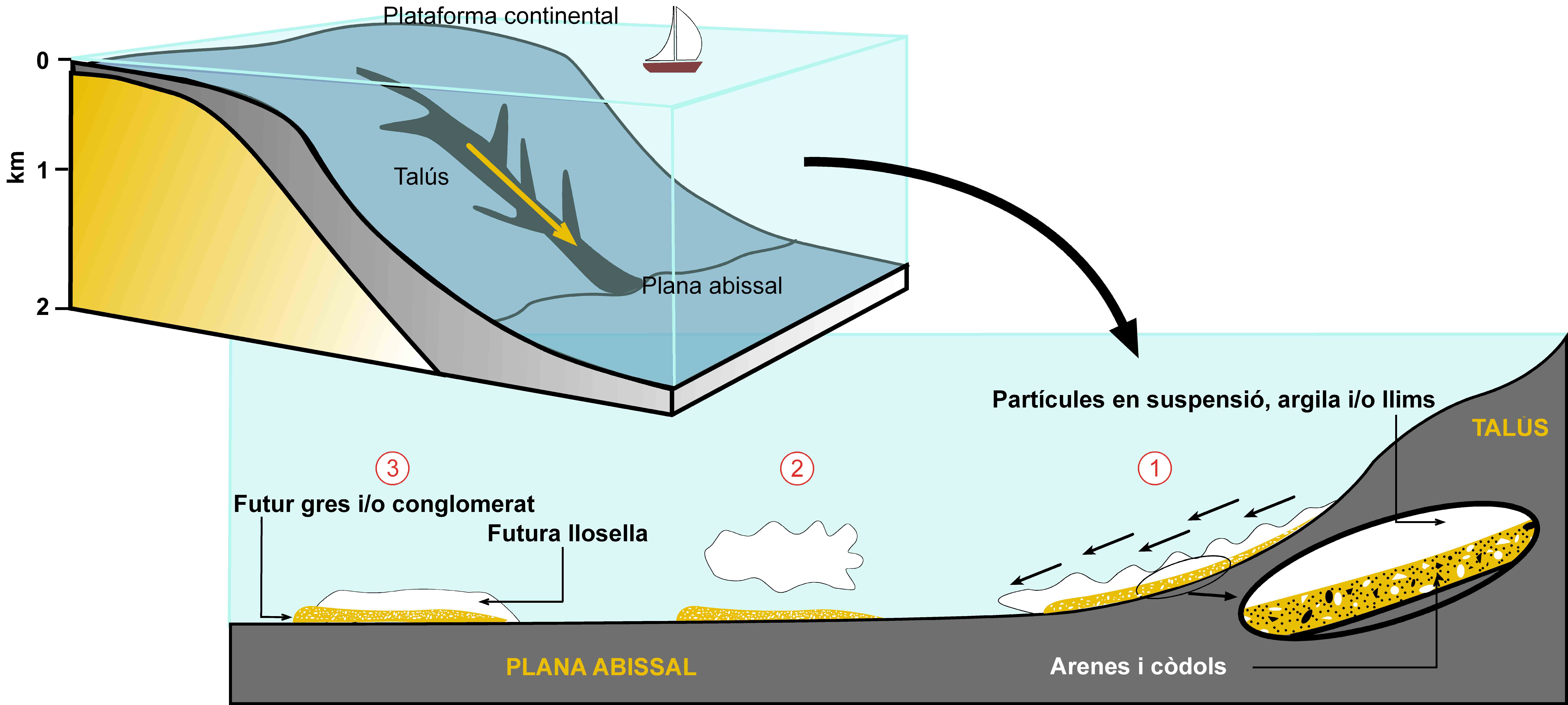
Diagram of the structure of the ocean floor comprising three parts (shelf, talus and abyssal plain) and of the formation of the turbidite strata; turbulent current that falls down the slope at great speed (1). It decelerates when it reaches the abyssal plain, causing sedimentation of the thick particles first (sand and cobbles), with the finer particles still in suspension (clay and silts) (2), and subsequently sedimentation of the fine particles (3). Over time, the thick particles form conglomerates and sandstones, while the fine particles form lloselles.
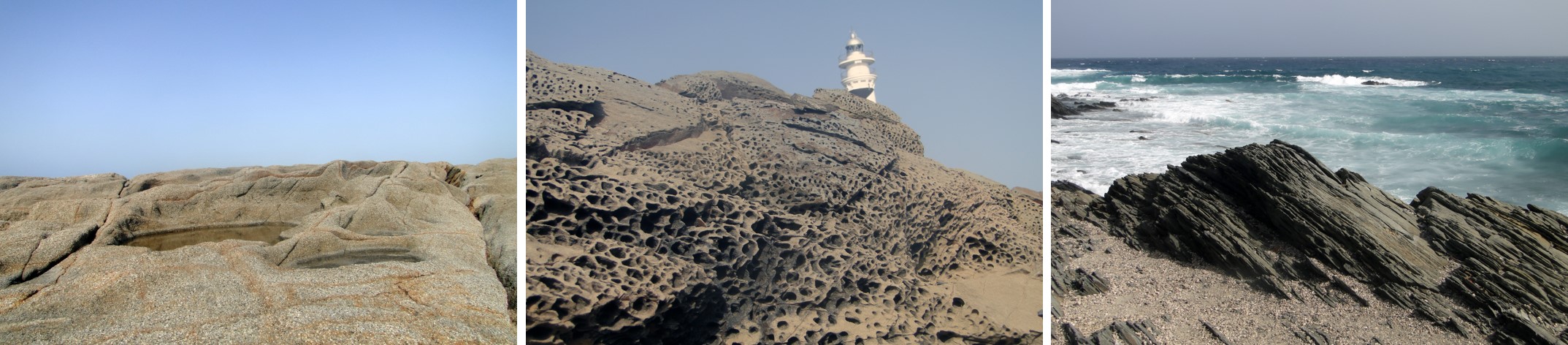
Examples of microconglomerates, sandstones and lloselles at Favàritx. Sandstones often have alveolar or honeycomb erosion. Very often these shapes are caused by the corrosive action of salt on the sandstones and due to the uneven distribution of the cement that binds the rock particles. Erosion “drills away” at the softest points, the ones with less cement, or softer grains, which it makes jump and create cavities. On the harder parts, it sometimes leaves small protrusions, points with higher levels of cement.
Sandstones and microconglomerates have grooved bodies that are interleaved with overflow deposits that correspond mainly to lloselles. They are massive and resistant to erosion and we do not normally detect any lloselles layers between them, the presence of this rock is only observed as soft cobbles.
Thick grain layers are sometimes observed in amalgamated layers (layers of mixed grains of different sizes) and pseudonodules. For example, in cases where we find a layer of microconglomerates on top of a layer of sandstones, the latter may include fragments of isolated microconglomerates in the form of pseudonodules, created by the carrying effect of the overlying microconglomerate, when these had not yet consolidated.
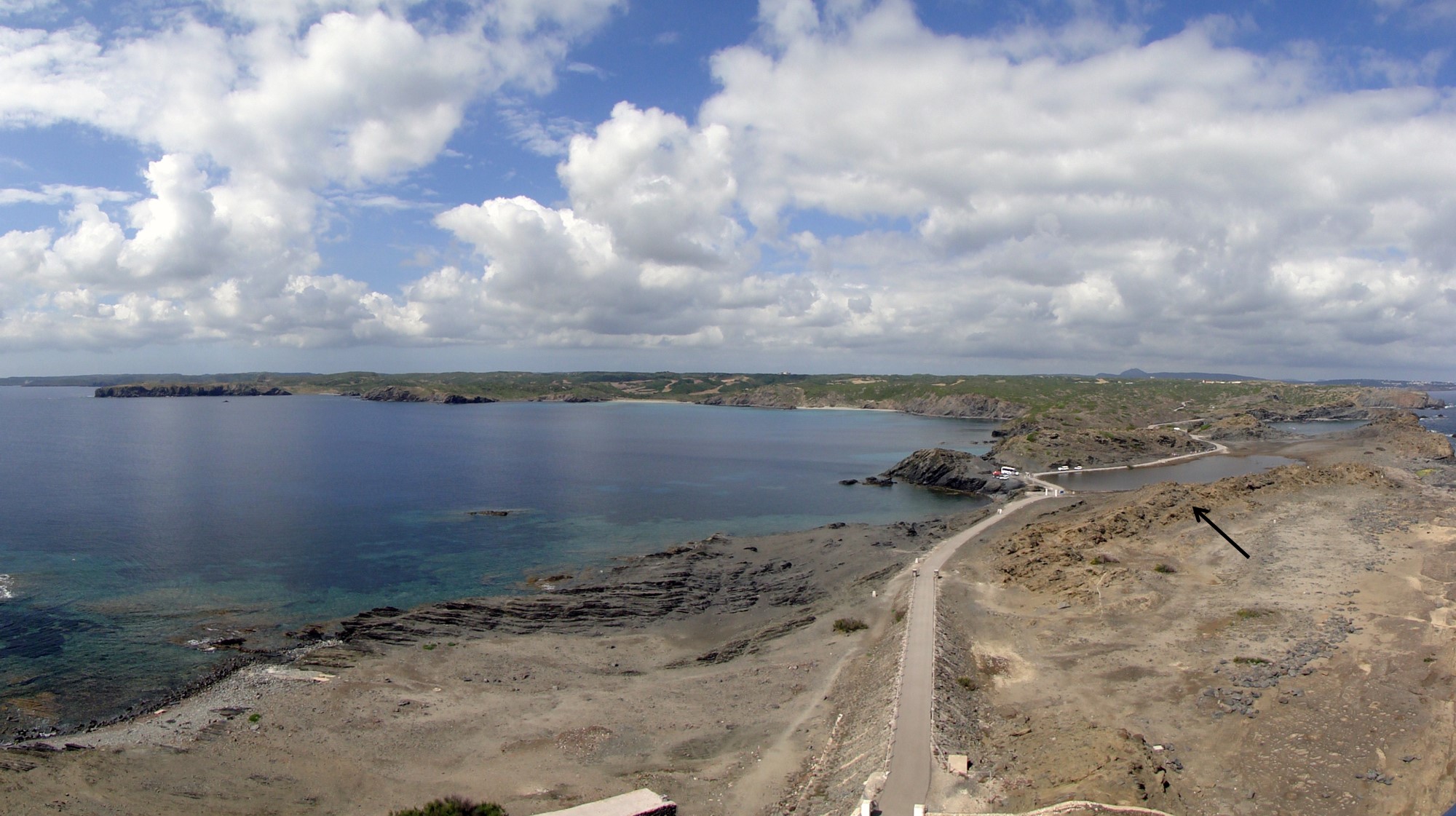
Panoramic view from the Favàritx lighthouse. The arrow indicates one of the bodies of layers of grooved coarse-grained sandstones between the lloselles.
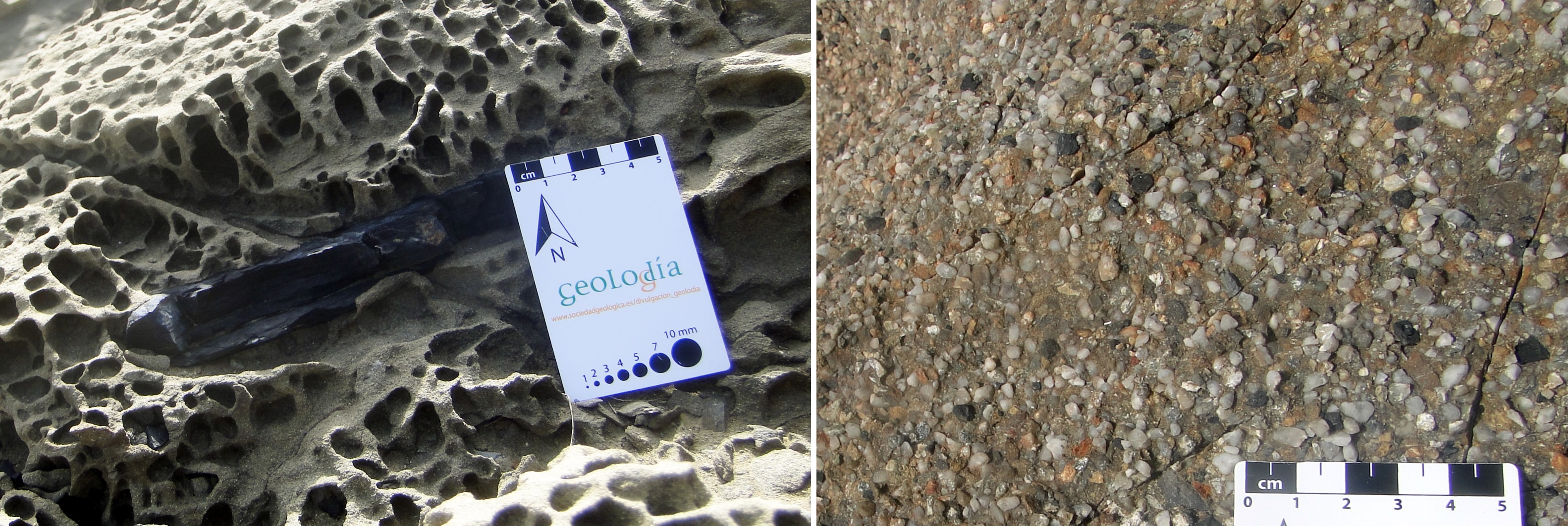
Close-up of a soft llosella cobble inside a sandstone with honeycomb erosion and a microconglomerate where we can clearly see the minerals that make up the rock.
These layers show no internal organisation, they only display a certain large grain grading. In some cases, after sedimentation of the material, the layers have been affected by traction, in other words, by being dragged by the subsequent turbulent currents, which have led to large-scale cross-stratifications. This type of stratification has also been detected on a small scale and is a consequence of the action of water in the turbulent current, which led to a succession of grooves and small piles of sand that give the sediments a fluted and undulating appearance.
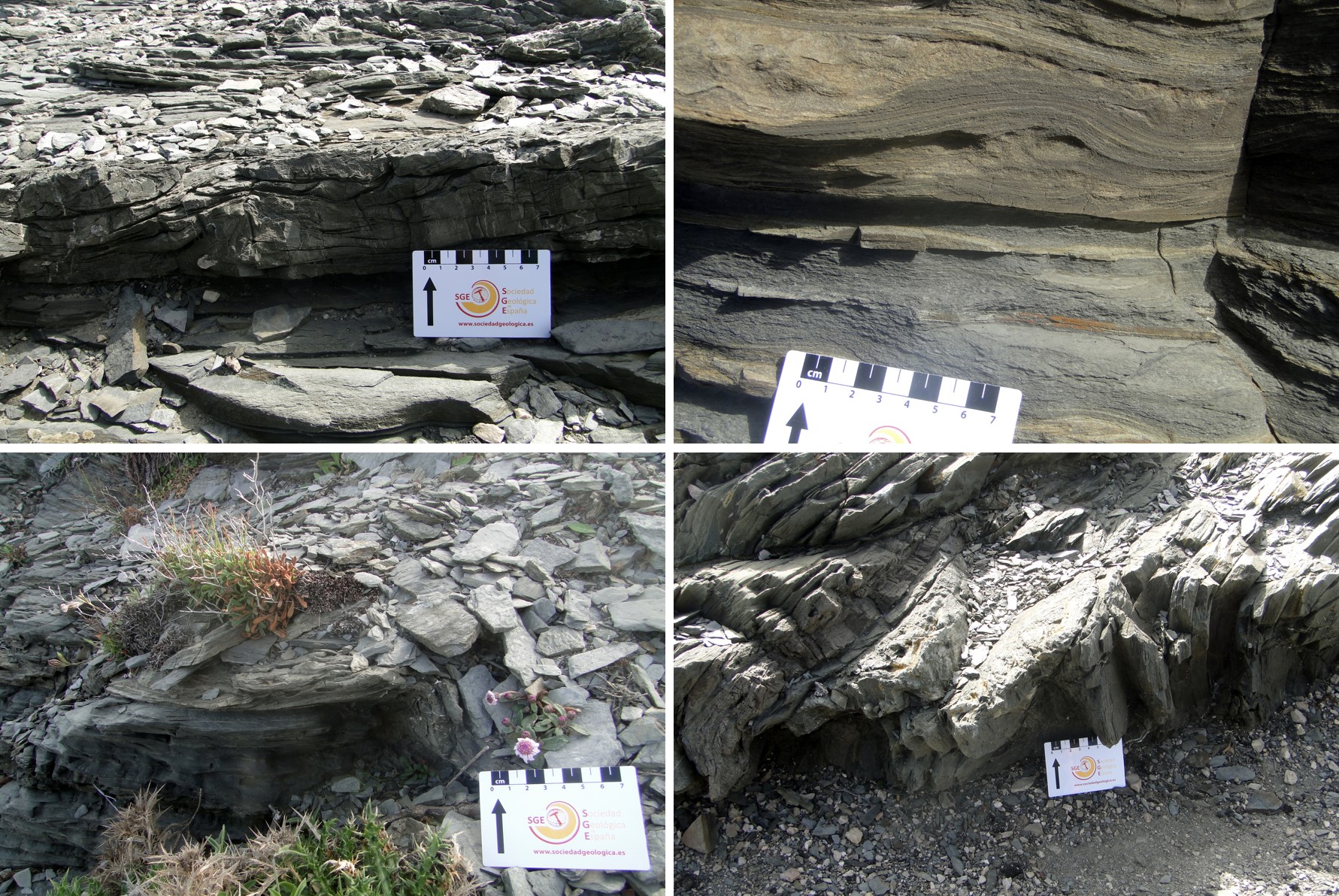
Cross-laminations in fine-grain sandstones at Cap de Favàritx (above), that should not be confused with the numerous microfolds that also abound in the area (below).
The layers of lloselles are made up of three different types of materials: thick layers definable using Bouma sequences, layers of deep water tractive currents and layers of turbidites that have been diluted with a significant slate-like interval and a figurative bioturbation (ichnofossils or trace fossils) of different well-preserved species.
These types of rocks that were formed on the seabed have very few fossils, very occasionally a trilobite can be identified, the remains of vegetation or coral that travelled from the shelf as another element in the turbulent current. However, in the lloselles, we often observe marks that appear to decorate the rocks. These are marks made by animals (such as worms or snails) which, during the Carboniferous, in their desire to find food, shelter or escape their predators and enemies, moved (generally during moments of calm from the point of view of the avenues of turbulence) above the sediment of the seabed leaving marks known as’ ichnofossils’ or ‘trace fossils’.
Very often we do not know which species of animal left these traces, as no fossilised remains have ever been found and we have no skeletons (the hard part). Note that these traces vary, given the different animals that could have created these marks and their different activity, each animal created a different one, each animal behaved differently and had a distinct body.
The fossils and ichnofossils such as the ones at Cap de Favàritx are exceptional and essential for our understanding of the history of our planet and, consequently, our islands. If they are removed from the field by non-specialists, the information that they contain will be lost, so it is extremely important that if you find a fossil in the field, you leave it where it is.
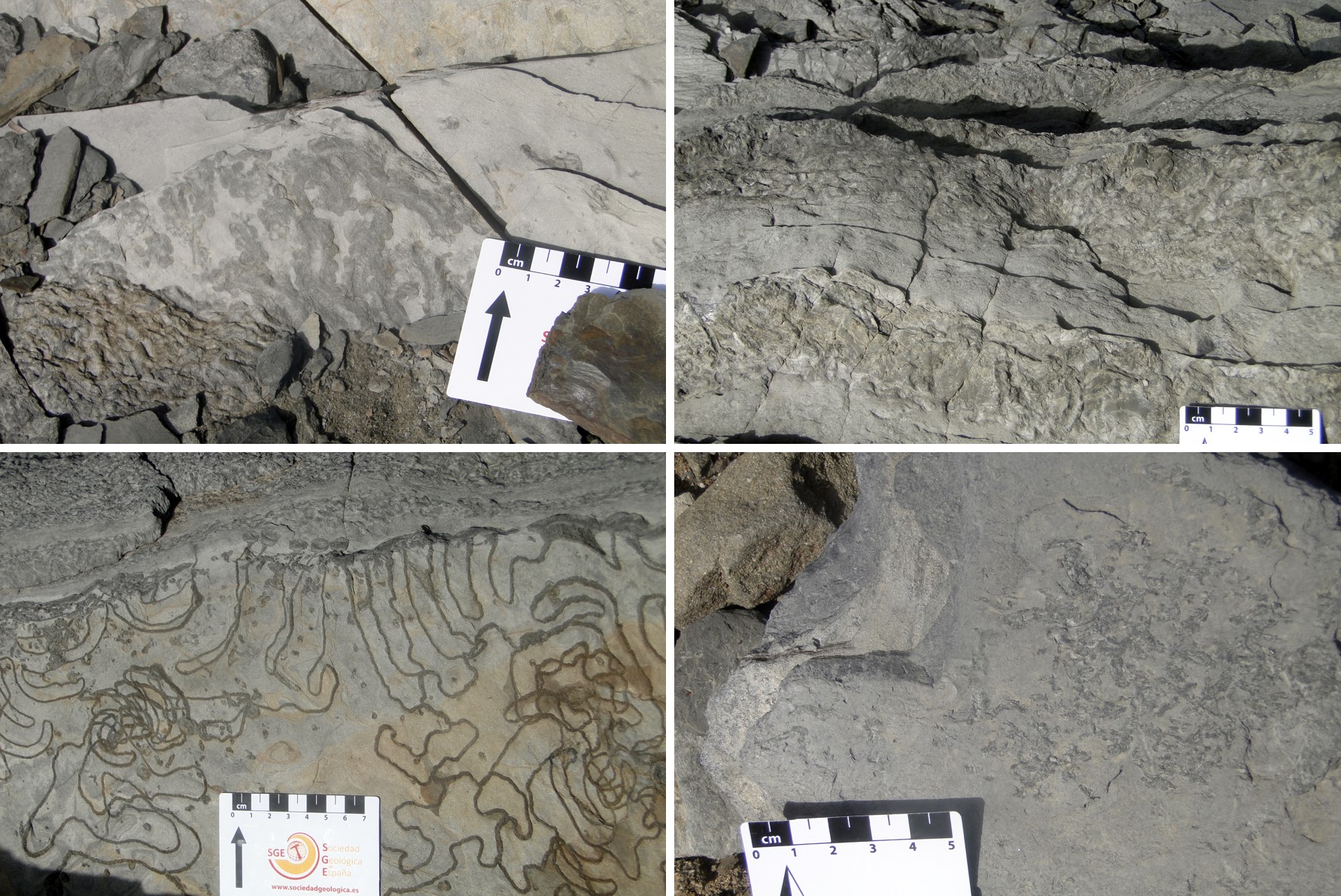
Examples of different types of ichnofossils or trace fossils at Cap de Favàritx.
