Cap de Cavalleria is the northernmost point of Menorca, with a vertical cliff crowned by the lighthouse, measuring nearly 90 m at its highest point. The base is made up of dolomites sedimented in the Jurassic period (some 180 million years ago), which creates abrupt coastlines, on which dunes were deposited in the lower Quaternary (around 2 million years ago), which are the oldest Quaternary sediments in Menorca.
Many dolomites were originally Sedimentary rock whose main component is calcium carbonate (CaCO3). Its origin can be chemical, organic or detritic.</p><p><br></p></div>">limestone rocks that were buried and covered by other materials that pressed down on them. Under these conditions and through the presence of water with magnesium, Sedimentary rock whose main component is calcium carbonate (CaCO3). Its origin can be chemical, organic or detritic.</p><p><br></p></div>">limestone can become a dolomite. In other words, it is very common for a dolomite to have originally been a Sedimentary rock whose main component is calcium carbonate (CaCO3). Its origin can be chemical, organic or detritic.</p><p><br></p></div>">limestone rock, made up like all of them of CaCO3. Water can very often infiltrate these rocks, as they are usually permeable, and if there is a high magnesium content, the Ca can be replaced by Mg, giving rise to this new rock. During this transformation, a process of crystallisation occurs, the rock becomes a little smaller (around an 11% loss in volume) and the sedimentary structures normally disappear, as do the fossils. It should be remembered that usually not all the Ca is replaced by Mg.
The dunes form a sandy sedimentary rock of Sedimentary rock whose main component is calcium carbonate (CaCO3). Its origin can be chemical, organic or detritic.</p><p><br></p></div>">limestone composition, which is known in the Balearic islands as marès. The Quaternary experienced climatic alternations between cold periods (glacial) and warm periods (interglacial), which gave rise to significant variations in the sea level. The glacial periods were times of global falls in sea level. When the sea level fell, large quantities of accumulated sand that had been under the water until that time were left exposed to the elements, at the mercy of the wind, which blew them onto terra firma. The marès of this period is the remains of dunes, also of old beaches, that hardened over time to form a rock that can be found at different heights, but always near the sea. It is known in Menorca as ‘poor marès’, ‘northern marès’ or ‘Mercadal marès’, a rock formed to a large extent by the accumulation of fragments of skeletons of millions of marine organisms that were deposited on the seabed and that the wind carried inland.
In the place known as S'Olla, you get superb views of these rocks on the very high vertical cliffs. The contact between the two forms a stratigraphic series or successions.</p><p><br></p></div>">discordance, a surface that separates two sets of strata of different ages, which indicates that the deposition of sediments was not continuous. In this case, the stratigraphic series or successions.</p><p><br></p></div>">discordance is angular as the upper strata (the Quaternary marès) were deposited on inclined and severely eroded strata (the Jurassic dolomites).
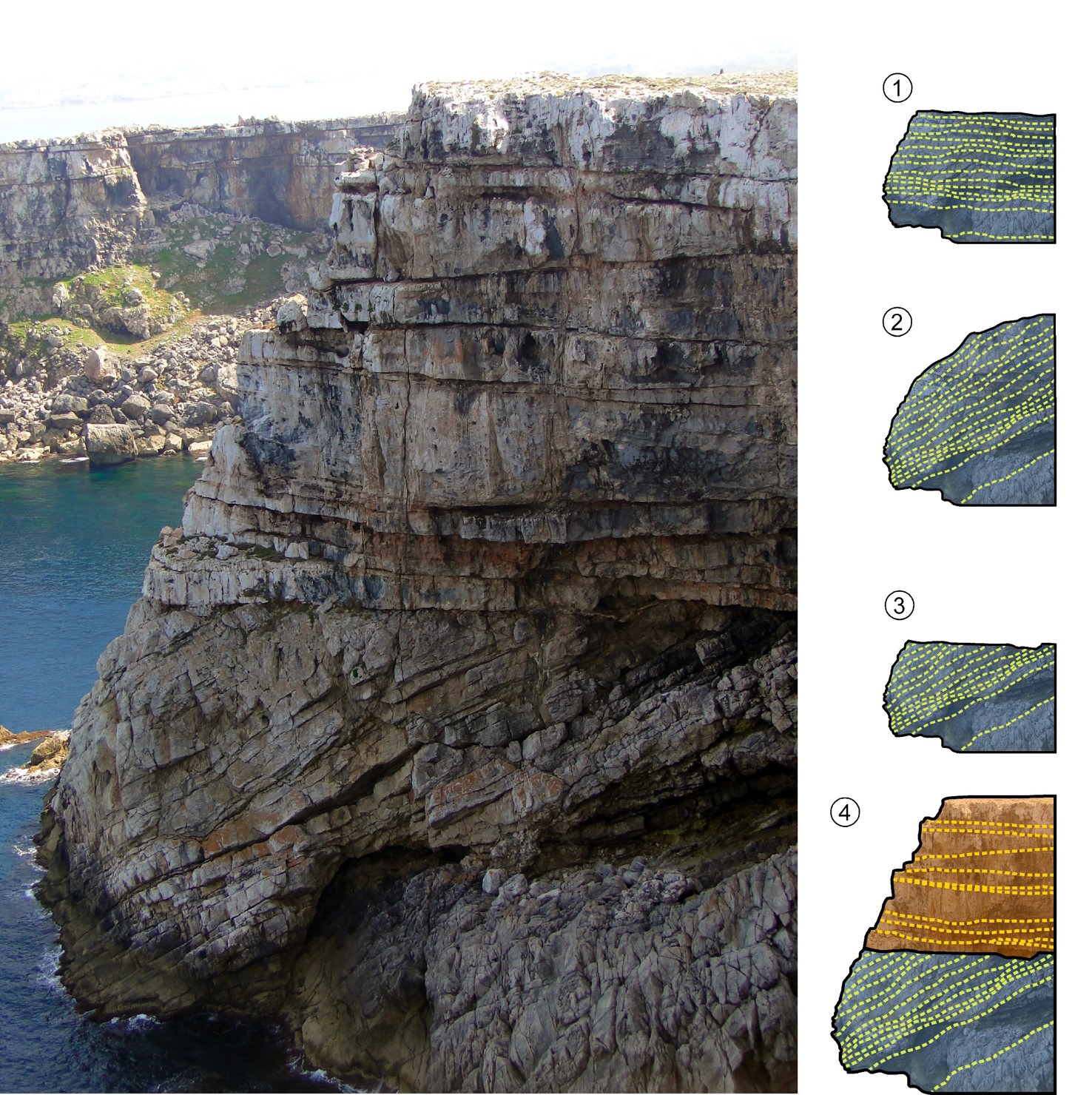
Angular discordance at Cap de Cavalleria and its evolution. The Jurassic sediments were deposited in horizontal and parallel strata (layers) (1). Then, tectonic forces caused them to incline as a whole (2). Later, the rocks underwent intense erosion, which completely destroyed the relief, forming a plain (3). Finally, in the Quaternary, horizontal strata of sand were deposited on this flat surface above the inclined strata of the Jurassic (4).
The strata of marès are thick, and are formed of 8 principal units, in all exceeding 40 m in top of a stratigraphical unit or stratigraphical sequence. </p></div>">thickness. The rock is porous and very hard and displays a very spectacular slightly undulated horizontal stratification. In other words, the strata of marès form lenticular bodies as a result of the deposition of sand by the wind, which are separated by small layers of red clay. This clay indicates moments of sedimentary stoppage, in other words, periods when no sand is deposited for a more or less prolonged length of time, and consequently soil develops on the rocks due to the alteration of the sands themselves. Fossils of land snails that lived in the Quaternary have been identified in this clay.
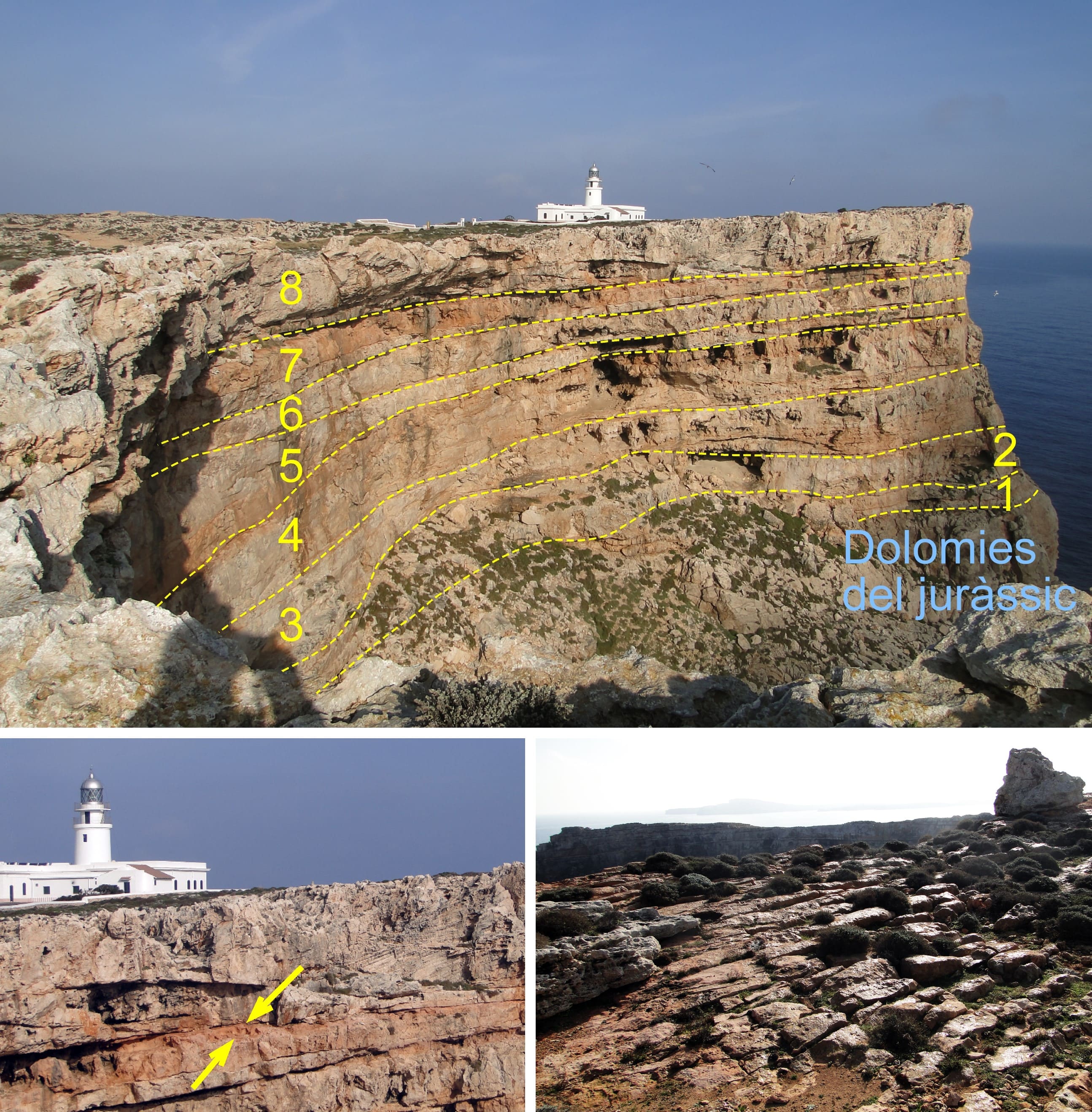
Strata of marès from the Quaternary at Cap de Cavalleria. The layers are separated by accumulations of red clay (arrows), which is old soils, which on the surface can stain the marès this colour.
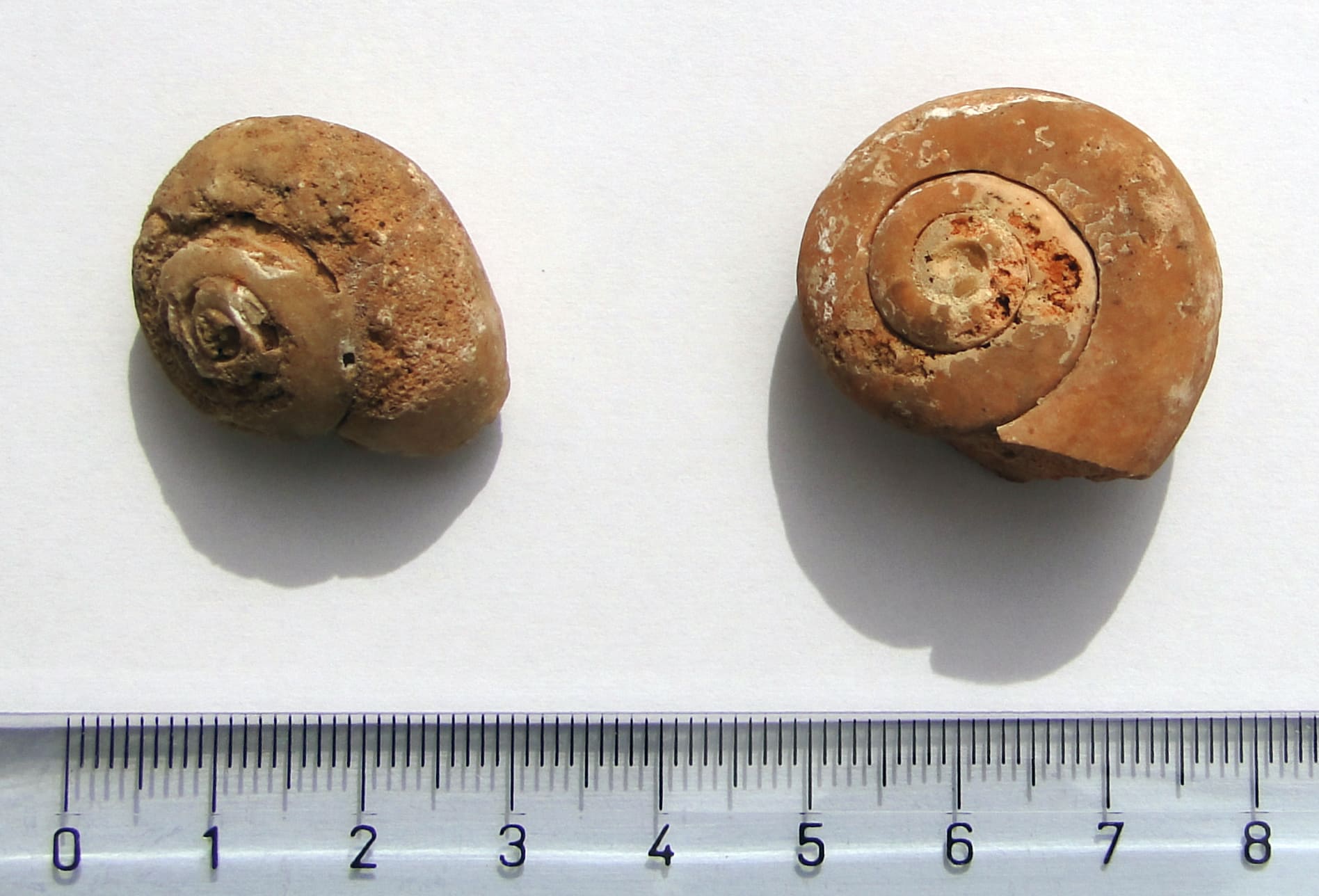
Fossils of land snails from the Quaternary found at Cap de Cavalleria and deposited at the Menorca Geology Centre.
Just to the left of the lighthouse is an excavation created by the extraction of blocks of marès, which were very probably used to construct the lighthouse buildings. In the walls of the small quarry, we can identify a series of inclined lines, which are the cross stratification of the dunes. These are structures that were formed by the sand being dragged by the wind to create piles of sand, such as the present-day dunes we can see at the rear of beaches. When the sediments consolidate, these structures can persist on the rocks, giving rise to fine cross-laminae in the section of a rock, which are a reflection of the currents that carried the grains of sand.
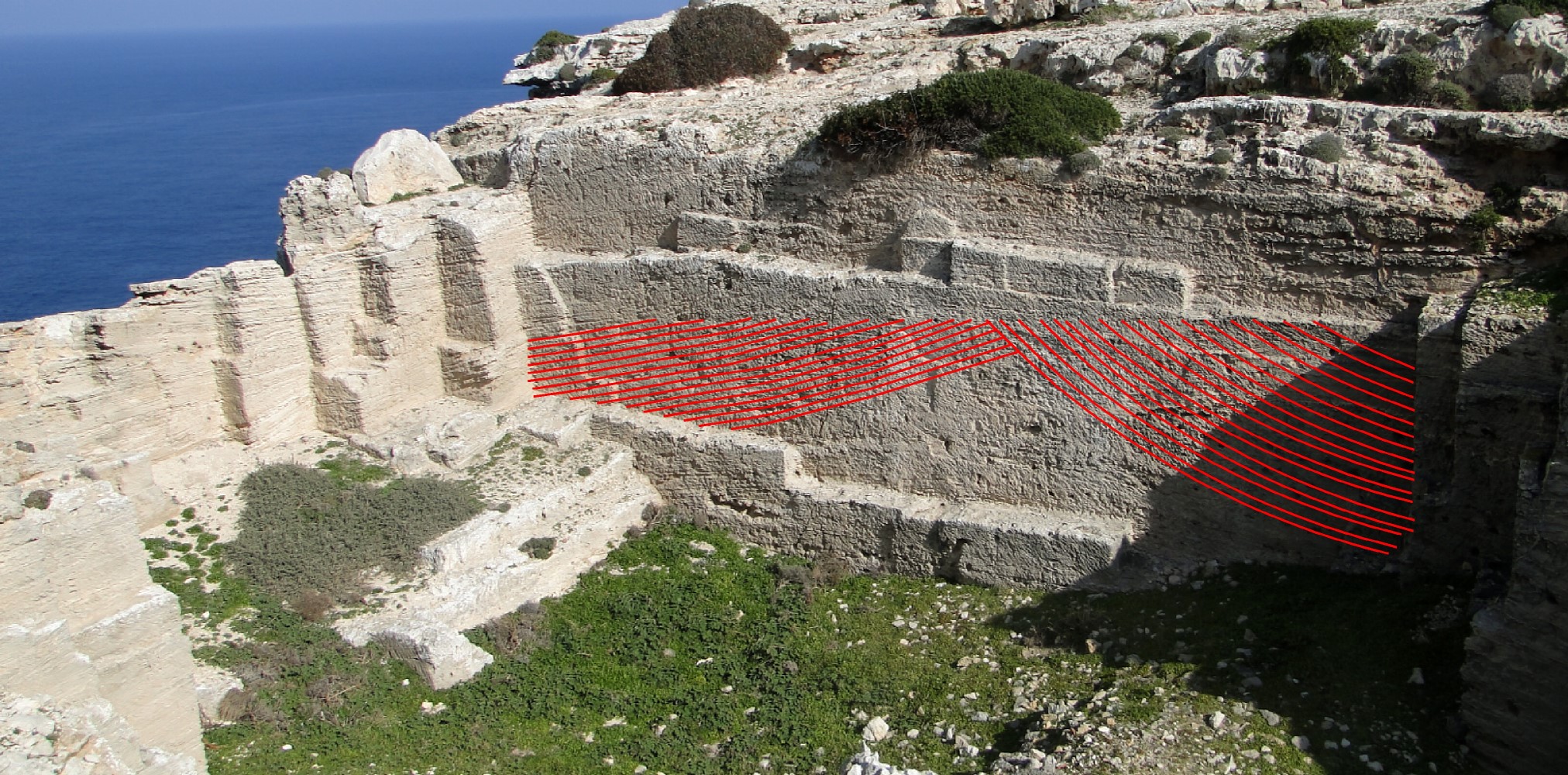
Marès quarry near the lighthouse. The red lines map out the cross-laminations we can see in the rock and that indicate the direction of the wind that carried the grains of sand, in this case, from the south.
Finally, we should point out that as occurs with all the carbonate rocks in Menorca, the present surface of Cap de Cavalleria displays a landscape that is abundant in karst erosion phenomena, such as lapies (clints) and caves.
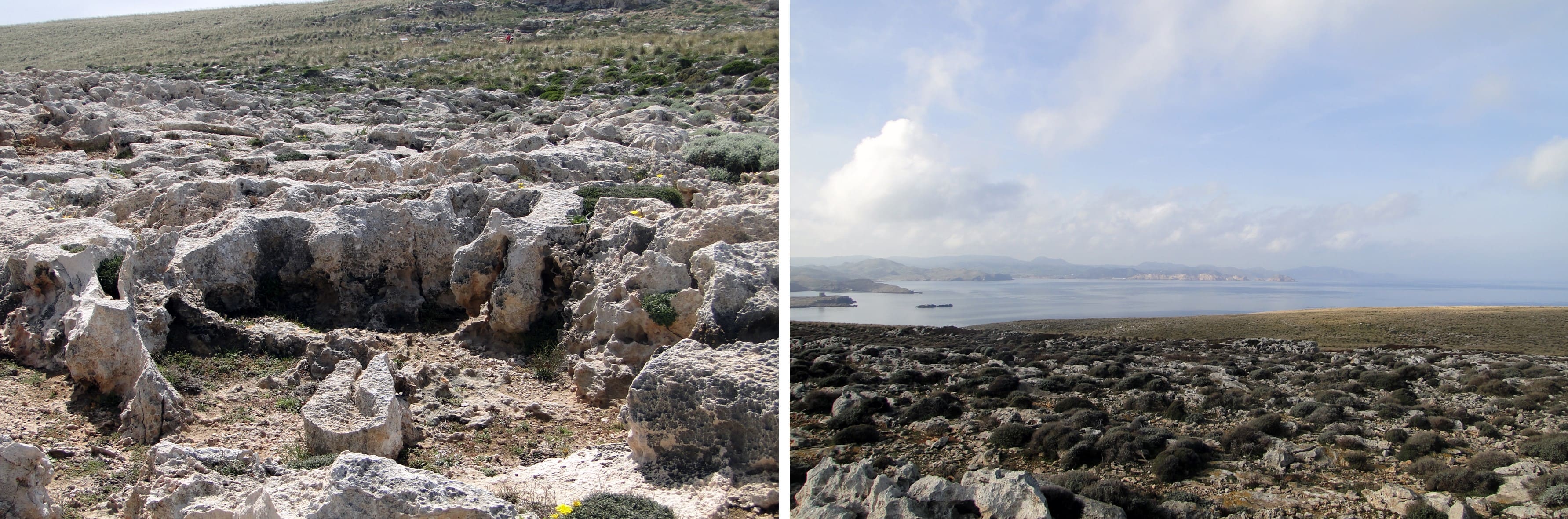
Uneven ground at Cap de Cavalleria due to the effect of karst erosion, where rainwater reacts with CO2 to dissolve the rock.
