The cove of Cala Pi is an ideal spot for observing the impressive tropical coral barriers that were created in the Balearic Islands during the Upper Miocene, (12-5,5 Ma approximately).
This reef is located in the Marina of Llucmajor, in the south of the island. It is a platform with a height of 20 to 30 metres above sea level and is truncated by the torrents and coastal cliffs.
The origin of the cove is related to the development of the torrent of Cala Pi, which takes advantage of a system of large fractures (faults) in the rock.
The falls of rocky blocks are the most important active geomorphological processes in the zone and the cause of the recession of the cliffs.

Faults existing in the torrent of Cala Pi (in yellow).
The Marina of Llucmajor is constituted by the superimposition of several reefs which developed in an environment similar to that of the coral reefs existing today in the Caribbean. Between Cala Pi and Cap Blanc, to the north, there are up to four superimposed reefs, the oldest of which is the one observed in Cala Pi.
Where the fossils are best observed is in the walls of the cliffs, composed of various superimposed layers of white limestones in a horizontal arrangement. The most frequent type of rock is lumaquela, formed by an accumulation of mollusc shells, but the most abundant fossils are corals.
As in modern-day reefs existing in tropical zones, in the reef of the Llucmajor platform various different zones can be distinguished (see figure below). The zone with the greatest development of corals is the reef core that connects with the open sea by means of a sharply sloping zone: the reef slope. Behind the reef front there is a lagoon of calm, shallow waters.
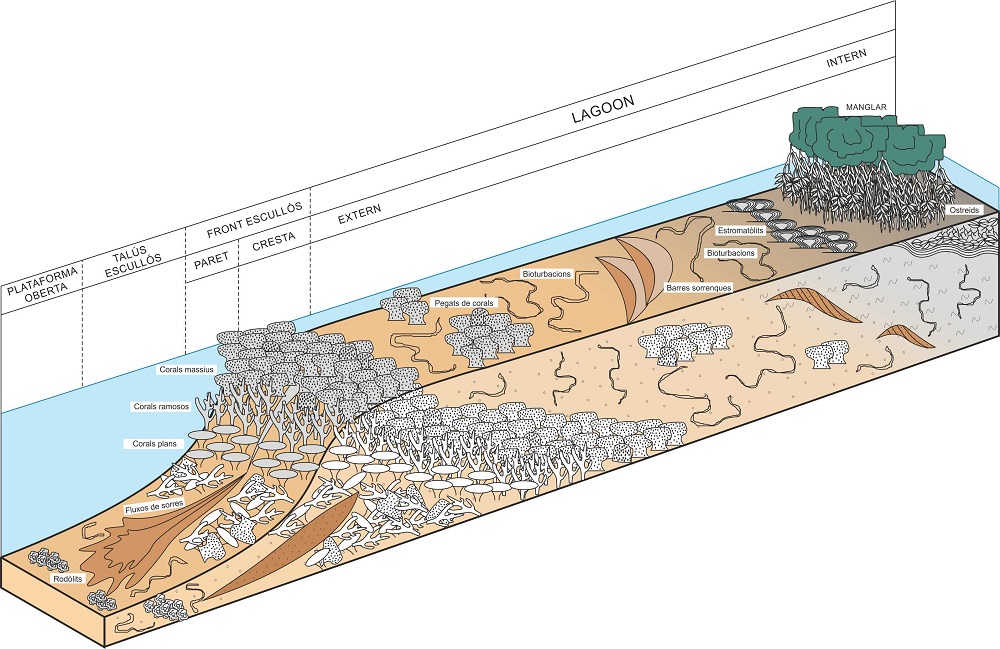
Depositional model of the Reef Complex (based on Pomar & Ward 1991).
The reefs of the Llucmajor platform have a well-developed reef core and a broad lagoon.
This last sector of the reef is precisely the part where we observe the fossils in Cala Pi, characterised by the presence of massive and branching corals and perforant organisms (molluscs, sponges and worms). The corals can measure up to several metres in height, the base of the reef lying below the sea level.
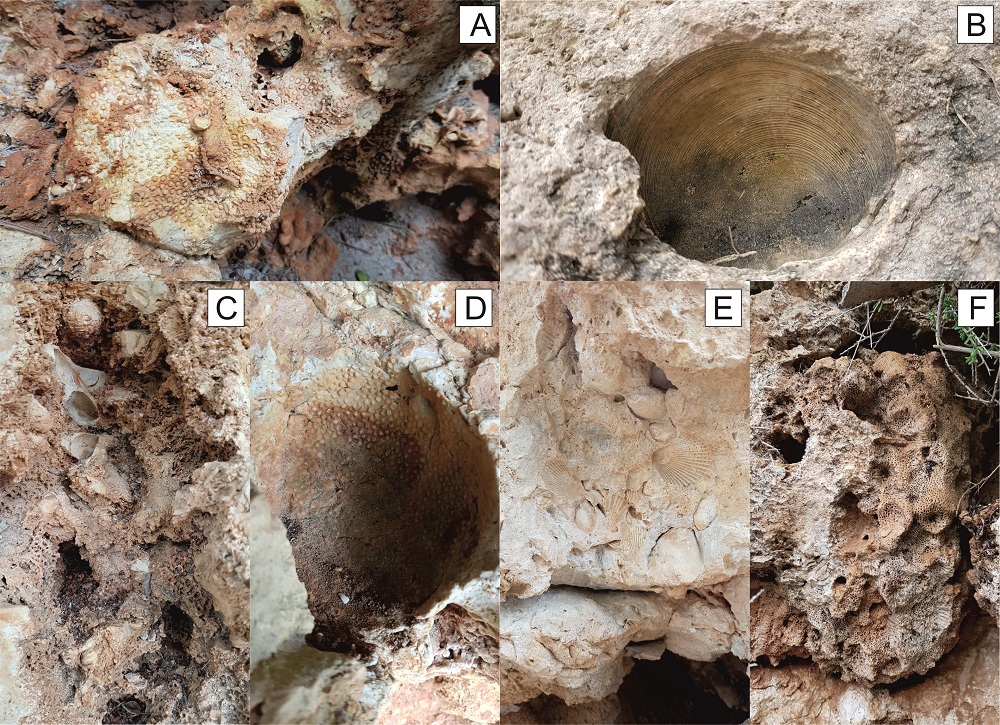
Detail of the fossils: corals (A, C, D and F), bivalves (B and E) and lithophaga (C).
In the eastern face of the cliffs there is a greater abundance of both corals and bivalves and perforant molluscs (also named lithophaga). The latter are characterised by a shape reminiscent of dates. The fossils are in a live position; that is to say, we see them as they were when they formed.
The skeleton of the corals is composed of aragonite, which dissolves and leaves only the internal moulds, which are very fragile and porous. For this reason, what we see is often the hollow with the morphology of the original coral.

Internal moulds of corals.
These dissolution processes favour the formation of karstic-origin caves like those observed in the cliffs that surround the beach. This makes it necessary to carry out detailed studies of the subsoil every time construction works are planned in the area.
In order to evaluate the existence of cavities in the subsoil, the method normally used is geophysical prospection, based on studying the physical properties of the materials of the Earth. Among the methods most commonly used to detect cavities are georadar and electrical tomography.
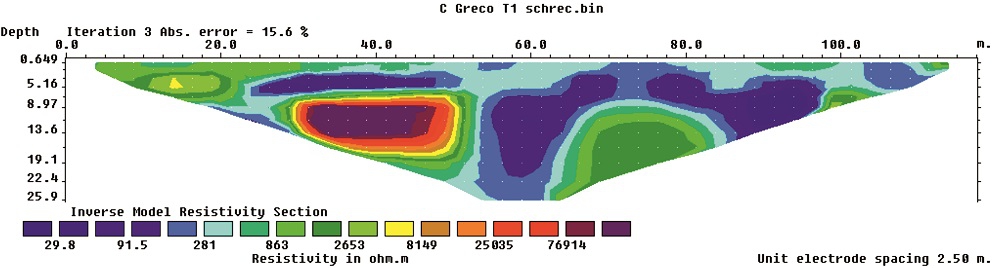
Electrical tomography detecting a cavity (red colours).
