This is the most evident and most easily observed stratigraphic series.</p></div>">paleorelief of the island of Mallorca.
In the coastal cliff of Cala Estellencs we can observe two types of very different materials: reddish rocks arranged in inclined layers and a granular deposit that covers them.
The surface that separates the two materials is not horizontal but displays a concave shape because it corresponds to an old channel excavated by a watercourse which was later filled in. It is therefore a fossil relief or stratigraphic series.</p></div>">paleorelief.
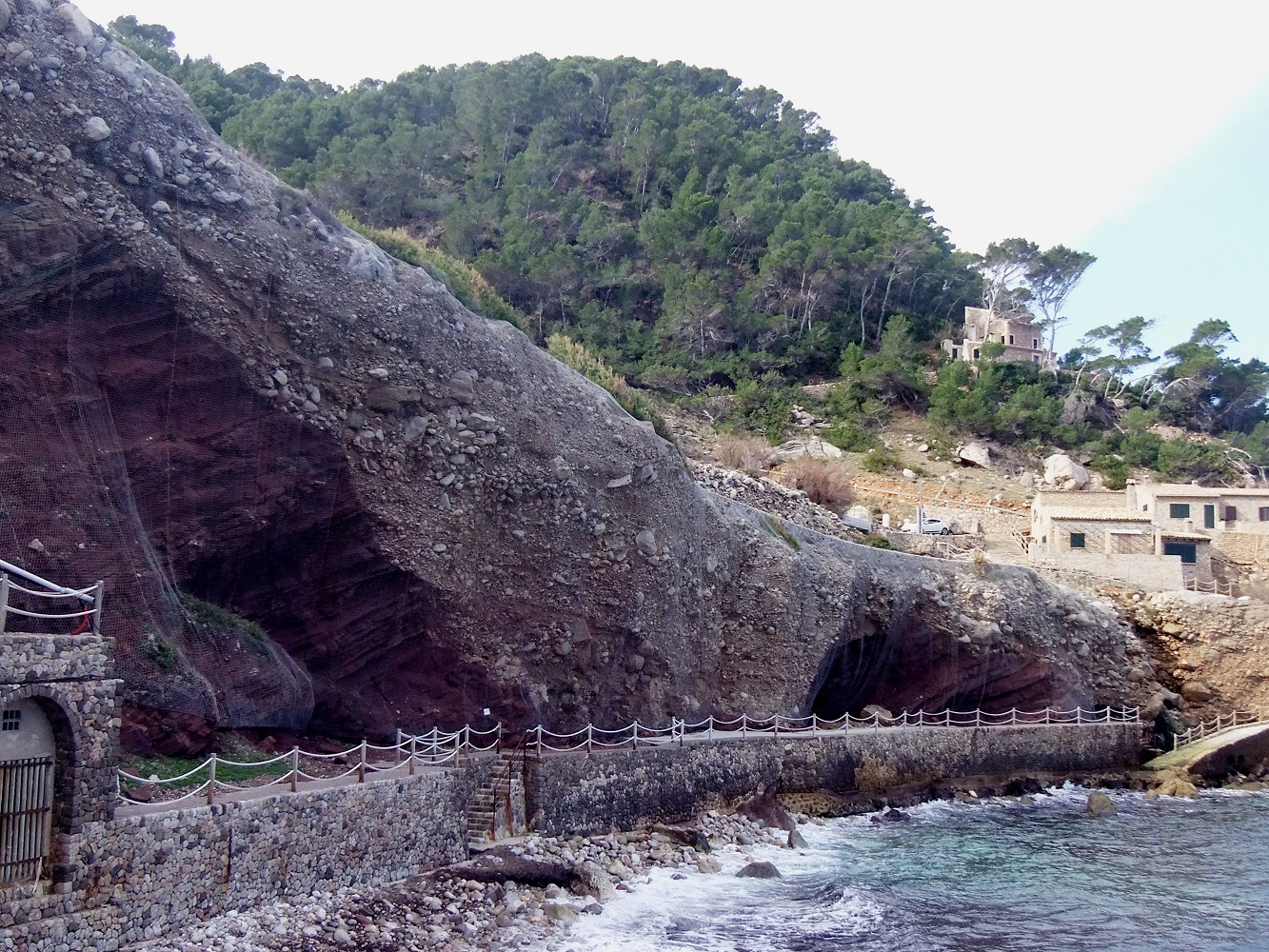
General view of the paleorelief of the Estellencs Cove, showing its concave morphology.
The sediments deposited over the stratigraphic series.</p></div>">paleorelief are constituted by a thick package of Quaternary (2.5 Ma-present) conglomerates. Their dimensions range from a few centimetres to several metres, which reveals the great energy of the watercourse that created the deposit, much greater than what exists today, which is observed close to the start of the cove.
The origin of the rocks is very varied because it proceeds from the erosion of the reliefs that surround the cove. Being located in nearby zones, they have undergone little transportation, so they display a large variety of sizes and shapes.
The rocks lying underneath are much older red sandstones, from the Triassic, some 245 Ma ago. Although they originally deposited horizontally, like the conglomerates, they have been affected by tectonic processes that have tilted them.
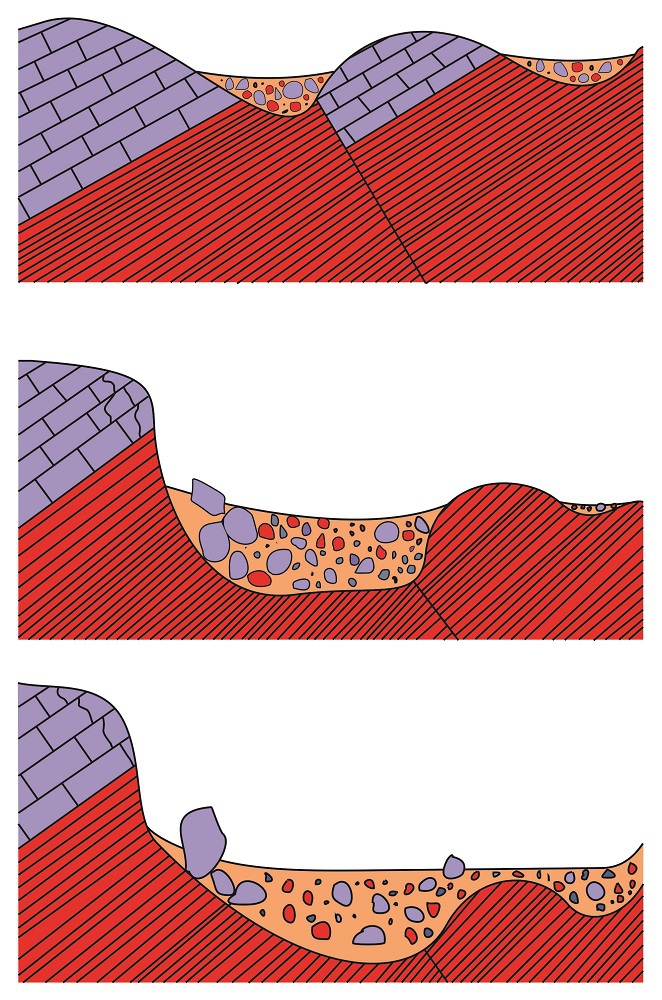
Genesis of the paleorelief observed in Cala Estellencs.
In the sandstones we can observe laminations that cut across each other: this is called cross-stratification. In this case, the type of stratification tells us that the sand that composes the sandstones was driven and accumulated by fluvial streams. Its red colour is due to the high degree of oxidation. Its principal component, the minerals of the group of silicates, is atypical in the island’s geological record, where carbonates predominate. This is because the sediment proceeds from the erosion of old reliefs composed of siliceous rocks.
At the northern end of the cove, and on top of the red sandstones, there appear lighter-coloured sandstones, normally in whitish and greenish tones (see photograph below). In these same strata, in the vicinity of Cala Estellencs, remains of plants, insects and fish and reptile footprints have been found, constituting one of the most important paleontological sites of this period.
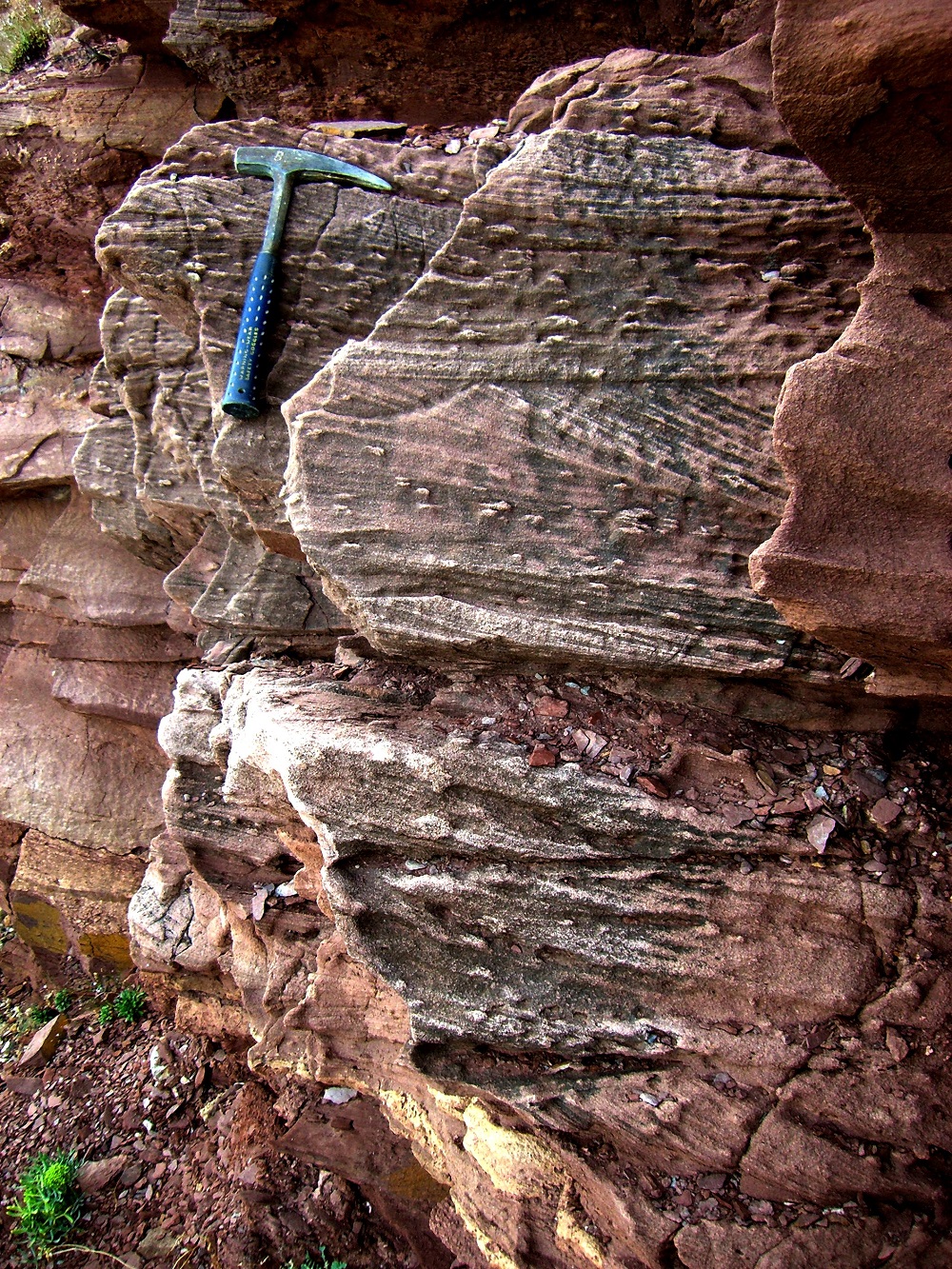
Cross-stratification of the red sandstones of the Buntsandstein (red sandstone) in the vicinity of the jetty.
In addition to the materials described above, the southern end of Cala Estellencs is one of the few places on the north coast that feature fossilised dunes, which are very common in other parts of the island. In the same zone there are deposits of Sedimentary rock originated by the precipitation of calcium carbonate from supersaturated waters, especially in zones of karstic emergences.</p></div>">travertine, a very porous type of rock formed by the precipitation of carbonates in waterfalls, which fossilises the plants onto which it falls.
Due to the erosion processes, there are frequent falls of the rocky blocks that compose the Quaternary conglomerates and occasional falls of the Triassic rocks that constitute the cliffs. For this reason, a series of protective measures have been installed to prevent these rockfalls from reaching the cove, which receives many visitors in summer.
In order to retain the conglomerates, a steel triple-torsion mesh has been fixed to the upper and lower parts of the embankment.
In contrast, the large blocks of Triassic sandstones have been fixed to the embankment by means of steel bars (anchorages).
Finally, in the area of the fishermen’s huts, a large dynamic retention screen has been installed.
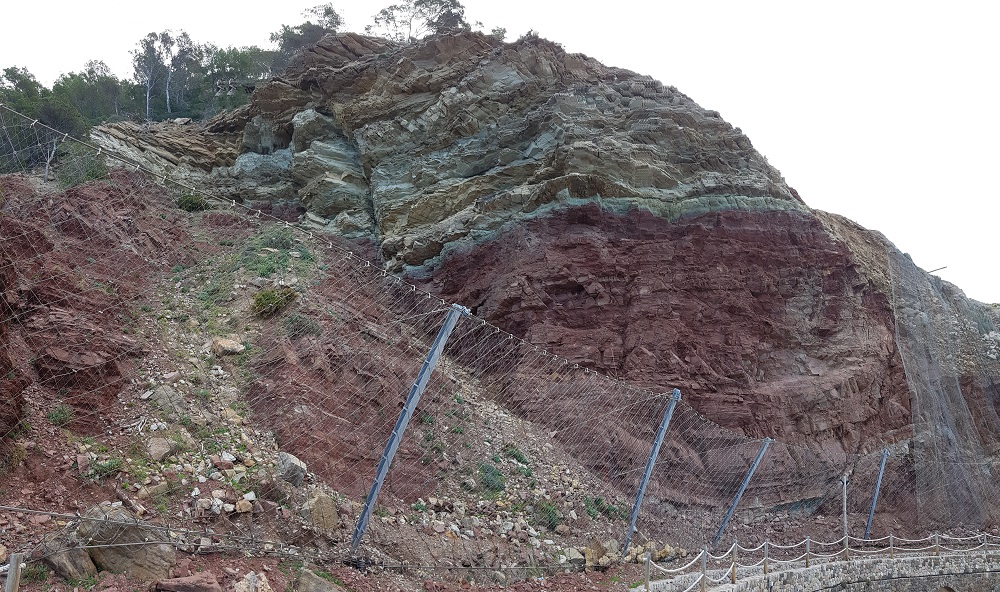
Detail of the protective measures (in the foreground the dynamic screen and in the background, to the right, the triple-torsion mesh).
