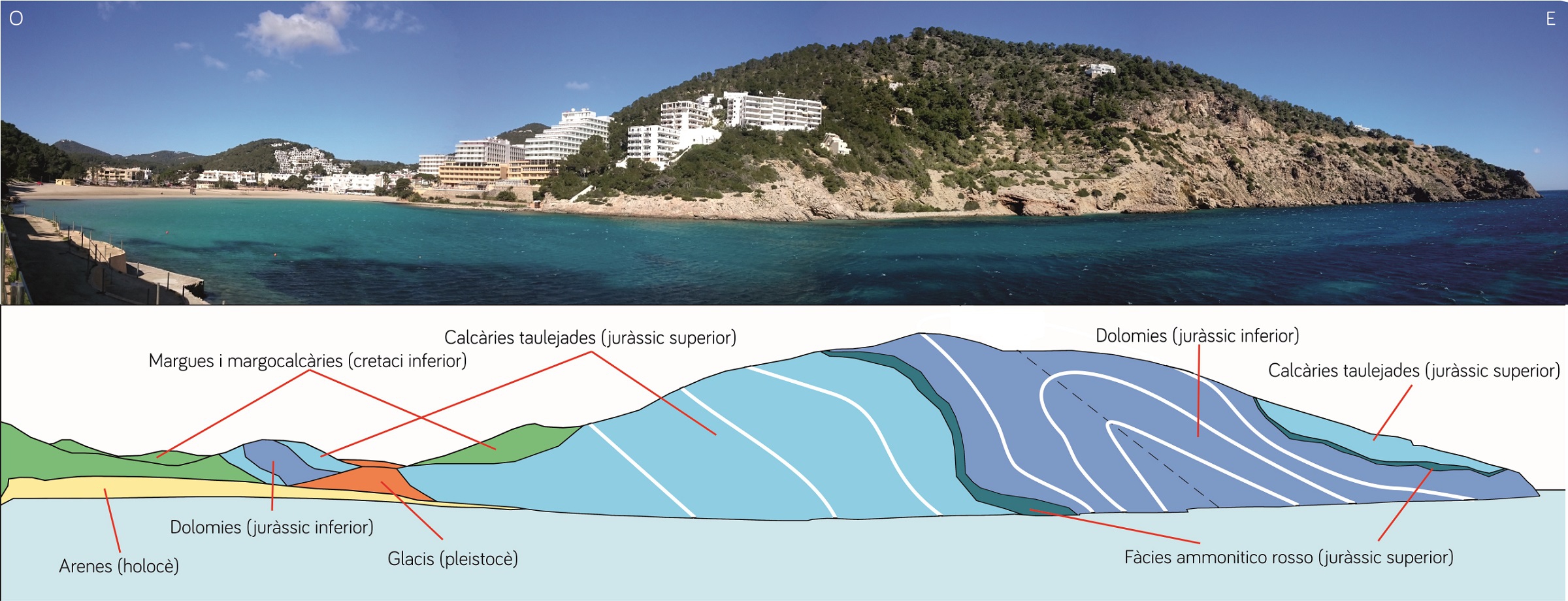
Panoramic diagram of the anticline of Cala Llonga and its geological scheme.
Panoramic diagram of the fold in which the oldest materials are situated in its core.</p><p><br></p></div>">anticline of Cala Llonga and its geological scheme.
The geological record of the Jurassic in Eivissa, despite being incomplete, has some important outcrops. One of the most representative ones in the island is without doubt that of Cala Llonga. It is folded forming a large over-turned fold in which the oldest materials are situated in its core.</p><p><br></p></div>">anticline known as the Cala Llonga fold in which the oldest materials are situated in its core.</p><p><br></p></div>">anticline, a product of the Alpine Orogeny.
The peculiar disposition of this fold means that one of its limbs (in this case, the one located to the west) has an inverted sequence of strata, that is, the oldest levels lie above the youngest. On the other side the sequence is normal

Roadside embankment displaying the dolomites (in the foreground) followed by the ammonitico rosso facies, and the layered limestones, which reach the end of this section of the road. Normal sequence of the eastern limb of the fold.
Its nucleus corresponds to the oldest materials of the series, in this case dolomites of the Lower Jurassic. Initially this material was a Sedimentary rock whose main component is calcium carbonate (CaCO3). Its origin can be chemical, organic or detritic.</p><p><br></p></div>">limestone, but has suffered a process of alteration known as dolomitisation. During this process, the rock can erase all the fossil traces it previously included.
In the absence of paleontological material, in most of the cases in which this stratigraphic unit has been studied, no specific age has been determined. However, there are exceptions which situate the roof of the formation within the Upper Lias (upper part of the Lower Jurassic). Its base, which in other outcrops belongs to the Upper Triassic, does not seem to be present in Cala Llonga. This whole series of dolomites culminates with a large stratigraphic hiatus which causes the Middle Jurassic and the first levels of the Upper Jurassic likewise not to be represented. The environment in which these sediments were deposited corresponds to a sea bottom with very shallow waters.
Over the stratigraphic hiatus thereis a unit with low top of a stratigraphical unit or stratigraphical sequence. </p></div>">thickness but great importance. It is a series of levels of nodulous limestones which tend to have reddish tones. They are named ammonitico rosso stratigraphic unit and reflect the specific environmental conditions in which they were formed.</p><p><br></p></div>">facies, following the Italian nomenclature, as they contain a great abundance of ammonites and a red characteristic colour.
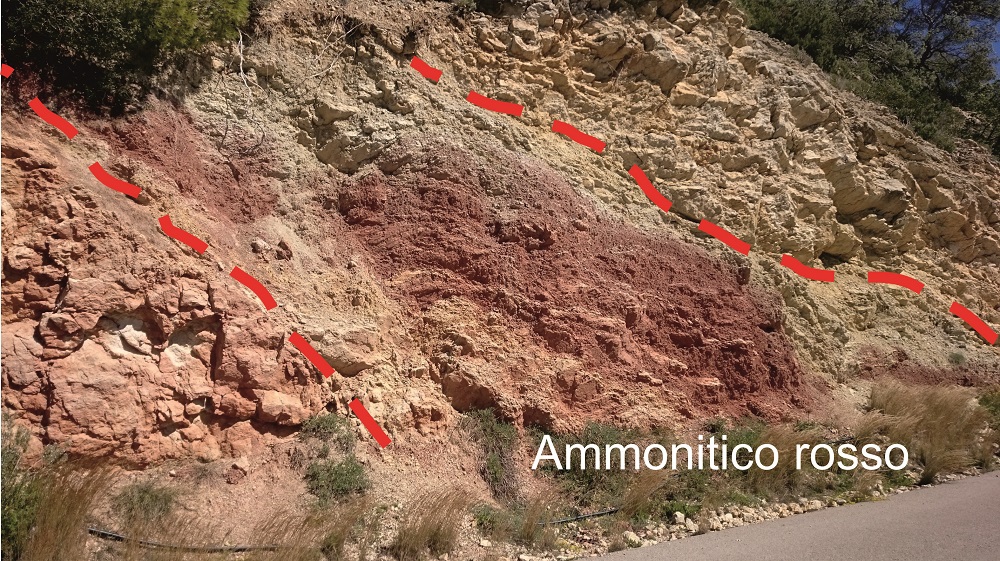
Detail of the ammonitico rosso facies.
In Cala Llonga the different species of ammonites found in this stratigraphic unit and reflect the specific environmental conditions in which they were formed.</p><p><br></p></div>">facies enables to date them to 160 Ma. This fauna lived in a stage of marine transgression to relatively shallow waters, after an erosive period corresponding to the stratigraphic hiatus.
Although in Cala Llonga these stratigraphic unit and reflect the specific environmental conditions in which they were formed.</p><p><br></p></div>">facies can be clearly observed, their top of a stratigraphical unit or stratigraphical sequence. </p></div>">thickness progressively decreases towards other nearby outcrops, where they are no longer traceable at geological scale.
The most modern Jurassic unit is at the same time the most potent. It is a long series of levels of layered limestones, dated using microfossils as Upper Jurassic, deposited concorantly with the previous unit.
Its stratigraphic disposition follows a repetitive pattern (rhythmite), combining calcareous levels with narrow strata of marls and margo-limestones. This unit, alike the rest of the materials present, is intensively folded due to the tectonic forces which affected this sector during the Alpine Orogeny.
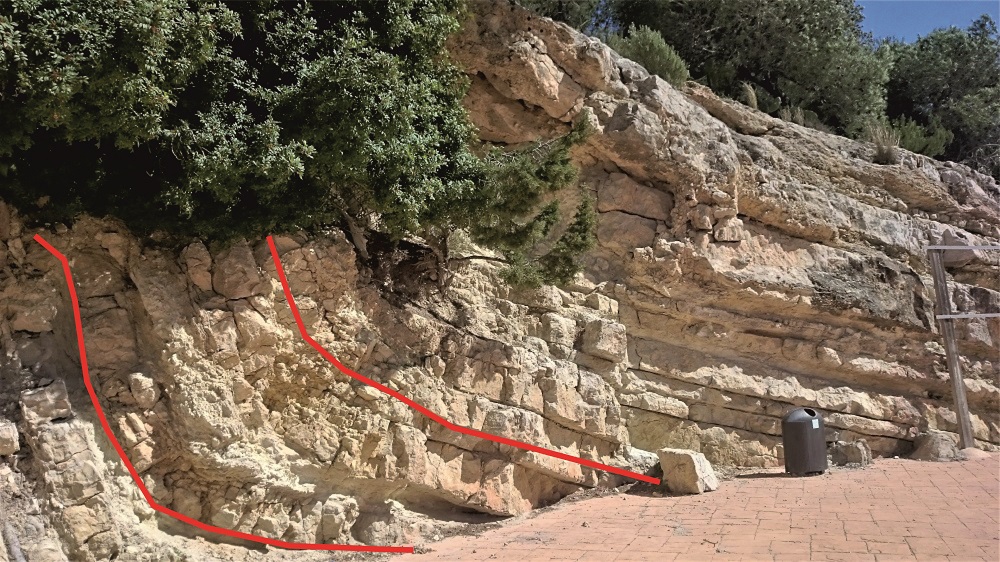
Folding of the layered limestones.
A particular strata is calcareous, margo-calcareous or marly depending on the proportion of carbonates deposited on the sea bottom: the more carbonates there are in the medium, the more calcareous the material will be once lithified, and on the other hand, the less amount of carbonate in the sediment, the more marly the resulting material will be. In the highest part of the unit there is a predominance of marls, which continue to be dominant also in the Lower Cretaceous which outcrops in the proximities of the fold in which the oldest materials are situated in its core.</p><p><br></p></div>">anticline.
The setting in which this stratigraphic series was deposited corresponds to a platform of shallow waters.
These layered limestones are covered by much later sediments, situated on a small tectonic, eustatic or antropical processes</span></p></div>">outcrop located on the northern shore of Cala Llonga, at the foot of the buildings. This is a marine sedimentary rock of detritic origin (clasts larger than 2 mm).</p></div>">conglomerate with fragments of marine molluscs, covered by red silts.
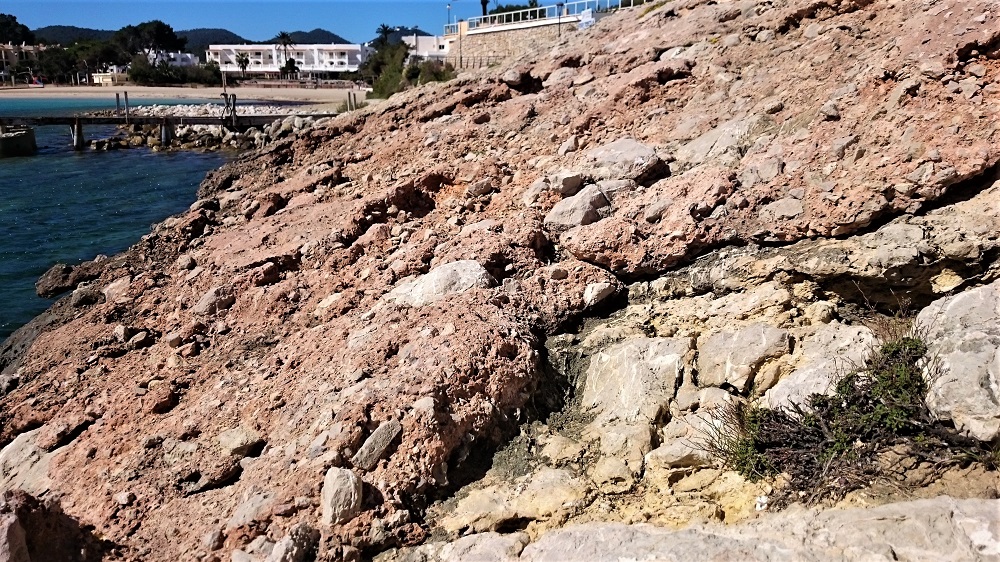
Outcrop of the Pleistocene corresponding to the marine conglomerates.
