
Panoramic view of the Port de ses Caletes.
The zone of the Port de ses Caletes is a good testimony of the tectonic deformation which occurred during the Alpine Orogeny. The materials that tectonic, eustatic or antropical processes</span></p></div>">outcrop in the cove are folded and deformed due to the existence of two thrusts and possibly a normal fault. The thrust located easternmost is, moreover, the limit between two of the three Structural Units of Eivissa: the Eivissa Unit and the Llentrisca-Rey Unit.
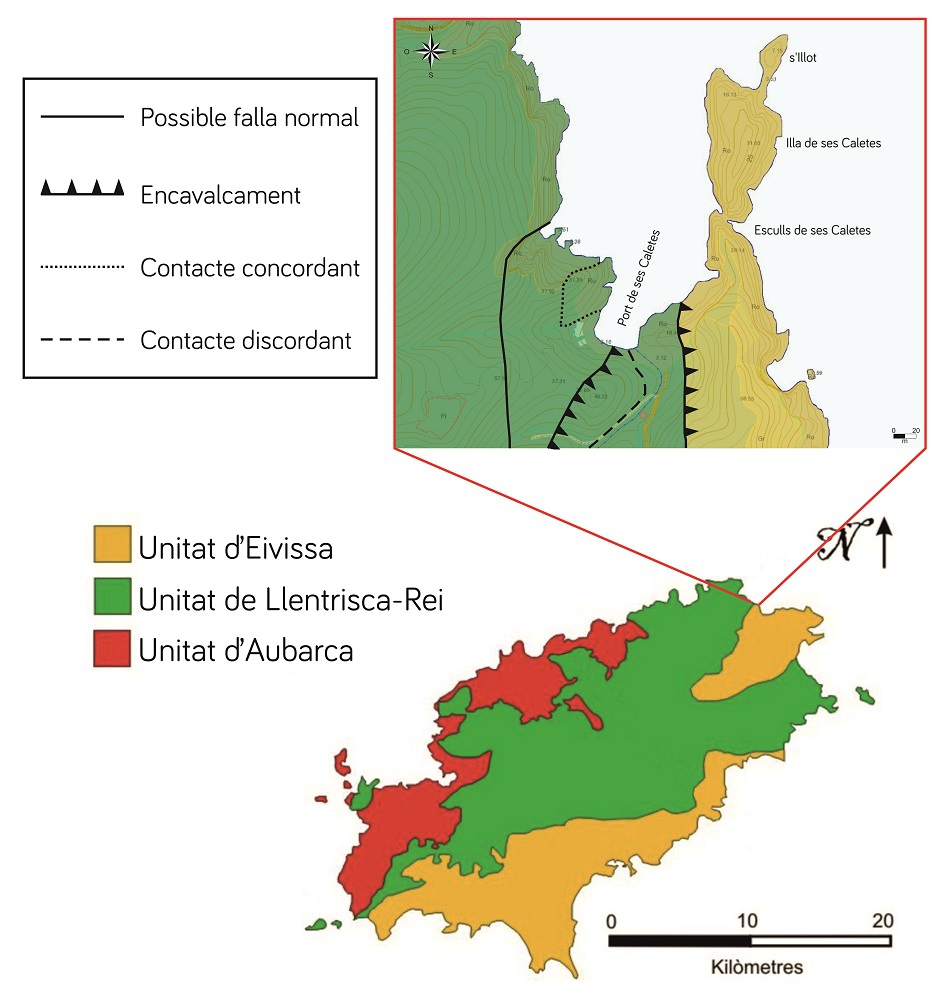
Map of the Structural Units of Eivissa with enlargement of the zone of the Port de ses Caletes indicating the thrust, the possible normal fault and the types of contacts existing between the materials.
The thrust which limits the two Structural Units affects the massive dolomites and dolomitic breccias of the Lower Jurassic which give rise to large strata (Eivissa Unit) and the leaf-like Miocene marls which have intercalations of levels of sandstones and conglomerates along with olistolites of Triassic and Jurassic materials (Llentrisca-Rey Unit).
The more plastic Miocene marls act as a sliding surface, favouring the Jurassic dolomites and breccias to rise above them.
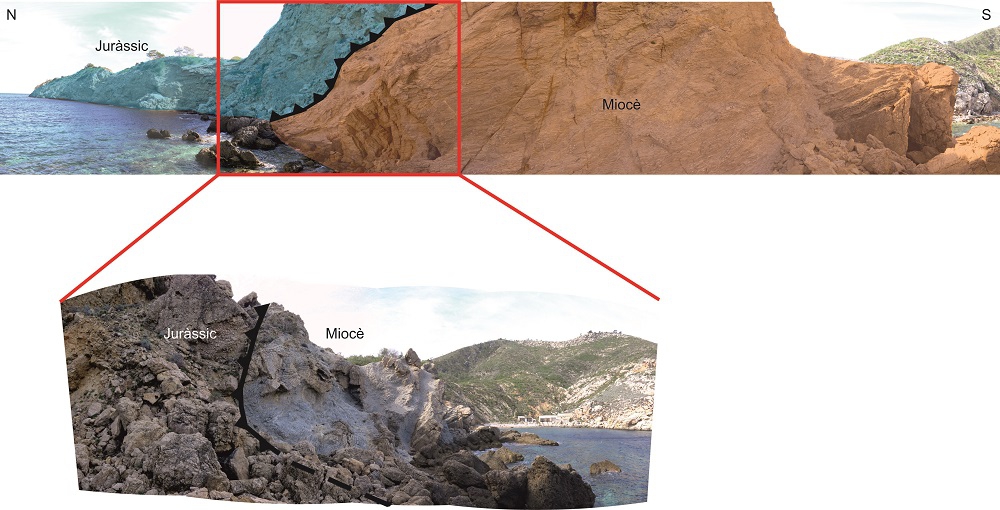
Thrust (in black) which projects the materials of the Lower Jurassic (in blue) over those of the Miocene (in orange).
Due to this thrust, the marly strata of the Miocene display great deformation with small folds.
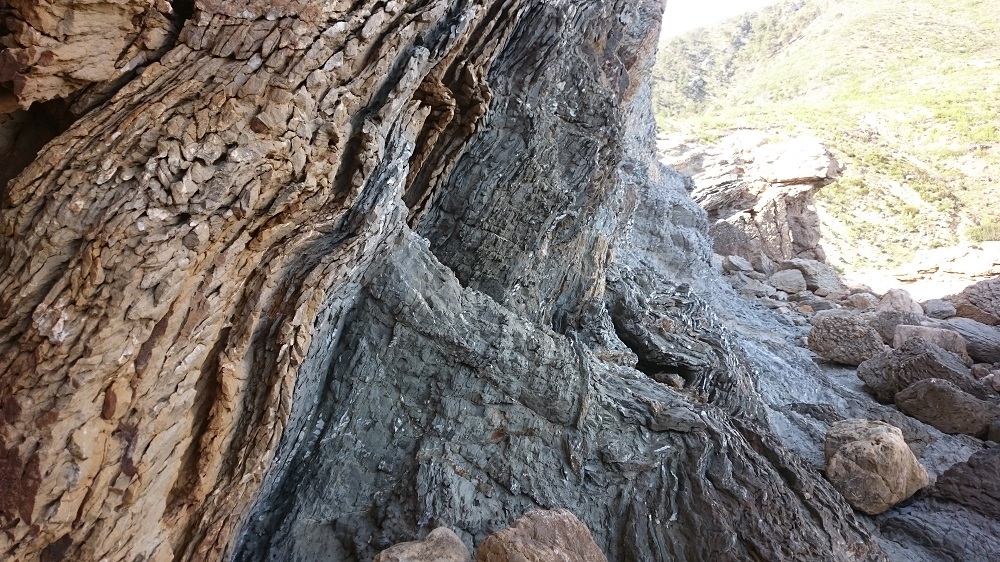
Small folds formed in the marly strata of the Miocene due to strong deformation caused by the thrust. It is also possible to appreciate the leaf-like appearance of the marls.
The Miocene unit tends to be related with the thrusts because its origin is associated with moments of tectonic compression.
At the centre of the cove the Miocene marls lie in discordant contact with the layered limestones of the Upper Jurassic. There is also a second thrust which overlaps the layered limestones over the calcarenites, marls and sandstones of the Lower Cretaceous.
The Lower Cretaceous materials are folded, giving rise to a small syncline which includes in its nucleus the white limestones of the Upper (more modern) Cretaceous.
The dolomites of the Upper Jurassic – Lower Cretaceous. crown the hills and get in contact within the calcarenites, marls and sandstones of the Lower Cretaceous, possibly through a normal fault which has projected the Lower Cretaceous downwards.
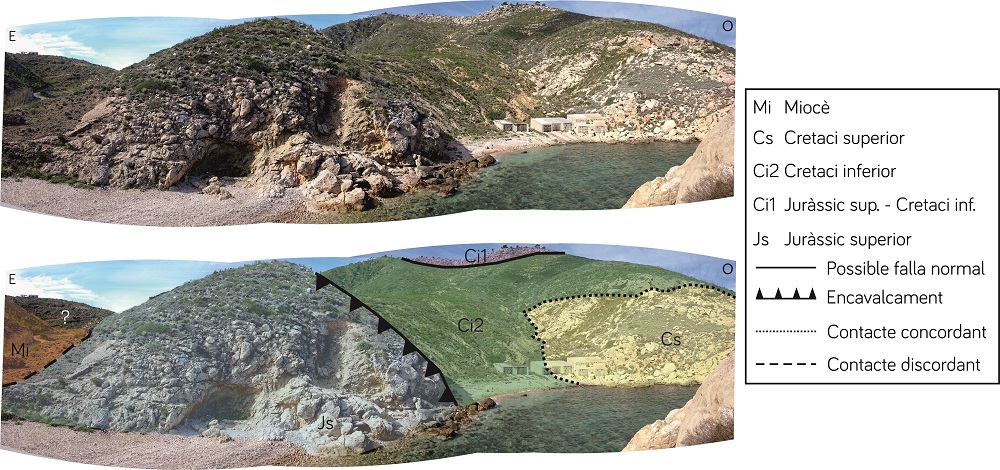
Cartography of the centre of the cove of the Port de ses Caletes representing the different lithologies which outcrop and the structural relationship between them.
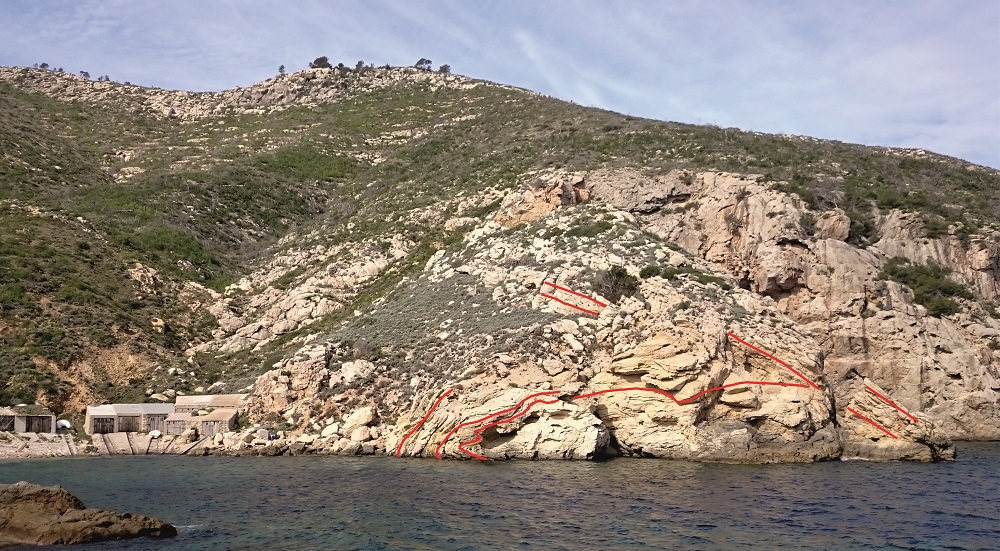
Folding of the strata of the white limestones of the Upper Cretaceous located in the nucleus of the syncline. Some strata are marked in red.
It is very possible that the geological history which has given rise to the present-day structure of the different materials outcropping at the Port de ses Caletes is as follows:
1) Sedimentation of the dolomites and massive breccias of the Lower Jurassic and of the layered limestones of the Upper Jurassic.
2) Sedimentation of all the lithologies of the Cretaceous.
3) Strong erosion during the Palaeogene which swept from the entire island of Eivissa the sediments deposited during this geological period.
4) Start of the Alpine Orogeny in the Balearics and syntectonic sedimentation of the Miocene materials. During this stage all the faults and lithologies present in the zone today were formed.
