Although the eivissenc Miocene (from 25.0 to 5.3 Ma) is a geological period with numerous outcrops, the majority correspond to materials sedimented before or during the Alpine Orogeny, that is, the uplifting of the present-day reliefs of the island.
The Cala Portinatx area has one of the few outcrops in Eivissa corresponding to the post-tectonic Miocene. These materials are not affected by intense foldings, a fact which notably facilitates their study.
Following the order of sedimentation, the materials found throughout the area of Pujolet des Morts and the small cliffs going as far as the Punta d’en Pau correspond to highly bioturbated white limestones. This is a fossilised coral reef which in its time formed part of a shallow seafloor with clear waters and abundant fauna.
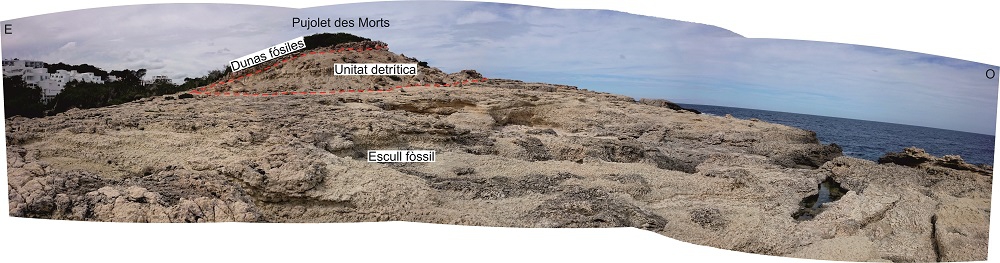
Fossil reef in the foreground. On the hill of Pujolet des Morts the detritic unit and the Quaternary dunes are found.
While in the rest of the Balearics there are abundant testimonies of the coral reefs formed around the emerged zones, in Eivissa they are frankly unusual, limited to its north coast.
In the zone of Cala d’en Serra (to the south-east of Portinatx), this reef unit displays a large quantity of fossil remains of Madrepore-type corals and gastropods.

Detail of the bioturbation in the reef unit.
Above the fossil reef unit there is a detritic unit composed of fine sands, marls and silts of a yellowish-white colour which alternate with layers of Mesozoic calcareous materials of variable sizes (decimetric and metric). These materials deposited forming dejection cones at a moment when the sea level was lower than in the previous period. This can be observed on the hill of Pujolet des Morts and in the S’Aigua Blanca sector.
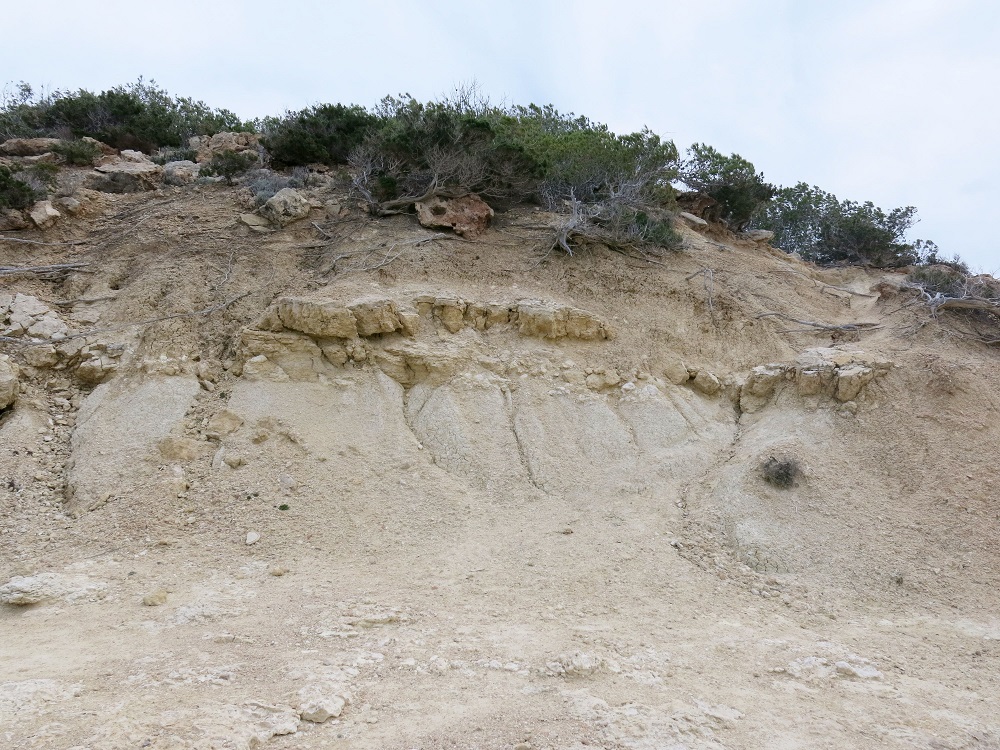
Outcrop of the detritic unit located on the hill of Pujolet des Morts.
Later the sea level rose slightly and the so-called Terminal Complex deposited itself, constituted by oolitic sediments and microbialites (rocks formed by the action of microbacteria).
Oolites consist in spherical or subspherical carbonated particles of a diameter smaller than 2 mm. They form in a shallow marine environment of medium energy where the microparticles of calcium carbonate are in suspension along with detritic sediments. The marine current continuously displaces the particles within the water column and sheets of calcium carbonate are gradually laid over a detritic nucleus.
The deposits of microbialites, for their part, originate in a shallow and relatively peaceful marine environment.
The Terminal Complex gives rise to the cliffs located between Cap Blanc de Portinatx and the Punta de Moscarter
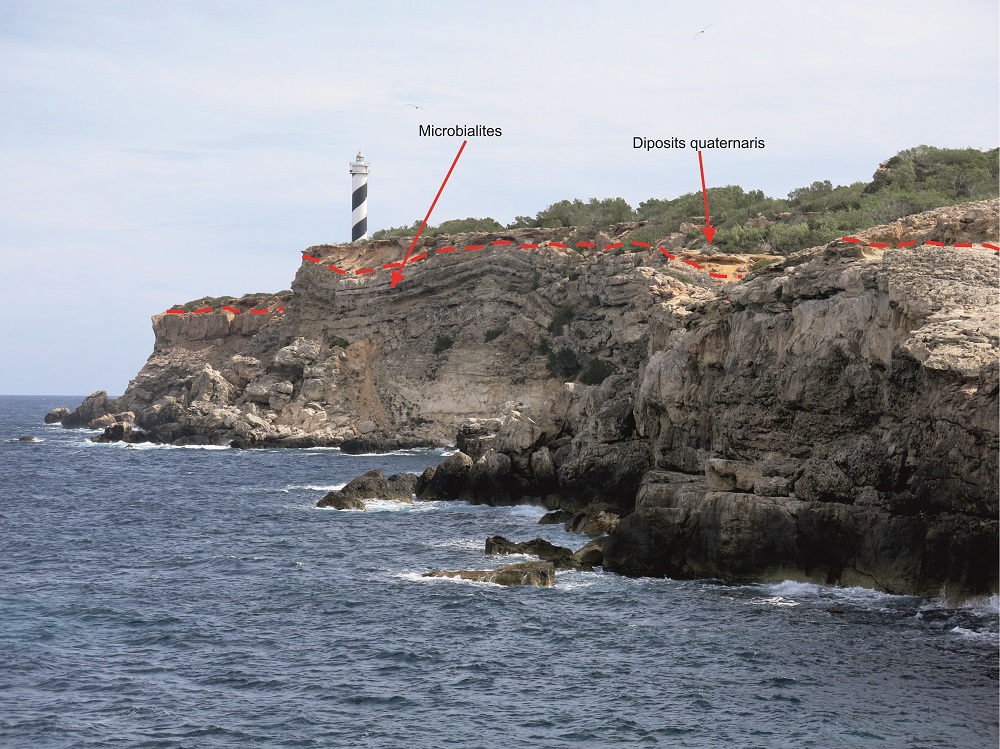
Terminal Complex, highlighting the laminations of microbialites. Above the Complex, fossil dune sediments of the Quaternary age.
Among the outcrops of the Terminal Complex there is a karstic collapse originated by the dissolution of the underlying materials and the later refilling of the cavity by the fallen upper strata (breccias).
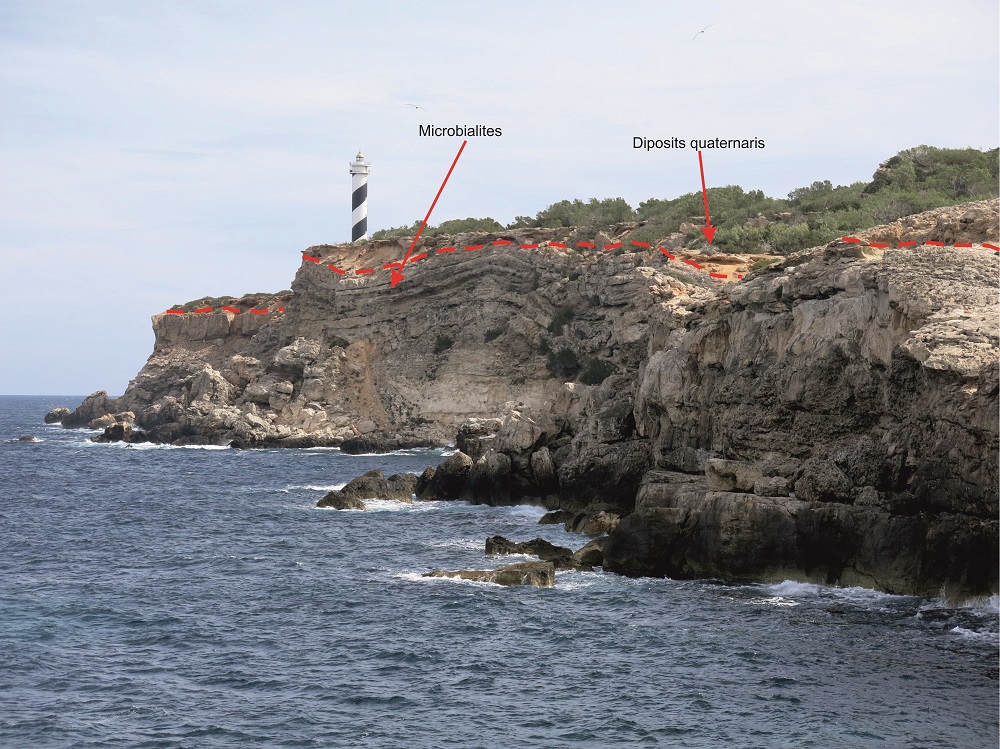
Karstic collapse and approximate delimitation of its breccias.
Partially covering all the post-tectonic Miocene deposits described above there are fossil dunes of the Pleistocene (Quaternary) which sedimented after the desiccation of the Mediterranean during the Messinian Salinity Crisis (approximately 5.6 Ma ago).
In the dunes it is possible to observe vestiges of the vegetation which populated it in the form of rhizocretions (empty moulds of roots which are preserved thanks to sediment which has hardened after the disappearance of the plant remains). These dunes also present numerous encrustments produced by the episodes of aridity which occurred during their formation
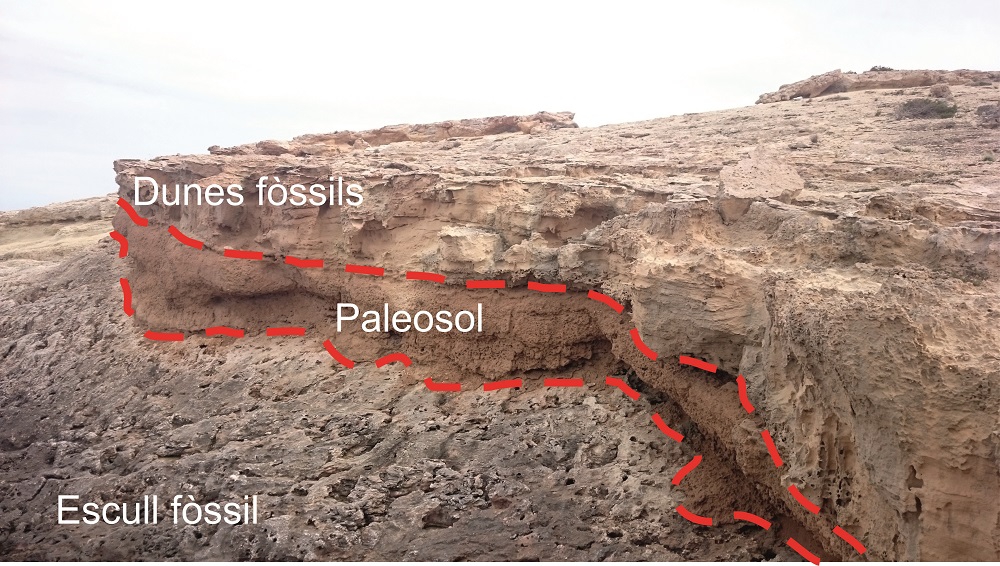
Contact between the fossil reef and the Quaternary deposits.
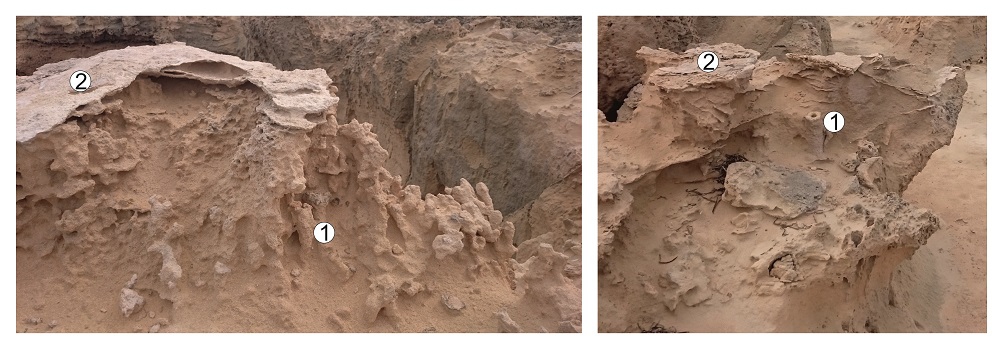
Rhizocretions (1) and encrustments (2) of the Quaternary dunes.
