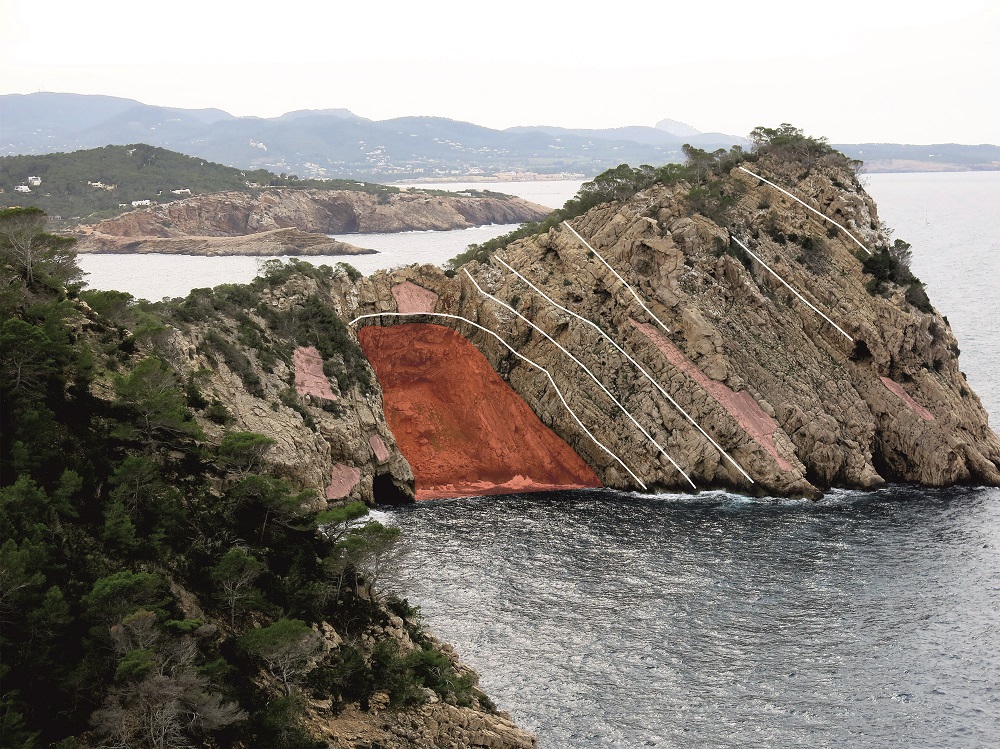
Rock arch, like that of Sa Foradada, are relatively recent and ephemeral geological formations. There are several examples in the Balearic Islands.
The materials that form them tend to be carbonate rocks of a certain hardness, which are weathered by karstic processes induced by fractures and the action of the sea on the shoreline.
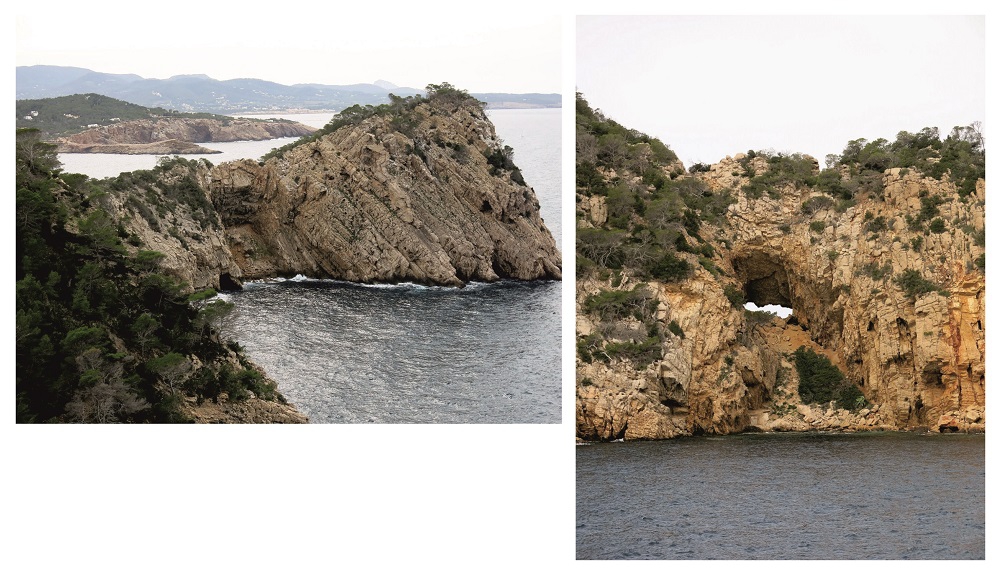
Left: General view of Sa Foradada. Right: detail of the cavity seen from the side opposite that of the previous photo.
At Sa Foradada and in its surroundings these rocks are represented by limestones, marls and dolomies of the Lower Cretaceous, specifically from the Aptian age. In the Sedimentary rock whose main component is calcium carbonate (CaCO3). Its origin can be chemical, organic or detritic.</p><p><br></p></div>">limestone and Sedimentary rock composed of clay rich in calcium carbonate. </p></div>">marl levels is not unusual to see a type of bivalves called rudists, very typical of the Urgonian stratigraphic unit and reflect the specific environmental conditions in which they were formed.</p><p><br></p></div>">facies, which are common in Eivissa but absent in the rest of the Balearics.
All these materials make up a landscape of abrupt cliffs traversed by a main fault running parallel to the sea between the sector of the Punta de Sa Pedrera and the Racó de Sa Foradada. It displays many smaller associated faults.
This system of fractures favours the action of karstic processes, dissolving rocks and forming cavities.
In the strait that joins the Foradada rock with the rest of the island, the main fault is associated with a cavity that initially must have been discreet, but has gradually grown due to successive collapses. As a result of this, the cavity has succeeded in traversing the headland and forming a rock arch.
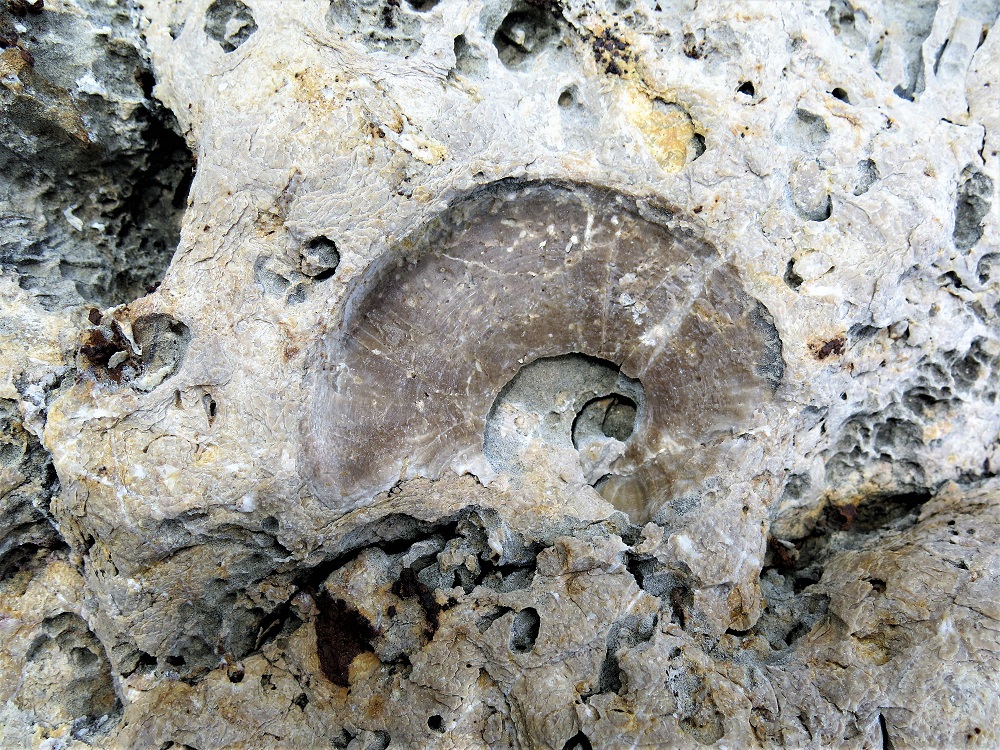
Rudist at a calcareous level of the proximities of Sa Foradada.
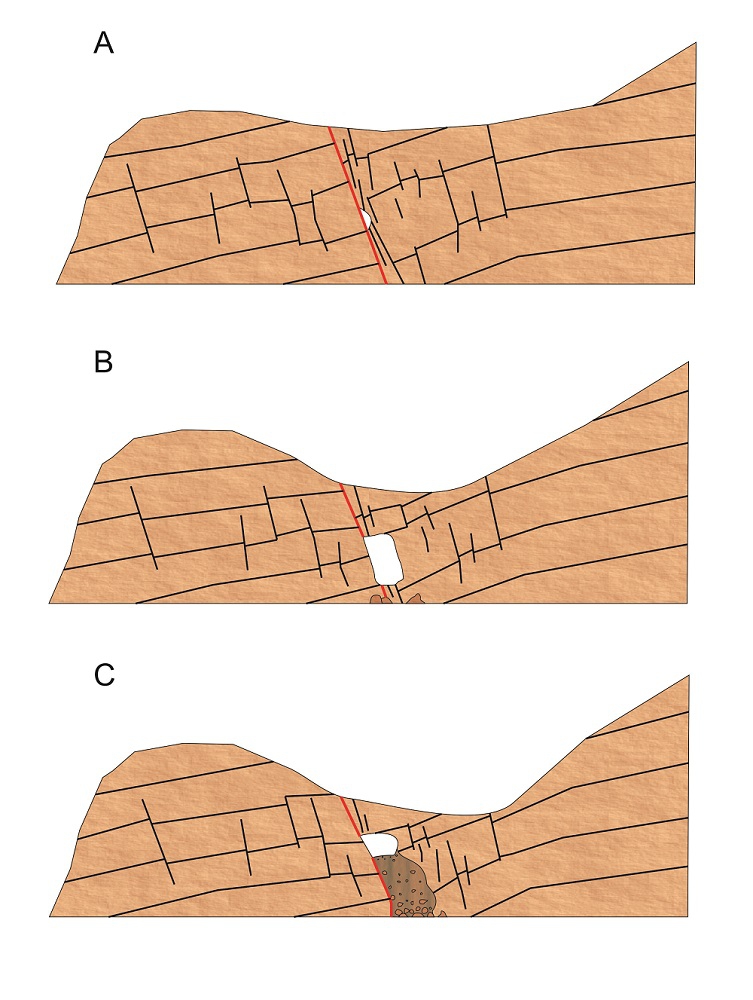
In parallel with the enlargement of the cavity, collapsing materials have accumulated, refilling its lower part. These materials are easy to distinguish for the large number of decontextualised blocks they display, reaching down to the sea.
Another interesting aspect of Sa Foradada is the presence of planar slides in the zone of the cavity.
Planar slides occur in favour of a pre-existing surface. In this case they are the stratification surfaces themselves: they need to plunge down the slope to generate these types of slides.
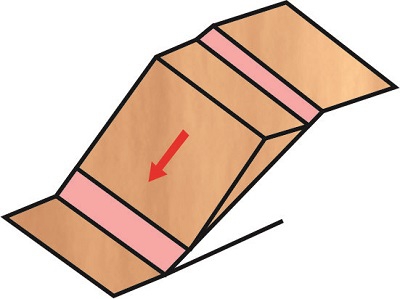
Left above: Diagram representing the origin of the rock arch of Sa Foradada. Right: Diagram showing how planar slides occur. Left below: photograph showing some of the stratification surfaces (pink): some strata have been marked with white lines and the space has been reconstructed later (red).