This Site of Geological Interest is the only one in Menorca that comprises exclusively rocks sedimented during the Quaternary, the latest of the geological periods. This is down to a huge fossil dune that outcrops discontinuously from Es Canutells to the Cala Llucalari cove, although because of the quality of the outcrops, the site of interest only stretches as far as the Racó d’en Pudent inlet on the edge of the Cala en Porter residential area.
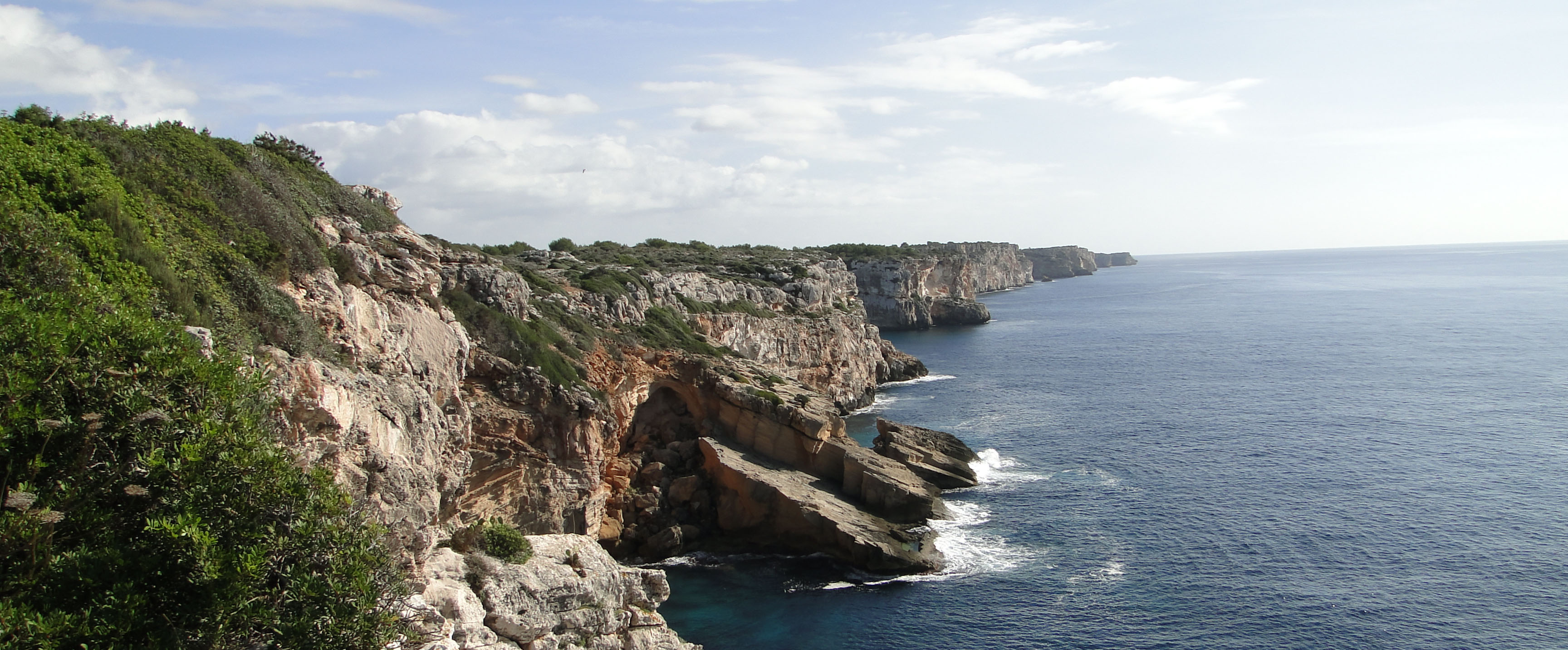
General view of the Site of Geological Interest from Cala en Porter with the fossil dunes at Racó d’en Pudent hugging the cliff in the foreground.
These dunes form a rock created by the consolidation of the sand that accumulated on the coast through the action of the wind and which in the Balearics is called marès. This great pile of sand was the consequence of successive climate changes that have affected the Earth over the last million years. During the extremely cold periods of glaciation, the water on Earth accumulated in the form of large glaciers at the geographical poles and on mountains, leading to a drop in sea level. This process meant that huge extensions of sand were left to the mercy of the wind, which, if it blew from the sea inland, could drag the sand towards the coast creating a line of dunes, which, when it came up against an obstacle, such as a cliff, would deposit sand at the foot of it.
In the site of interest, the drop in sea level and the subsequent accumulation of sand that formed the rocks would have occurred some 140,000 years ago. Dating has been possible thanks to the identification of fossil remains of land snails that lived in the dune when it had not yet been consolidated. These fossils were identified in silt with red colouring contained in the dune at Calescoves cove, as well as at other sites, such as Racó de Sant Josep.
Also of particular interest are the Myotragus tracks, a mammal from the species of the subfamily Caprinae, that have been identified in these fossil dunes. It is believed to have arrived in the Balearics at the end of the Miocene (around 5 million years ago) when a large part of the Mediterranean dried up. Isolated from the outside world and free from predators, its evolution resulted in the rather curious-looking species known as Myotragus balearicus, small in stature, with very short robust legs, very centrally positioned eyes and just one incisor.
The Site of Geological Interest also contains the outcrops at Racó des Suros (very near Es Canutells) and the Racons d’en Pudent and Sant Josep (next to Cala en Porter). At these sites, the rock was used to extract blocks for construction. Marès quarries are relatively common along the Menorcan coast, making it easy to transport the blocks by boat, but because of their distribution, they developed especially in the marès sedimented during the Miocene rather than in the Quaternary, as is the case here.
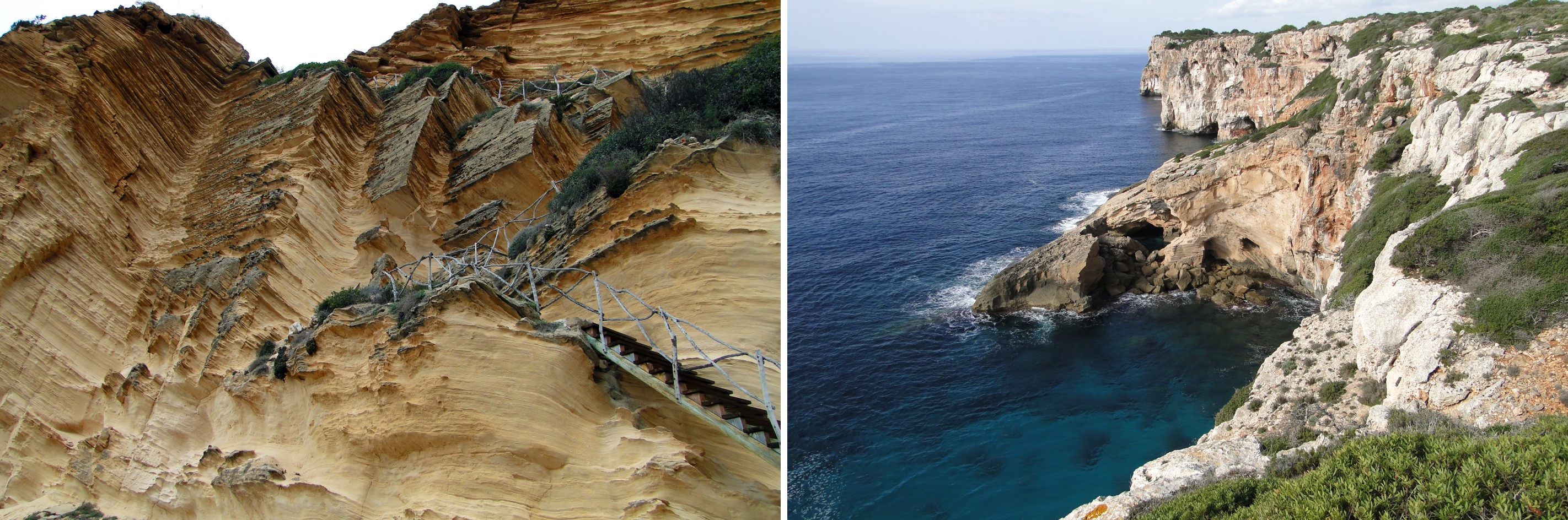
Fossil dunes at Racons des Suros and Sant Josep. Note the walls that adopt flat and vertical surfaces as result of marès mining.
This activity has uncovered stunning slices of rock that reveal its characteristics, such as the cross stratifications. This is a type of sedimentary structure resulting from the layout of the grains of sand, which arrange themselves in laminae that form angles between them. The arrangement is a reflection of the advance of the grains of sand due to the action of the wind that created these dunes. It should also be noted that mining triggers a series of instabilities, in other words, it accelerates its erosion, which causes blocks of rock to fall. Scientists have described the dunes at these two sites as climbing dunes. This type of dune occurs where the sand has risen along one slope due to the action of the wind.
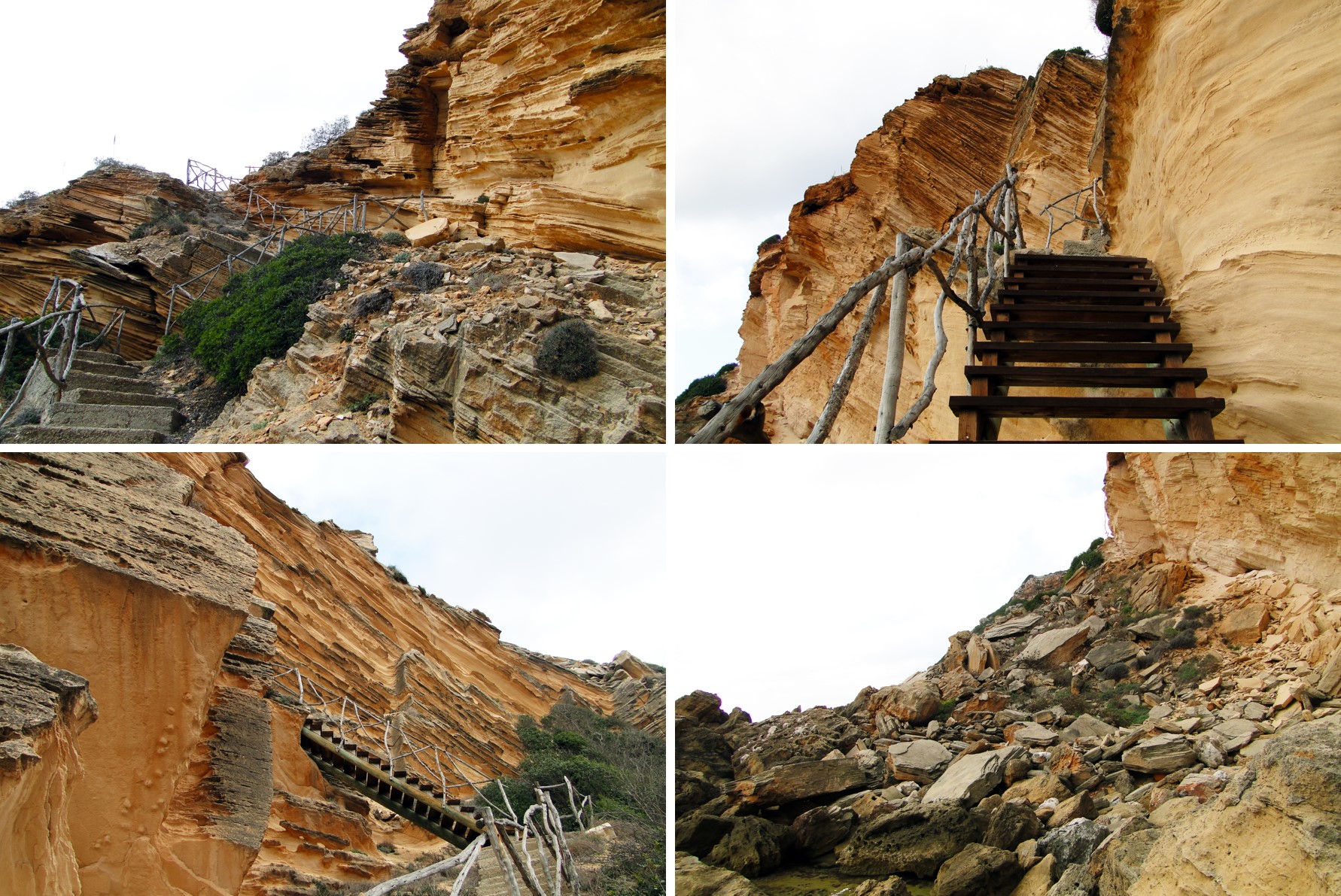
Close-up of the gently sloping laminations at Racó des Suros and of the fallen blocks.
Also, on the cliffs at the western edge of Calescoves cove is the Sa Duna cave, especially unique due to the fossil tracks that the site contains. This is a cavity in the coastline rising some 12 metres above sea level, inside which is a stunning fossil dune that stands at least 14 metres high and has significantly good stratification. The sand that forms the dune must have entered the mouth of the cave, which would have been higher than it is now, until it covered it completely. The mouth of the cave today is the product of erosion on the peak of the dune. In these rocks, an exceptional number of well-preserved traces and tracks of Hypnomys, a doormouse (rodent), described as a species of Balearic giant dormouse endemic to Menorca.
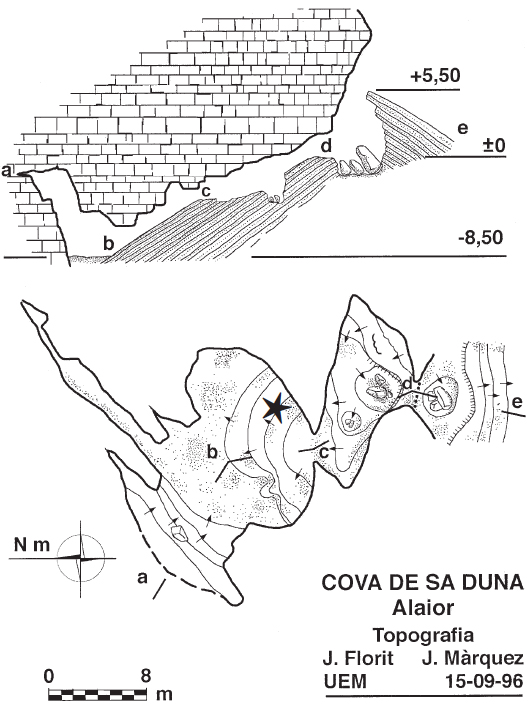
Topographical image of the Sa Duna cave, in cross-section (top) and the floor (bottom). The cave has two main chambers (d and b) with a maximum width of 16 metres, connected by a narrow passage (c). The cave is filled by a fossil dune from the the Quaternary that resulted in marès (topography by J. Florit and J. Màrquez and published by Quintana i Arnau, 2004 and Trias, 2004).
