The geographic and orographic heart of Menorca, the peak of the El Toro mountain offers stunning views over the geological landscape of the northern part of the island. However, its main point of interest is that its own geological series reveals many of the lithologies that make up Menorca’s Tramuntana region and from Es Mercadal looking towards the mountain’s peak, you can see Paleozoic and Mesozoic sediments from both the Triassic and the Jurassic.
From the most ancient to the most modern and from top to bottom, the initial materials that created this geological series are from the Paleozoic and can be easily identified in Es Mercadal. Sediments that were deposited around 400 million years ago (specifically in the Devonian) in the great sea depths by turbulent currents forming successive thin layers of sandstones and lloselles. These rocks dominate the first part of the climb up the mountain until you reach the area around Peu del Toro site. Here the dark materials are superimposed by red materials of continental origin which were sedimented in the lower Triassic (some 250 million years ago) on terra firma due to the action of large rivers.
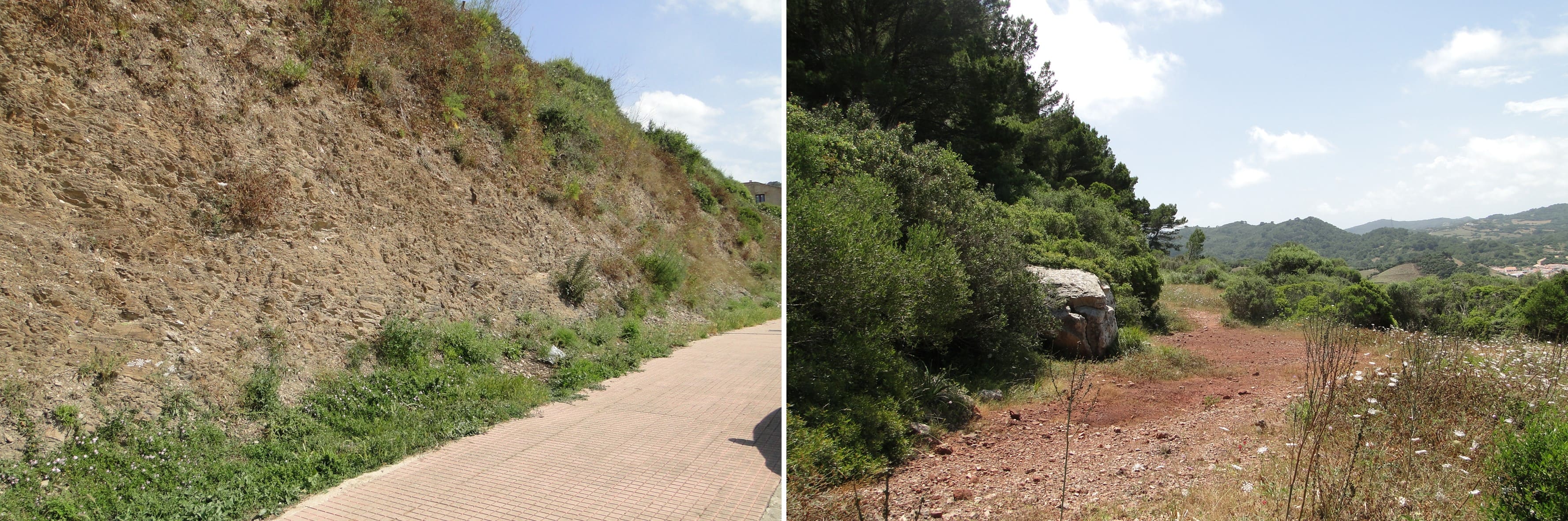
Dark sandstones and lloselles from the Paleozoic in the village of Es Mercadal, and therefore at the foot of the mountain, and red clays situated on top of previous ones in Peu del Toro area.
These red materials might be difficult to see as they are rather heavily covered by vegetation and severely broken by tectonic movements. The point of particular interest in the village is the La Rubia mine, which is very close to where these rocks come into contact with those from the Paleozoic. It was the most important copper mine registered on the island and the mineral is thought to have been first mined in the second half of the nineteenth century.
Almost all mines in Menorca extracted red materials from the Permian-Triassic to produce black or lead-grey copper, known as chalcocite (copper sulphide). This mineral is often found in a different form in other copper carbonate mines, such as malachite (green) and azurite (blue). In ‘La Rubia’, barite has also been identified and traces of zirconium detected. Copper mineralisation is linked to very oxygen-deficient environments where remains of vegetation accumulated, that became coal, which is why this sedimentary rock is often found in the walls of the mine.
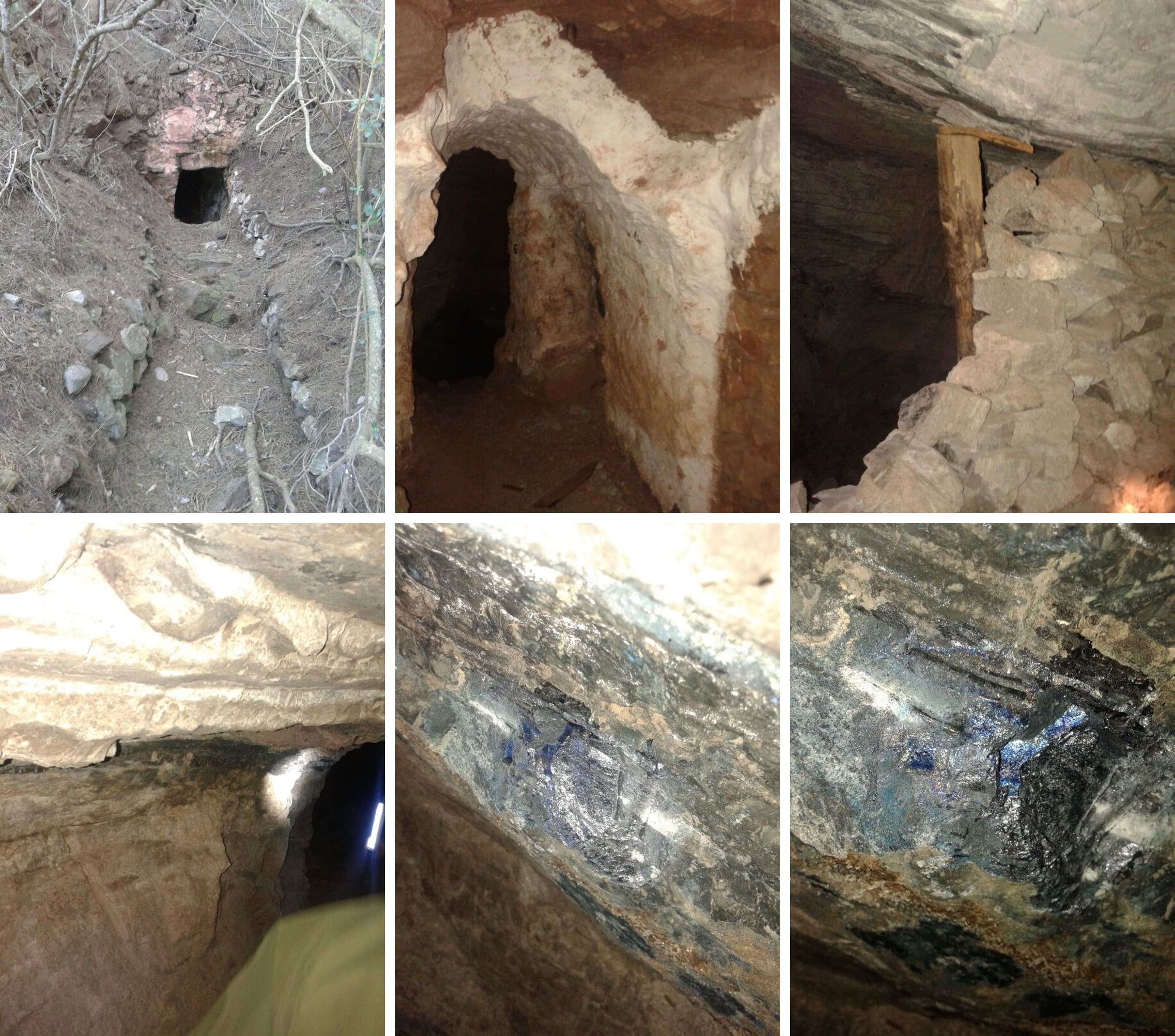
Main access to “La Rubia”, whitewashed masonry arch and remains of underpinning inside the mine (top); and the coal seam (lignite) with chalcocite (black – lead-grey) and with the presence of other altered minerals (azurite, blue) (bottom).
Above the red lower Triassic rocks you will see some other grey rocks that were sedimented afterwards, in the middle Triassic, albeit in a very different environment, as they were deposited in a tranquil shallow sea. Consequently, the continental sedimentation that created the red rocks was cancelled out by a rise in the sea level, which was home to many different forms of life, such as ammonoids and many other species of molluscs. The skeletons of these organisms, very frequently partially or completely broken by the waves, would end up creating a sediment. The cementation of the grains that form the sediment led to the formation of a rock: Sedimentary rock whose main component is calcium carbonate (CaCO3). Its origin can be chemical, organic or detritic.</p><p><br></p></div>">limestone.
Idealised reconstruction of a marine environment with calm and shallow waters in Menorca during the middle Triassic with an abundance of organisms, whose skeletons would form a large part of the sediment that would become the limestone rock we see today.
The middle Triassic Sedimentary rock whose main component is calcium carbonate (CaCO3). Its origin can be chemical, organic or detritic.</p><p><br></p></div>">limestone rocks present the best tectonic, eustatic or antropical processes</span></p></div>">outcrop conditions in El Toro’s geological series. From Peu del Toro site, rising some 200 metres, you will first see these rocks at a bend in the road called the Penya des Bou cliff. This very fine-grained Sedimentary rock whose main component is calcium carbonate (CaCO3). Its origin can be chemical, organic or detritic.</p><p><br></p></div>">limestone rock is characterised by the fact that it is very often bioturbated, in other words, when the rock had not yet consolidated and was still a sediment, it was shaken up by animals (possibly crabs) which dug tunnels that have become fossilised in the form of tubes. These animals were not fossilised as they had no hard parts, but their actions have been preserved. The result is a rock, known as El Toro stone, which has an uneven blemished surface that sometimes is shrouded in yellow. You can also identify flint nodules, rounded, globular masses, measuring centimetres to decimetres, with a silicate composition that is different to that of the Sedimentary rock whose main component is calcium carbonate (CaCO3). Its origin can be chemical, organic or detritic.</p><p><br></p></div>">limestone rock in which they are embedded.
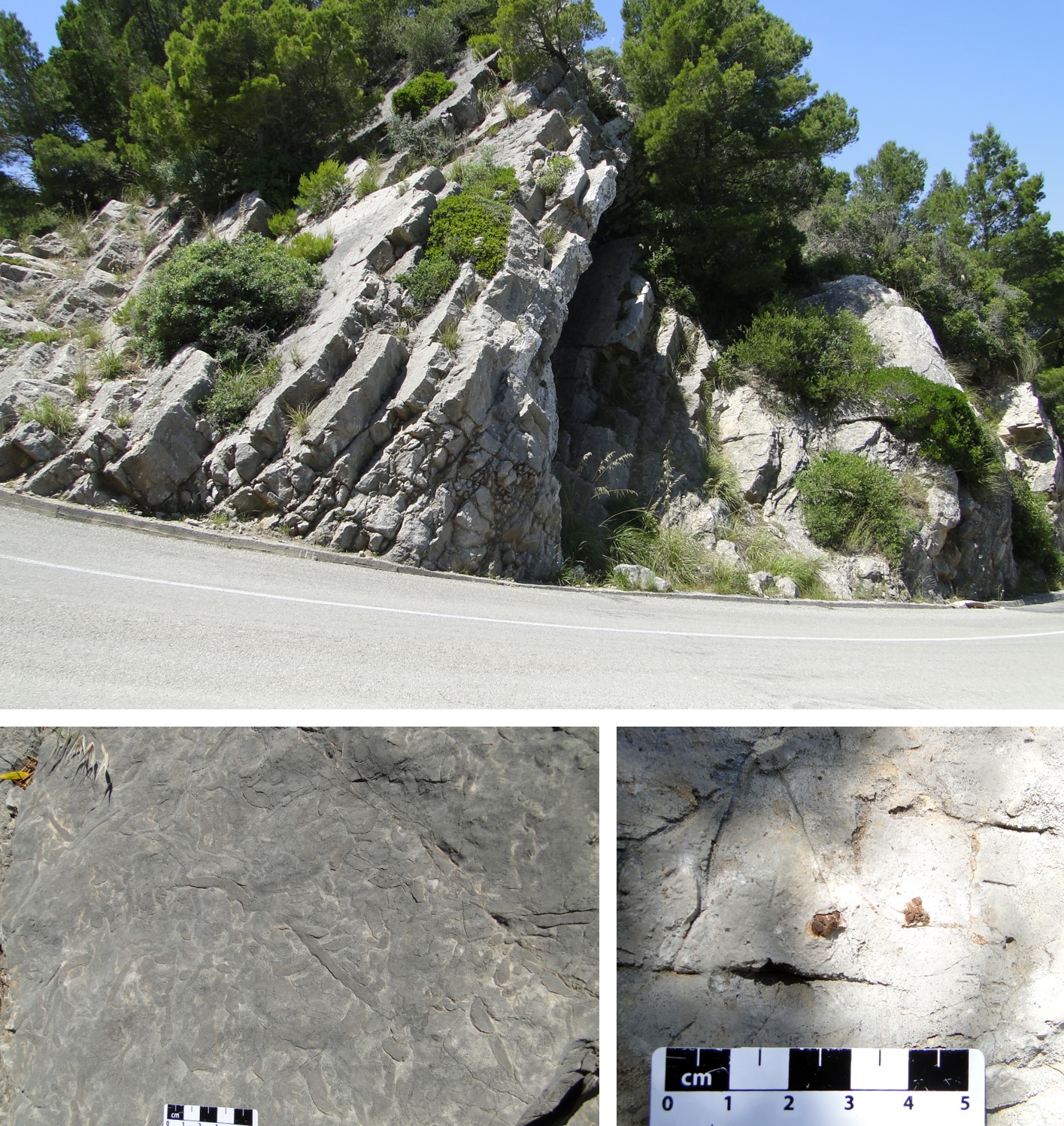
Penya des Bou outcrop. Rocks in the lower (and therefore oldest) section from the middle Triassic of El Toro’s geological series. The layers are arranged perfectly vertically due to the effect of tectonic movements. Below, a close-up of the blemished rocks due to the effect of bioturbation (El Toro stone) with flint nodules identified to the left of the outcrop.
These rocks can also be easily seen from the road in an abandoned quarry where the rock was extracted and ground to produce aggregate for the island’s construction industry. Here you can see the middle Triassic series more extensively: levels of bioturbated Sedimentary rock whose main component is calcium carbonate (CaCO3). Its origin can be chemical, organic or detritic.</p><p><br></p></div>">limestone (El Toro stone), underneath, thick strata of dolomites and below other finely stratified Sedimentary rock whose main component is calcium carbonate (CaCO3). Its origin can be chemical, organic or detritic.</p><p><br></p></div>">limestone (which was the main work of the quarry).
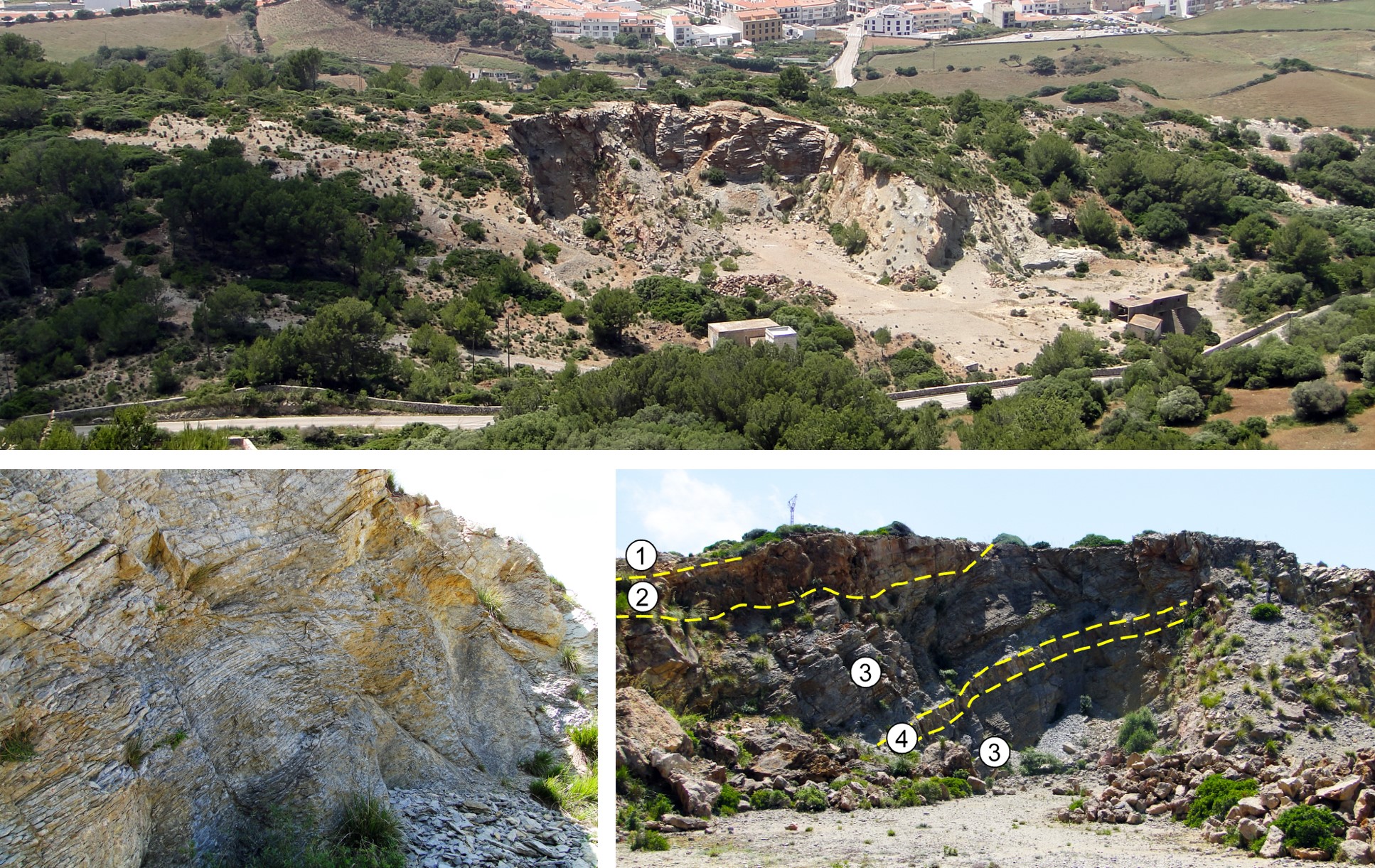
General view of the aggregate quarry, close-up of finely stratified limestone and the geological series: El Toro stone (1), massive dolomites (2), finely stratified limestone (3) and level of dolomitic limestone (4).
Marls and Sedimentary rock whose main component is calcium carbonate (CaCO3). Its origin can be chemical, organic or detritic.</p><p><br></p></div>">limestone containing fossils of bivalves (clams), known as ‘Daonella’, and that lived only during the middle and upper Triassic, have also been found at the quarries. The appearance of this fossil, with a radiating heavily-ribbed shell, meant that mythologically they were thought to be the rays left by the Virgin of El Toro on the rocks. In these outcrops, you can also see other fossils, such as cephalopods ammonoids (ceratitida). In any event, the entire tectonic, eustatic or antropical processes</span></p></div>">outcrop has been thoroughly plundered making it difficult to find any fossils.
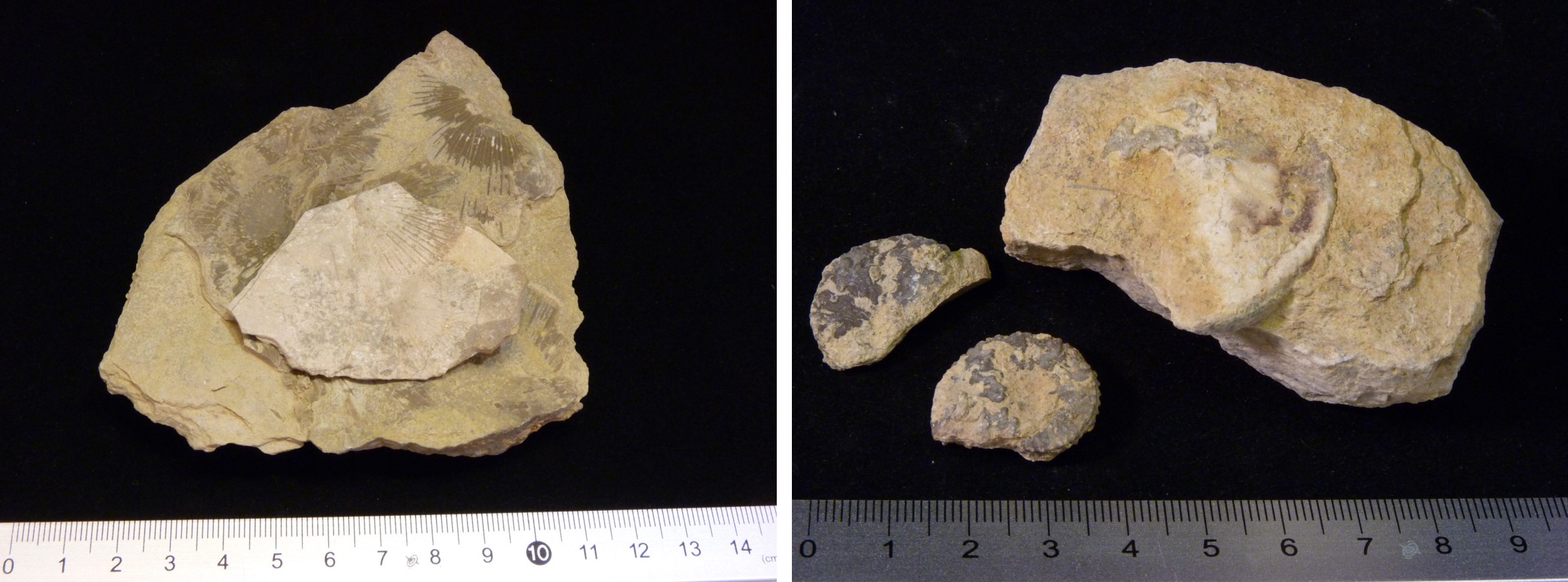
Fossils of Daonella and ceratitida from the Triassic on Menorca that have been deposited and exhibited at the Menorca Geology Centre.
Some 300 metres south of this quarry is another where the slabs of El Toro stone were extracted, which, due to its unusual appearance, was highly-prized on the island for dressing façades and use in garden pavings. Perpendicular to the strata that make up these levels of rocks (among which you find yellowish clay), the fractures are rather widely-spaced, making it easy to separate relatively large slabs.
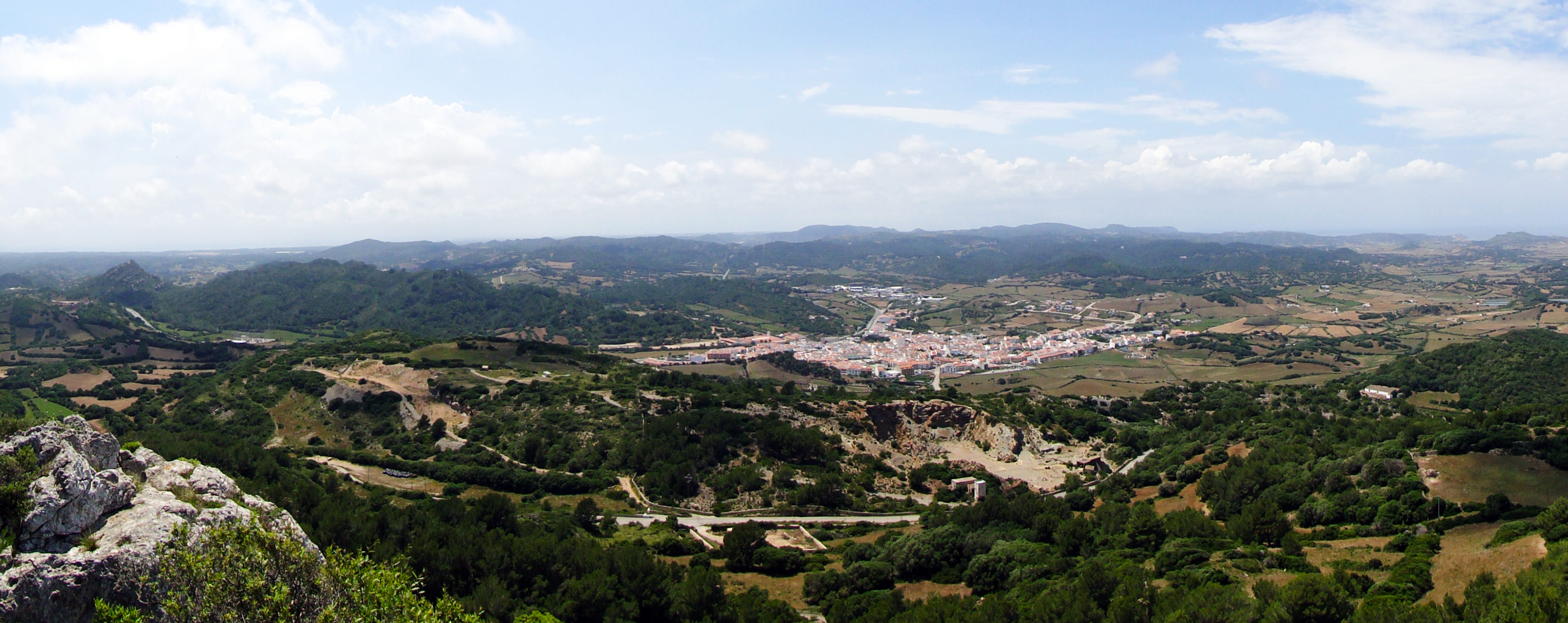
Quarry where the ornamental El Toro stone is extracted left) and aggregate quarry (right).
Above these rocks we find the marls from the upper Triassic, the first of which are more yellow and the ones above green-grey in colour. This section is more or less covered by overlying materials that have slipped. Finally, the series is topped with rocks from the Jurassic (sedimented some 200 million years ago) comprising mainly dolomitized Sedimentary rock whose main component is calcium carbonate (CaCO3). Its origin can be chemical, organic or detritic.</p><p><br></p></div>">limestone. These were originally Sedimentary rock whose main component is calcium carbonate (CaCO3). Its origin can be chemical, organic or detritic.</p><p><br></p></div>">limestone rocks that were buried and covered by other materials that pressed down on them. Under these conditions and through the presence of water with magnesium, Sedimentary rock whose main component is calcium carbonate (CaCO3). Its origin can be chemical, organic or detritic.</p><p><br></p></div>">limestone can become a dolomite. In other words, it is very common for a dolomite to have originally been a Sedimentary rock whose main component is calcium carbonate (CaCO3). Its origin can be chemical, organic or detritic.</p><p><br></p></div>">limestone rock, made up like all of them of CaCO3. When large volumes of water with high levels of magnesium flowed through these rocks, the calcium was replaced by magnesium, which led to the creation of this new rock.
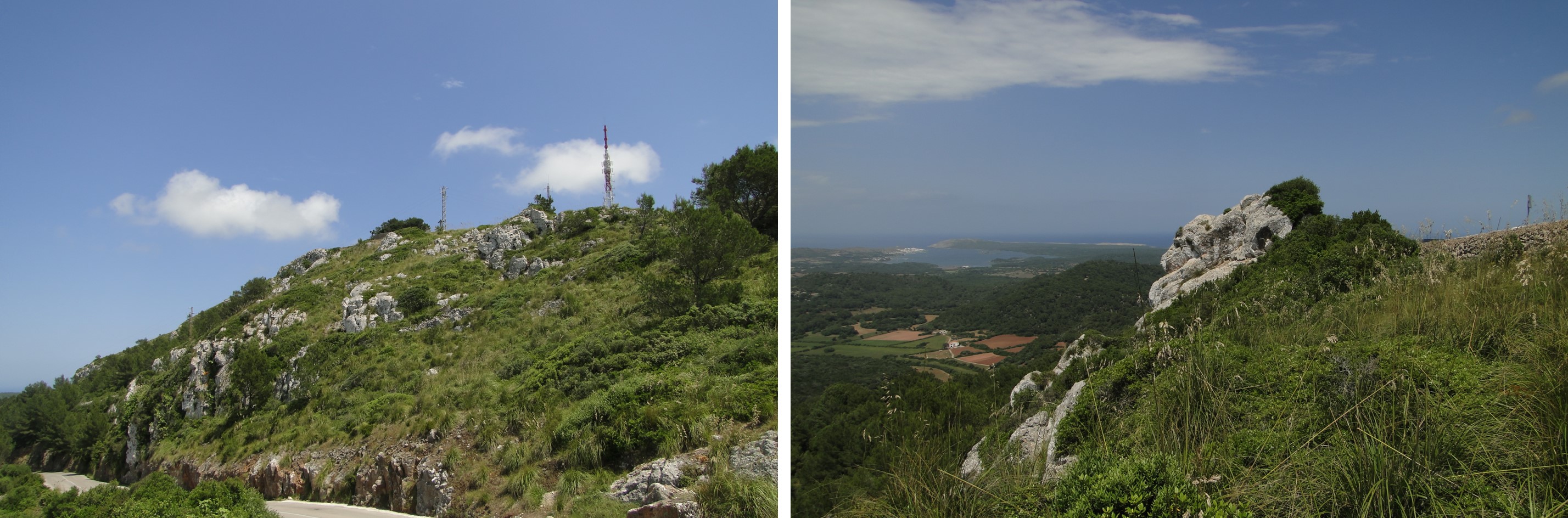
Levels of massive grey dolomites on the peak of El Toro.
