The Torrent de Pareis constitutes one of the classic excursions of the island of Mallorca because of its scenic beauty and natural values. Geologically speaking, it is very remarkable as it is the largest karstic canyon in the Balearic Islands.
The Serra de Tramuntana is formed by Sedimentary rock whose main component is calcium carbonate (CaCO3). Its origin can be chemical, organic or detritic.</p><p><br></p></div>">limestone rocks whose main component, calcium carbonate, tends to be diluted through the fractures by rainwater. This gives rise to a special landscape called karst, with an abundance of caves, chasms, karren and dolines.
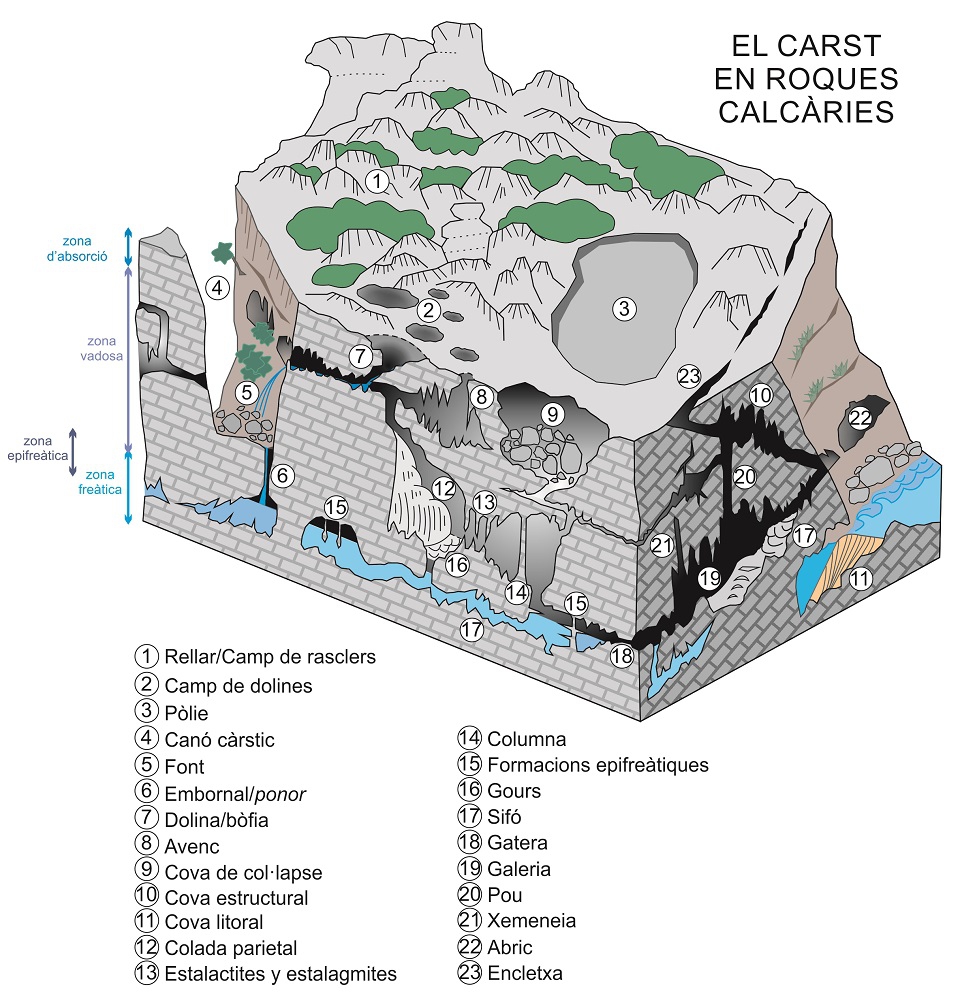
Torrents crack in the rock, taking advantage of the fissures. With the passing of many thousands of years they finally excavate gorges with vertical walls called karstic canyons (see the diagram of their formation). This category includes the Torrent de Pareis, located in the karst of Escorca with walls composed of limestones of the Lower Jurassic (200-185 Ma).
Although karstic canyons are relatively common structures in Mallorca, especially in the Serra de Tramuntana, the Torrent de Pareis has dimensions that surpass all the others because it derives from the union of two important watercourses: the Torrent del Gorg Blau, coming from the southwest, and the Torrent de Lluc coming from the east.
In the route from the zone of S’Entreforc (start of the stream bed) to S’Olla (its end), we can not only admire its impressive walls but also observe a set of geological features typical of the karstic torrents of the Serra.
There follow a comments on some of them, as they appear along the route.
S’Entreforc: it corresponds to the confluence zone of the Torrents del Gorg Blau and Lluc (also named d’Aubarca). This is the birth of the Torrent de Pareis.
This is one of the zones where erosion has had most impact, sculpting some of the tallest walls of its route, some of which reach 250 m. Observing carefully the limestones that form the cliffs, it is not difficult to detect the vertical striations caused by rainwater corrosion.
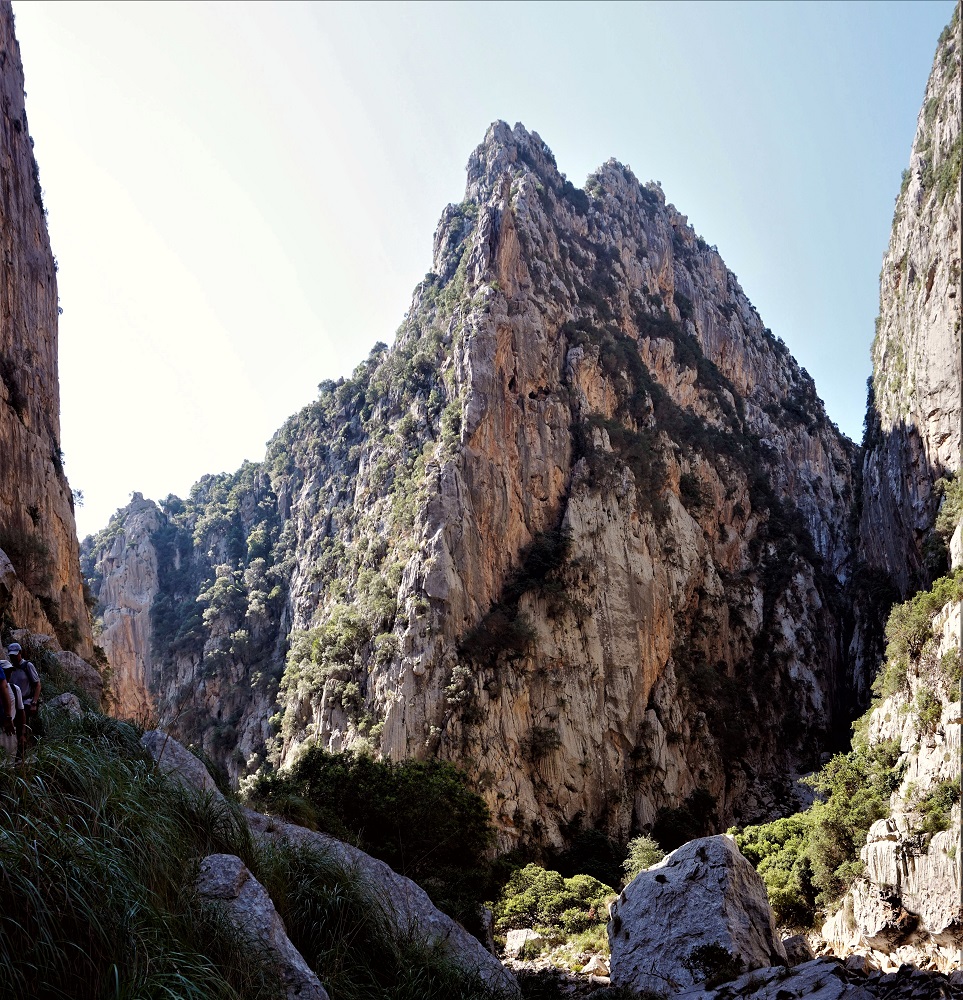
Panoramic view of S’Entreforc, with the Torrent de Lluc (left) and the Torrent des Gorg Blau (right).
Sa Fosca: walking some 5 minutes in the Torrent del Gorg Blau we will reach the final section of Sa Fosca. Its name (“the dark”) refers to the fact that the sunlight never enters it directly, being in penumbra even at midday. This is due to the narrowness of the bed, combined with the depth and verticality of its walls, which even come together at some points.
In addition to the grandeur of the place, a notable feature is a large parietal flow that cover the fallen blocks in the stream bed.
From this point on, the route becomes more difficult because we have to clamber over and around the large blocks that have fallen into the bed from the cliff walls flanking it.
Gorg des Capellà: this gorge is one of the many along the route, its features being common to all of them. These are zones where the stream bed narrows and the large blocks of rock suddenly disappear, leaving the substrate visible. This tends to be the Sedimentary rock whose main component is calcium carbonate (CaCO3). Its origin can be chemical, organic or detritic.</p><p><br></p></div>">limestone itself, stripped bare and polished by the action of the water currents, leaving a typical pattern formed by concave morphologies called gouge marks. In some zones this substrate corresponds to a sedimentary rock of detritic origin (clasts larger than 2 mm).</p></div>">conglomerate, rock formed in turn by fragments of other rocks. This tells us that in the past the stream must have been inactive for a sufficiently long time for the pebbles that then dotted its bed to become cemented. As we continue onwards, the substrate is covered with a large accumulation of small pebbles, similar to those forming the conglomerates. In the walls of the gorge we can observe the water level reached in flood periods.
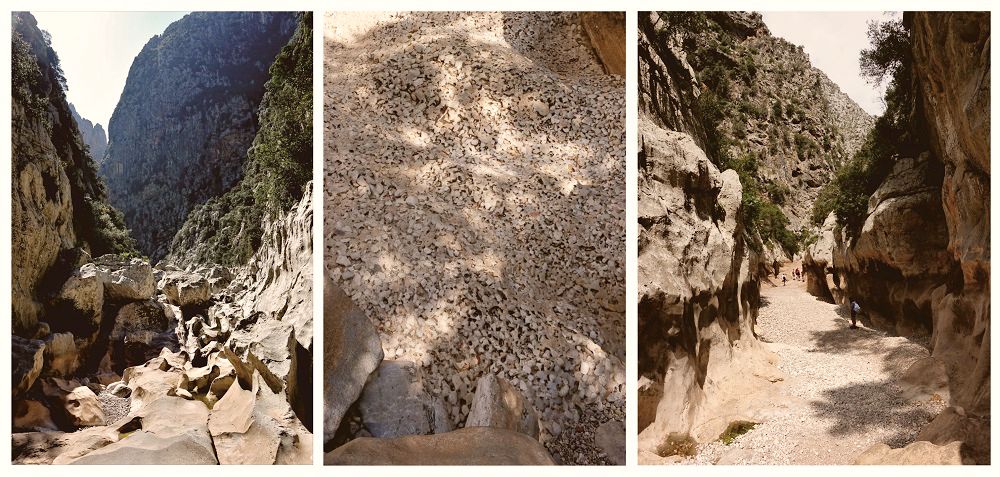
Start of the Gorg des Capellà, with gouge marks, detail of the conglomerates and intermediate zone filled with gravels.
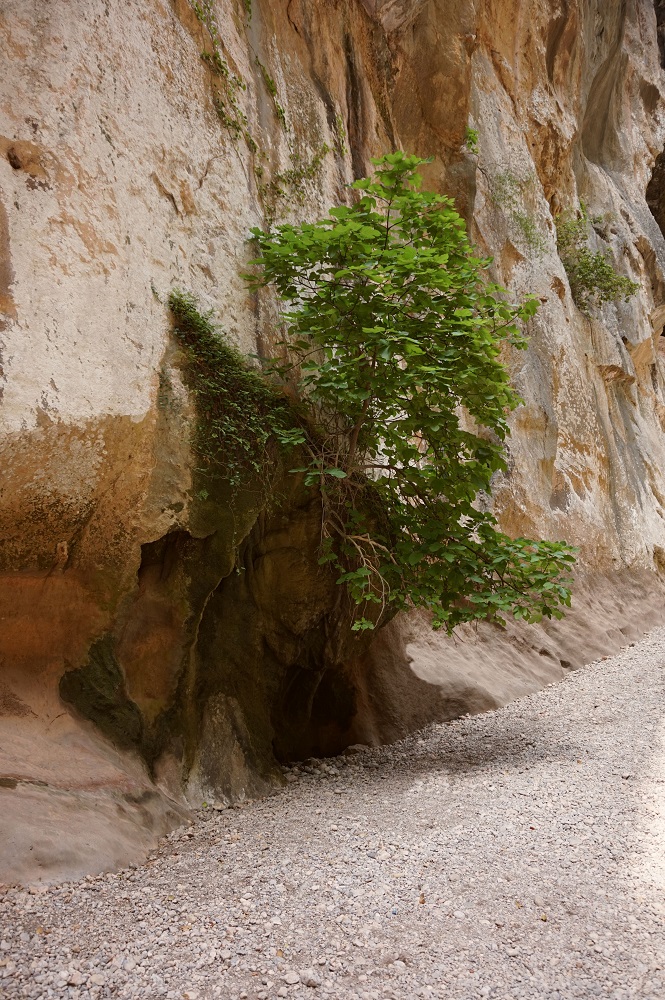
Cova des Romegueral: this is a cave with a wide entrance situated on one side of the stream bed. Its name comes from the romeguera, a bramble that grows in the area. The mouth has a characteristic fig or pear shape, very narrow and prolonged upwards and wide at the base.
This is a cave that developed from a vertical fracture of the rock affected by the karstic processes, which weak the rock and cause rock falls. It is a collapse cavity like many others we will see along the route.
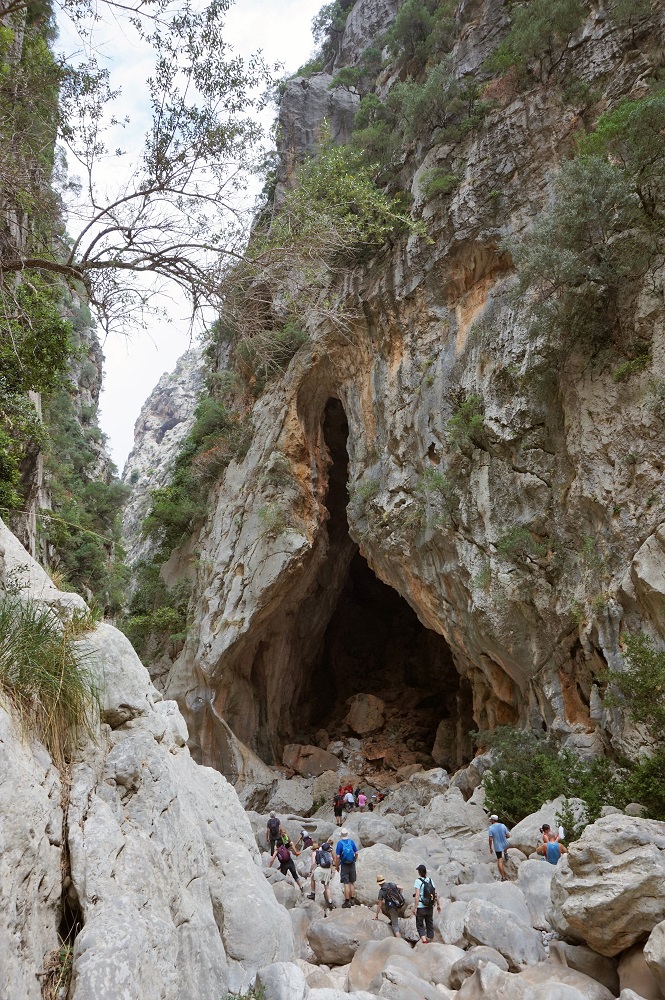
Cova des Romegueral and its characteristic pear shape.
El Degotís: it is an emergence of water through a crack in the rock where a small Sedimentary rock originated by the precipitation of calcium carbonate from supersaturated waters, especially in zones of karstic emergences.</p></div>">travertine concretion has formed. This type of spring is frequent in the walls of karstic canyons. Due to the drastic lowering of the pressure of CO2, the calcite precipitates developing Sedimentary rock originated by the precipitation of calcium carbonate from supersaturated waters, especially in zones of karstic emergences.</p></div>">travertine.
S’Olla: this zone constitutes the end of the torrent. In strong contrast with the narrow landscapes that precede it, at S’Olla the land widens out considerably, forming a large, flat valley surrounded by vertical walls that give the place its name (“saucepan”).
At this point the substrate consists of pebbles carried along the stream bed which finally accumulate in S’Olla because the energy of the water decreases.
Reaching the coastline, the walls narrow again. It is at this point that the stream bed ends in a pebble barrier (called a codolar) which normally separates the stream bed from the sea. However, after periods of heavy rain the flow reactivates and breaks through the barrier to enter the sea.

Zone of S’Olla and mouth of the Torrent de Pareis
In addition to these particular features of each zone described above, along the route it is very common to observe potholes, hollows in the rock formed in places where one or more stones have been trapped by the current, spinning around and finally eroding the substrate to the point of perforating it.

Various potholes along the route
