During the Jurassic (201-145 Ma), what is today Mallorca formed part of a seabed. Much later, approximately 25 Ma, the materials folded and rose up, forming the present-day reliefs of the island. They include a small mountainous system called the Serra de Son Amoixa, a part of the Serres de Llevant.
In the SGI of Son Amoixa we can observe one of the most relevant points of the area for studying the Jurassic, thanks to the good exposure and quality of the tectonic, eustatic or antropical processes</span></p></div>">outcrop.
This is a series of almost vertical Sedimentary rock whose main component is calcium carbonate (CaCO3). Its origin can be chemical, organic or detritic.</p><p><br></p></div>">limestone strata on the surface on which several consecutive numbers have been painted, corresponding to different layers identified during a stratigraphic study.
In order to carry out a stratigraphic study, geologists locate outcrops where the stratigraphic series they want to study is especially visible, determine the level from which the series is going to be “made” (base level) and a final level called top level, measure the thicknesses of each of the strata, number them and take samples of each one to take to the laboratory. In the laboratory the fossils they contained are studied by means of thin laminas, their chemical composition, etc., and with all this information the evolution of the environment within the stratigraphic series is reconstructed.
In the case of the tectonic, eustatic or antropical processes</span></p></div>">outcrop of Son Amoixa, the environment in which the limestones were formed corresponds to a zone of shallow waters of the Lower Jurassic (201 - 175 Ma).
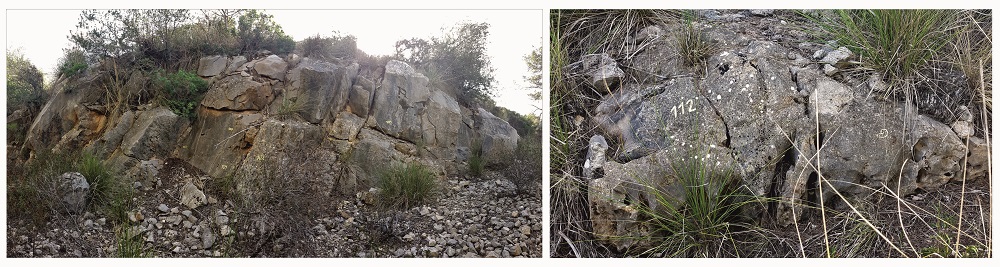
Panoramic view of one of the embankments with limestones of the Lower Jurassic, numbered in yellow (left). Detail of one of the numbered levels (right).
The strata continue above, but they are not numbered because they have not yet been studied in detail. On this occasion no hard limestones are observed but instead softer lithologies, marls, and in much thinner levels.
They correspond to the Middle Jurassic (175-165 Ma) and represent much deeper seawaters, named pelagic.
Occasionally some fossils can be observed in these materials at first sight. Perhaps the most notable are the belemnites, a type of cephalopod mollusc very similar to the modern-day squids, whose shell is very characteristic of the fossil record of the Jurassic.
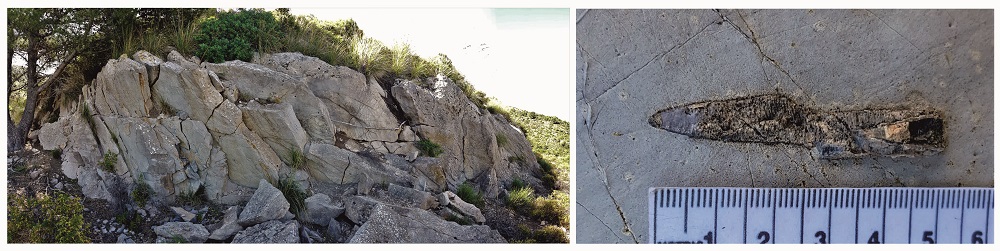
Well-stratified materials of the Middle Jurassic (left). Belemnite fossil fractured by small faults (right).
