This is an intermittent natural spring located in the Gabelí Petit property, close to the urban nucleus of Campanet. Due to its exceptional characteristics, in 2001 it was declared a Natural Monument by the Balearic Government, which has taken charge of it since 2005.
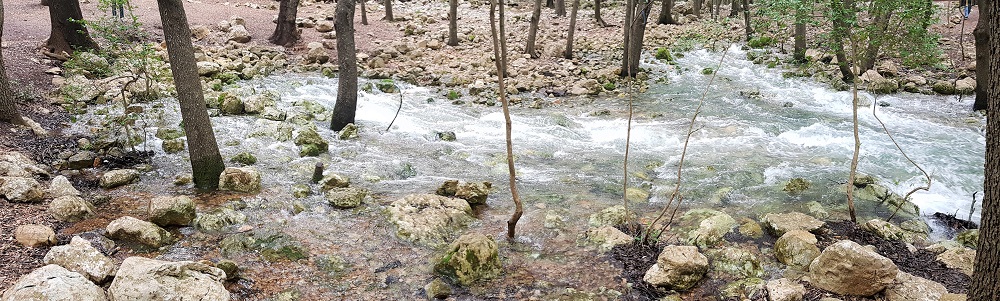
The Fonts Ufanes in action. Notice the force of the upwelling.
Although it acts only intermittently, coinciding with the times of heaviest rainfall, the water emerges abruptly, pouring out an enormous volume of water in a brief period of time, a scene that attracts numerous visitors.
The origin of its abnormal hydrogeological behaviour lies in the geological configuration of the zone.
The upwelling is related with the presence of a normal fault which brings extremely permeable materials due to karstic processes (limestones) into contact with very impermeable materials (marls).
In normal conditions - most of the year - the Top level of subterranean water where the hydraulic pressure is equal to the atmospheric pressure.</p><p><br></p></div>">water table remains below the surface because the aquifer is capable of accommodating the water that reaches it. However, after several days of rain in the mountains, the volume of water exceeds the aquifer’s storage capacity and bursts to the surface through the fault.
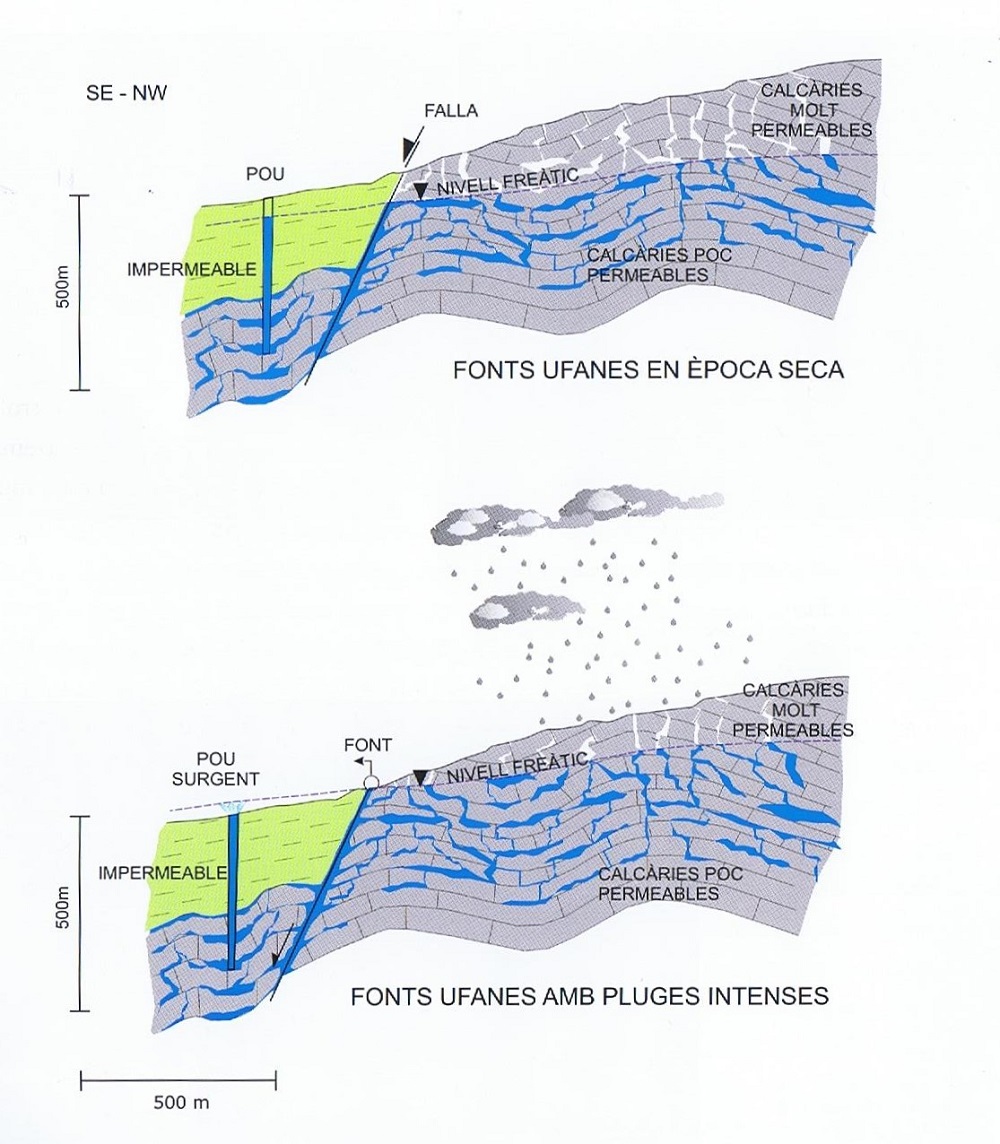
Diagram of the functioning of the Fonts Ufanes (Mateos & González, 2009).
The force of the upwelling is such that numerous studies have been conducted to determine its functioning and with the idea of exploiting it. Proof of this are the numerous sounding probes we can see in the property, some of which even pour out water when the springs are active.
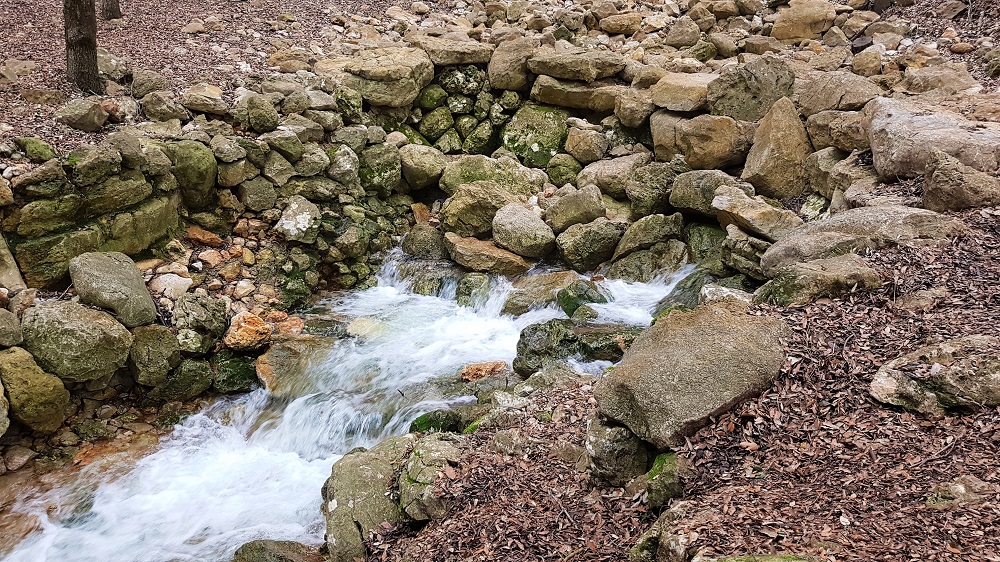
Detail of the wall of rocky blocks created in one of the main upwellings.
The landscape around the spring is the typical karstic scenery of the Tramuntana range: a holm oak wood developed over a substrate of limestones affected by phenomena of dissolution and formation of cavities (as can be seen in one of the hillsides).
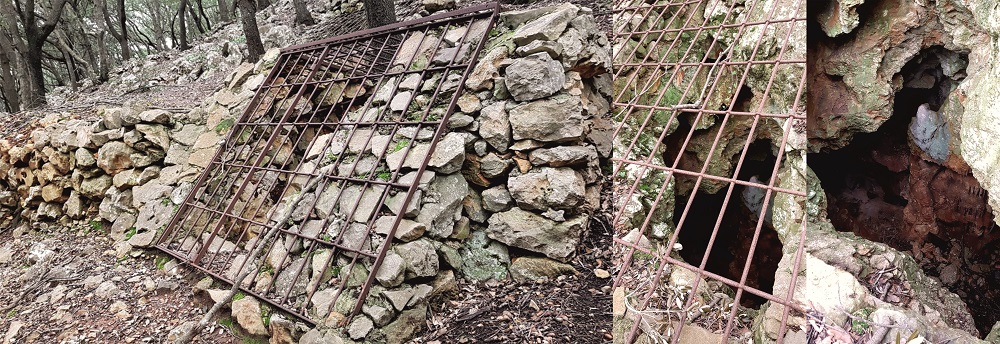
The Cova Estreta de Gabellí cave, located in one of the hillsides of the zone.
Age-old human activity in the area is manifested by the existence of a talayot, numerous sitges (circular stone platforms for producing charcoal from oak wood) and a lime kiln for extracting lime from Sedimentary rock whose main component is calcium carbonate (CaCO3). Its origin can be chemical, organic or detritic.</p><p><br></p></div>">limestone rock.
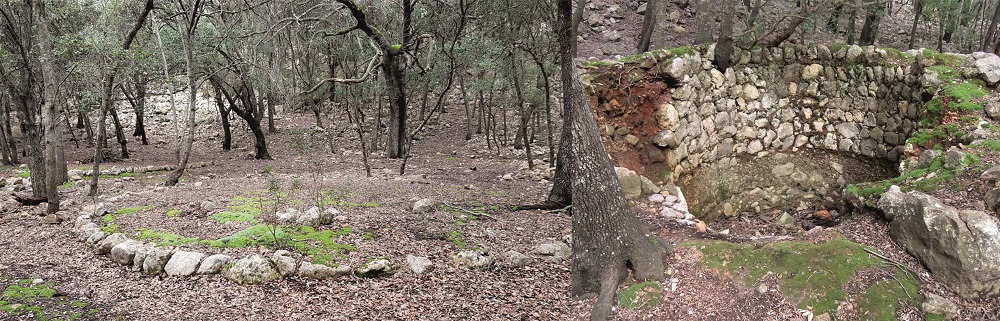
Numerous sitges like the one in the photo and a lime kiln testify to intense human activity in the zone.
It is worth going as far as the Biniatró stream, behind the talayot, to see a singular karstic landscape of large isolated blocks of rock riddled with holes, where in times of heavy rainfall numerous springs also emerge.
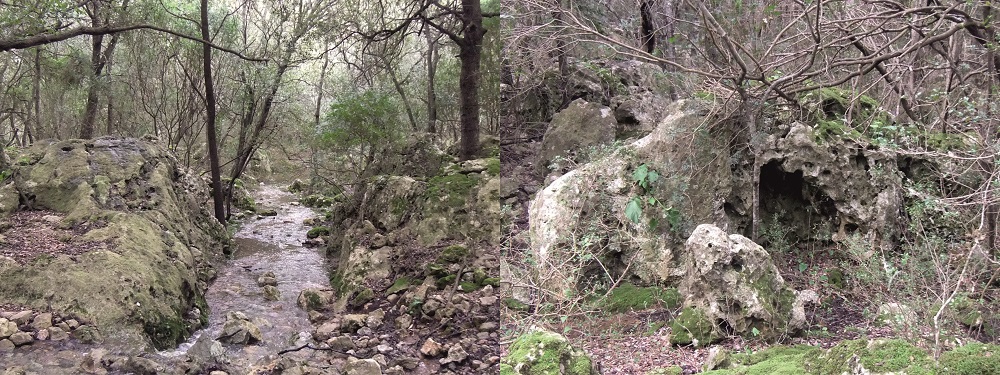
Singular karstic landscape in the vicinity of the Biniatró stream.
