Port Addaia is a narrow bay excavated in the contact between the rocks that were sedimented during the Triassic and Jurassic. The action of a river, probably at a time when the sea level was lower than today, swept away the softer sediments that had been deposited at the end of the Triassic (some 200 million years ago). These materials were most likely marls, a soft sedimentary rock with an earthy appearance, comprising fractions of clay and calcium carbonate (such as Sedimentary rock whose main component is calcium carbonate (CaCO3). Its origin can be chemical, organic or detritic.</p><p><br></p></div>">limestone) in many varying colours due to the different components that it may contain (organic matter, iron, etc.) and the proportion of them. They are usually sedimented in calm lacustrine marine environments.

General view of the site of interest from the Cala en Brut cove with the Punta de Mongofra headland in the foreground and the Illa Petita d'Addaia and Illa Gran d'Addaia small and large islands in the background that protect the port from storms.
The materials that are most resistant to erosion stand proud on either side of the bay, forming reefs and even islets inside the bay. As a result, the western edge of the port has outcrops of dolomites from the Jurassic, while the eastern edge has Sedimentary rock whose main component is calcium carbonate (CaCO3). Its origin can be chemical, organic or detritic.</p><p><br></p></div>">limestone from the Triassic (the characteristic intense bioturbation that this Sedimentary rock whose main component is calcium carbonate (CaCO3). Its origin can be chemical, organic or detritic.</p><p><br></p></div>">limestone experienced, and the lead tone of its grey colour, help locate the outcrops). In the centre of the port, Illa de Ses Mones island, modelled on Sedimentary rock whose main component is calcium carbonate (CaCO3). Its origin can be chemical, organic or detritic.</p><p><br></p></div>">limestone from the Triassic, has also resisted erosion. Also of interest here are the Illa Gran and Illa Petita d’Addaia islands formed of rocks from the Jurassic, dolomites and Sedimentary rock whose main component is calcium carbonate (CaCO3). Its origin can be chemical, organic or detritic.</p><p><br></p></div>">limestone that have also withstood erosion thanks to the fact that they are hard rocks, and also where numerous karst erosion processes have been identified, in other words, specific forms have developed, caused by the processes of erosion and corrosion due to the effect of drainage of underground water and the sea.
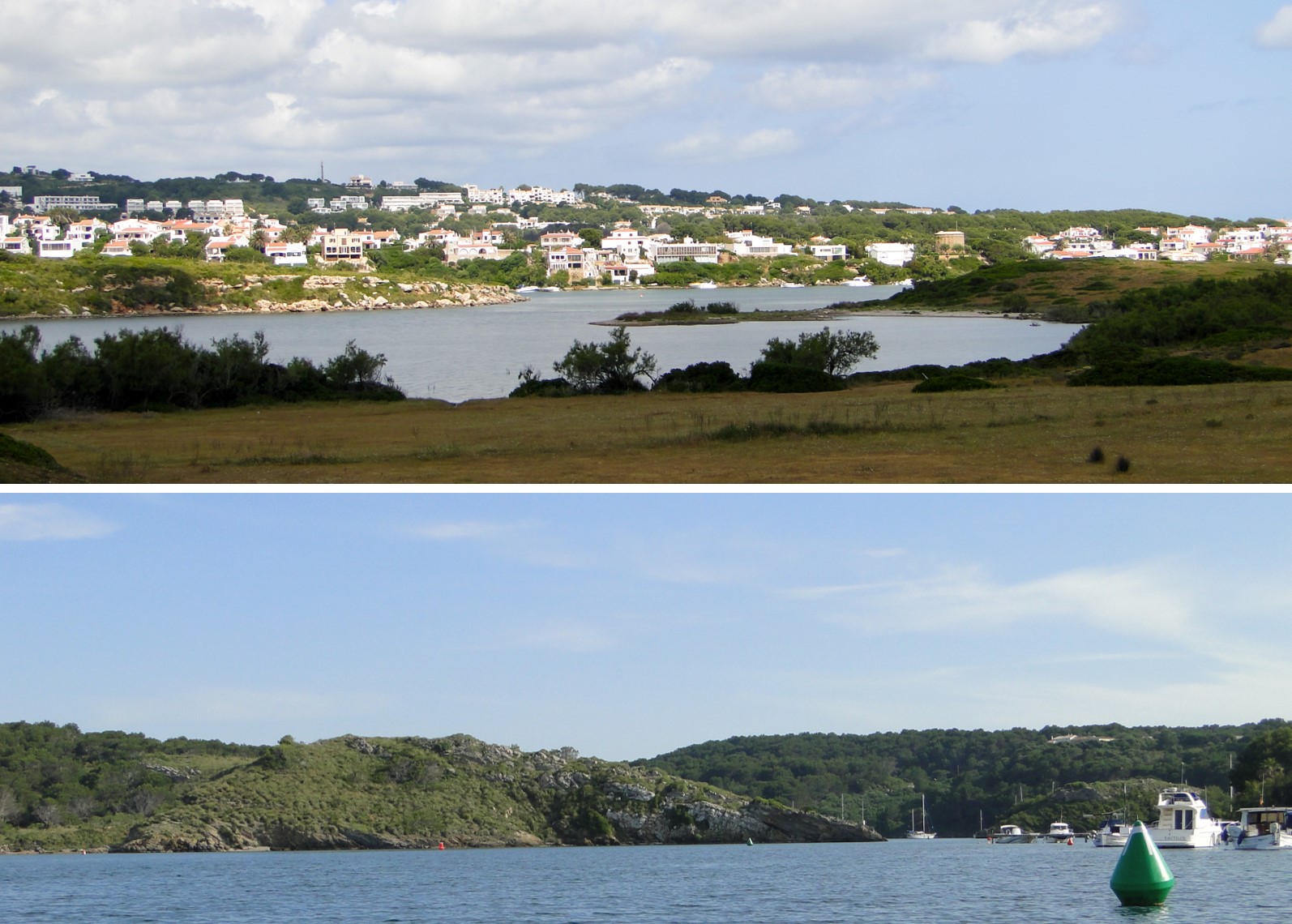
General view of Port Addaia and the entrance to it (bottom) with the limestone from the Triassic in the foreground that runs along its eastern edge. Along the other edge, the dolomites and limestone from the Jurassic are pretty much covered by the forest.
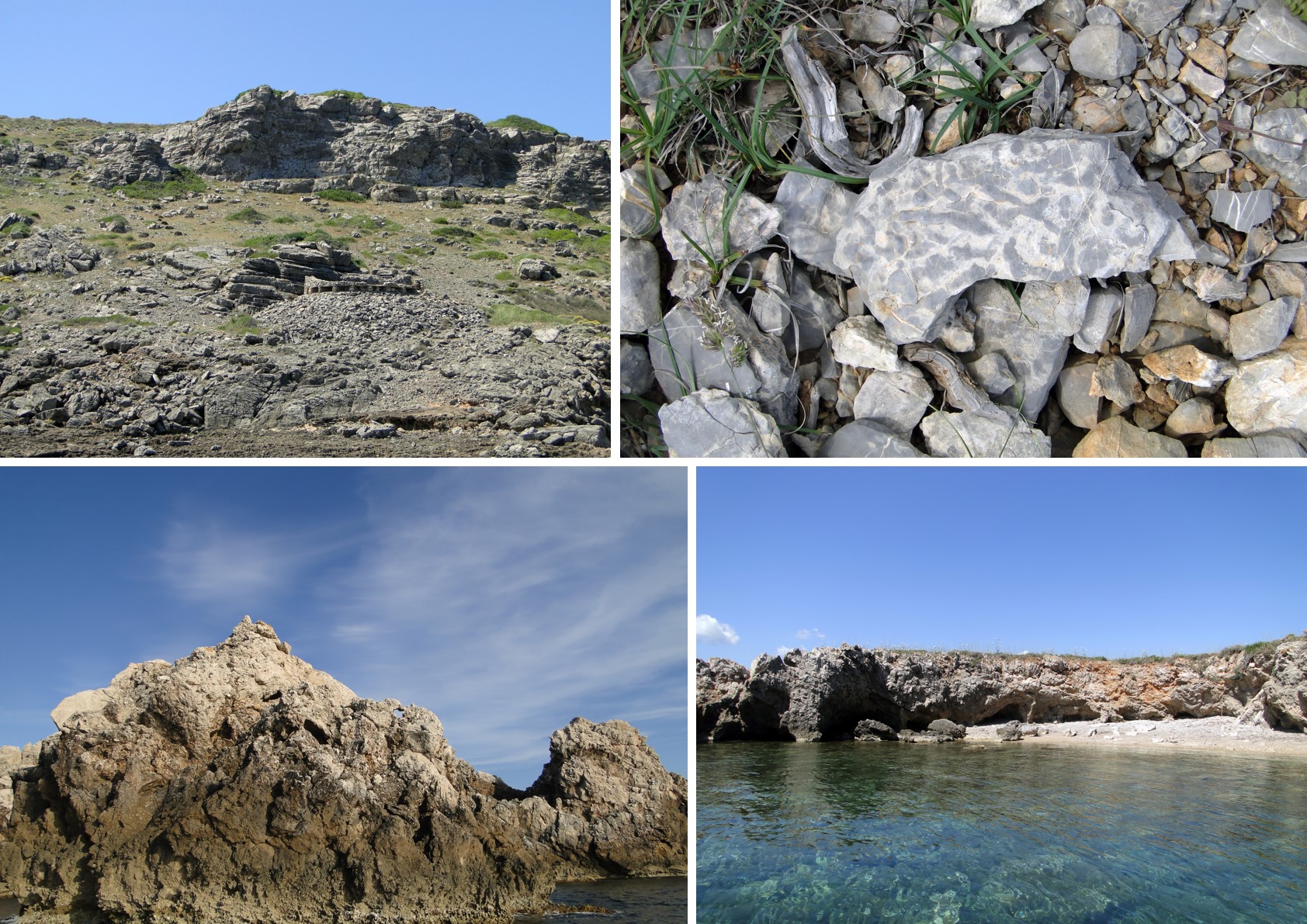
Limestone from the Triassic that make up the cliffs surrounding Cala en Brut cove, a close-up of the rocks that have been blemished by bioturbation (top). At the bottom dolomites from the Jurassic on Illa Gran d’Addaia and tiny cavities that have been gouged out by the action of underground water as it eroded the rock on the islet.
At the entrance to the bay, as suggested by the place name that created a small inlet in it (Cala Roja cove), are the red rocks that sedimented prior to the rocks that form the sides of the port. These rocks were sedimented by rivers in the late Paleozoic and early Mesozoic, creating sandstones from the channels along which water flowed filled with sand and clay deposits and silts that were deposited on the flood plains.
In any event, the most stunning outcrops of these rocks in the area can be seen at Es Costers area, between Es Capell de Ferro and Son Tema. Here, the tectonic, eustatic or antropical processes</span></p></div>">outcrop reveals the contact between the Paleozoic and the Mesozoic and consequently the change of era in a level of quartz cobbles that have created a rock known as sedimentary rock of detritic origin (clasts larger than 2 mm).</p></div>">conglomerate. The landscape contains a beautiful variety of sandstones that extend northwest to southeast with reddish and yellow colouration (depending on the iron oxides that coloured these rocks when they were still sediment transported by a river), magnificent cross stratifications that have been conserved on a large scale which were created by the water currents that transported the sand along the riverbed and alveolar or honeycomb erosion.
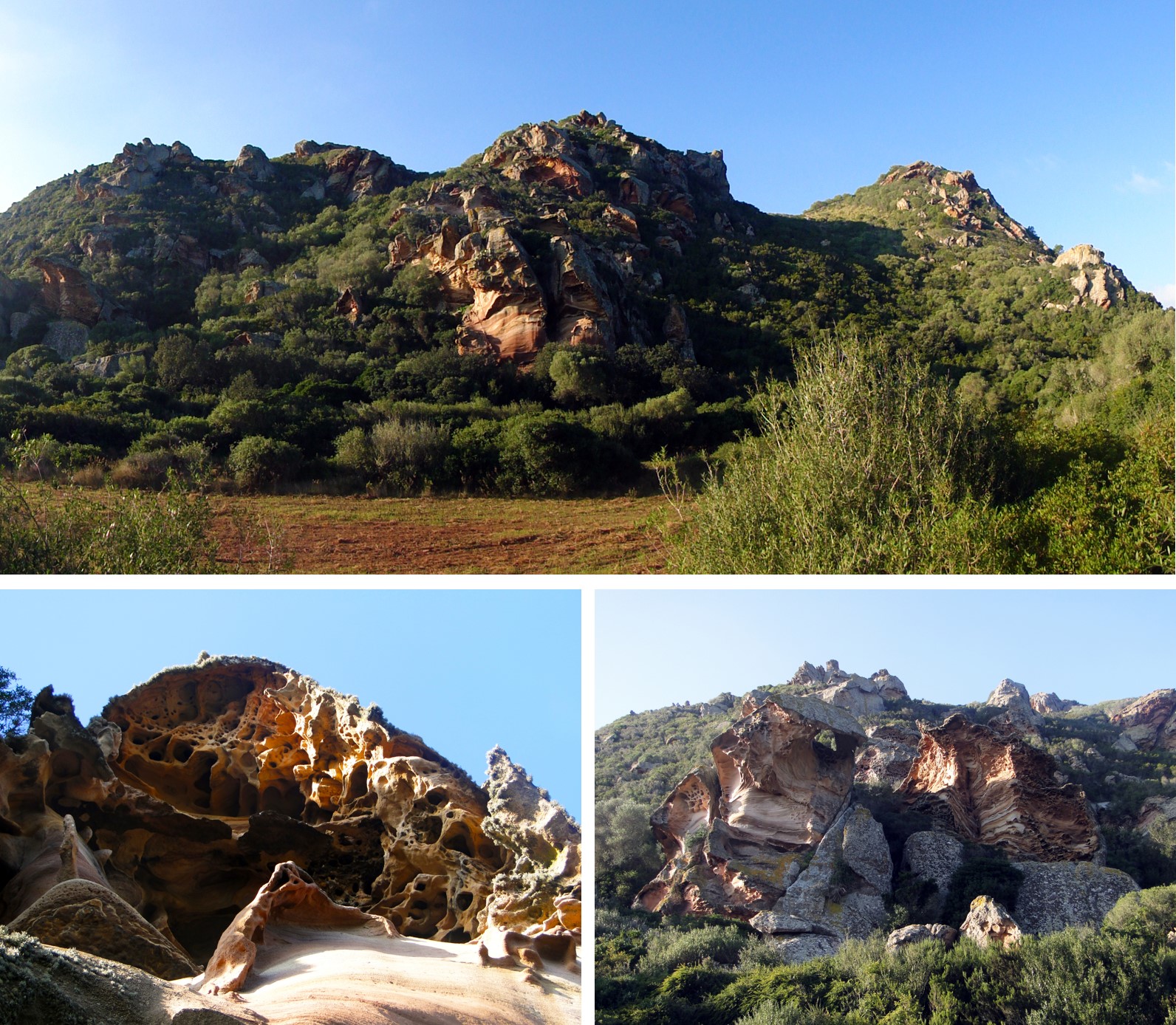
Sandstone at Capell de Ferro. Alveolar or honeycomb erosion is the result of an irregular distribution of the cement that binds together all the particles that form the rock, and where in the softer parts, the ones with less cement, wind erosion laden with salt drills away at the rock.
The Site of Geological Interest presents interesting examples of the Paleozoic series at the Punta de Mongofra headland. The site has a stunning toppled fold that originated during the Hercynian orogeny. This process was the origin of all the deformation movements in the Earth’s crust that occurred between the late Devonian (355 million years ago) and the late Paleozoic (250 million years ago). Later, during the Alpine orogeny, which began in the late Cretaceous (65 million years ago) and which was at its height in the middle Miocene (15 million years ago), Paleozoic materials that were already rigid were ripped up, whereas those from the Mesozoic, that had not yet consolidated, were folded. Also, the compressive movements of the Earth’s crust during this final orogeny caused some rocks to be superimposed on others (creating thrusts), which in the area that we are interested in led to Paleozoic materials being superimposed over Mesozoic materials.
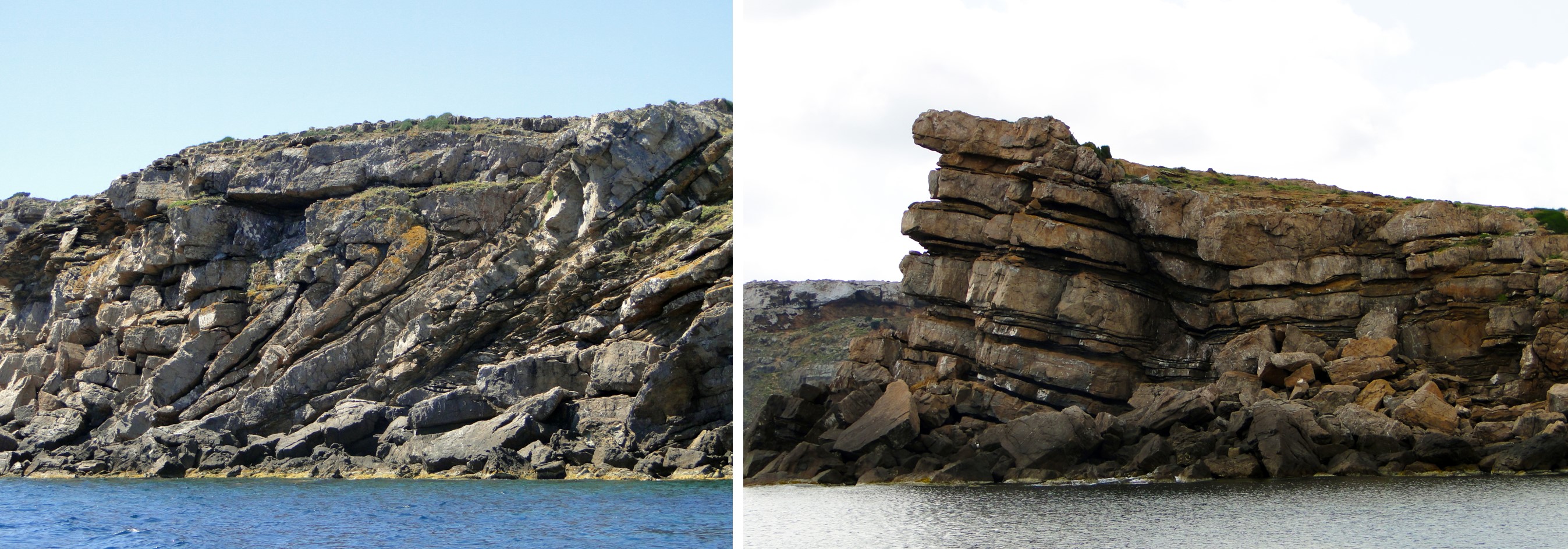
Toppled fold (left) and fault (right) affecting Paleozoic rocks in the area around the Els Armaris area. The orogenies correspond to geological processes that over millions of years led to the creation of the Earth’s mountain ranges originating the relief. During the first of these two orogenies identified during the Earth’s history, Paleozoic materials were plastic and folded (left), while in the second orogeny, the materials were rigid and broke (right).
The Paleozoic series shows stunning outcrops of alternations of sand-sized clasts.</p><p><br></p></div>">sandstone and lloselles in the area around the Els Armaris area. Here, we have also identified radiolarites, black lloselles and conglomerates interleaved in the turbidite series, interpreted as the product of a mud outflow that, in an underwater environment, slipped to become deposited in the great abyssal depths. All these materials have also been identified at Binimel•là beach and, just like in this area, it is thought that they sedimented on more than one occasion.
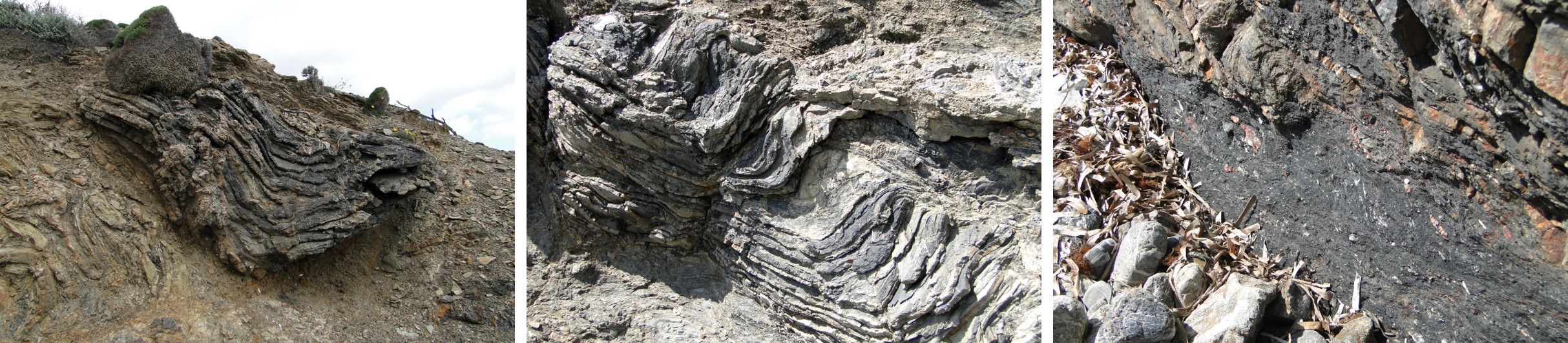
Disorganised levels of radiolarites, black lloselles and mud outflows at Cala en Brut cove.
The western part of the bay has a great abundance of mass Sedimentary rock originated by the precipitation of calcium carbonate from supersaturated waters, especially in zones of karstic emergences.</p></div>">travertine outcrops, staggered from the mountain to the sea, that lead us to believe in the existence of upwellings, in a much rainier climate than today’s, that have now disappeared. The southern edge of the port contains salt marshes that developed on clay materials from the Permian-Triassic that are also a wetlands area during bird migration periods.
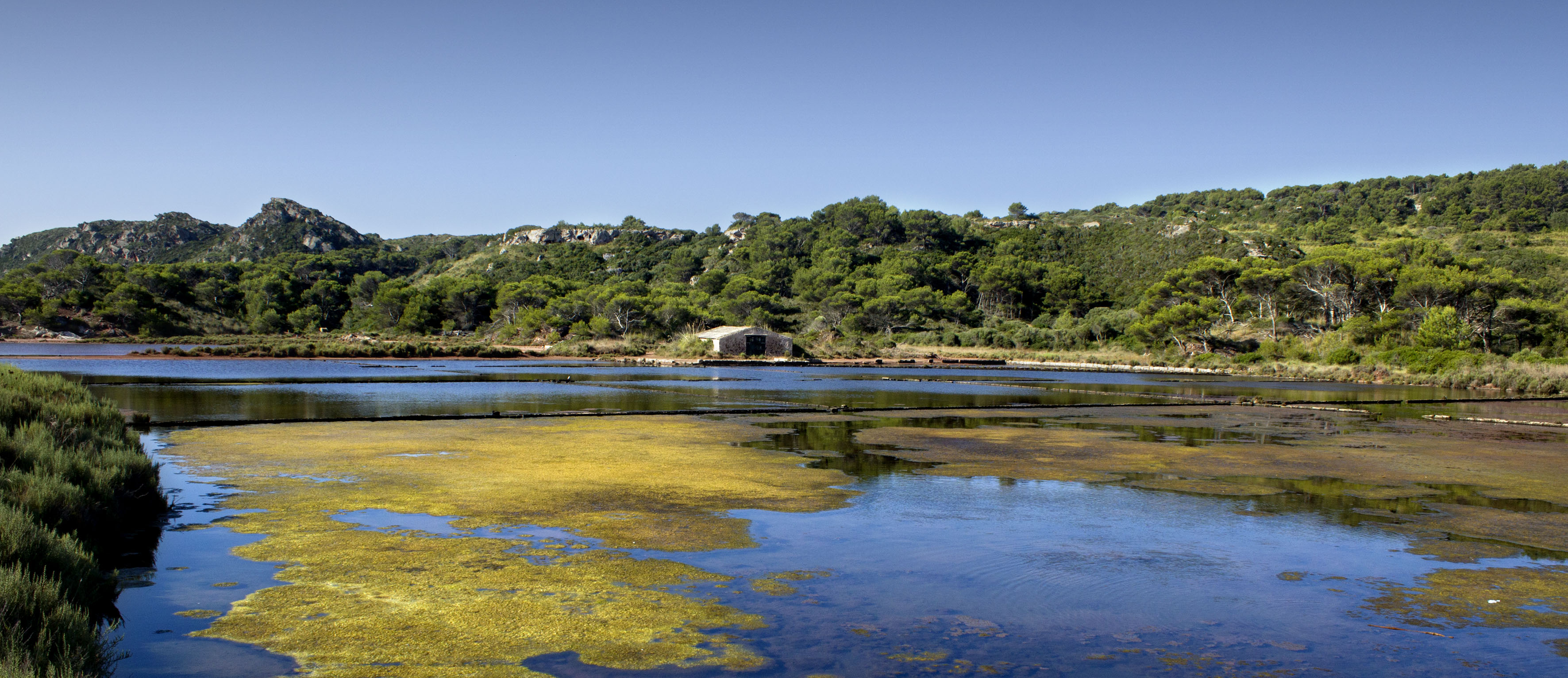
Salines d’Addaia salt marshes with the sandstone reliefs at Capell de Ferro in the background.
