Cap Blanc constitutes one of the best outcrops for studying the Upper Miocene (10,0-5,5 Ma), because in its cliffs it is possible to observe the large coral edifices that proliferated during that epoch.
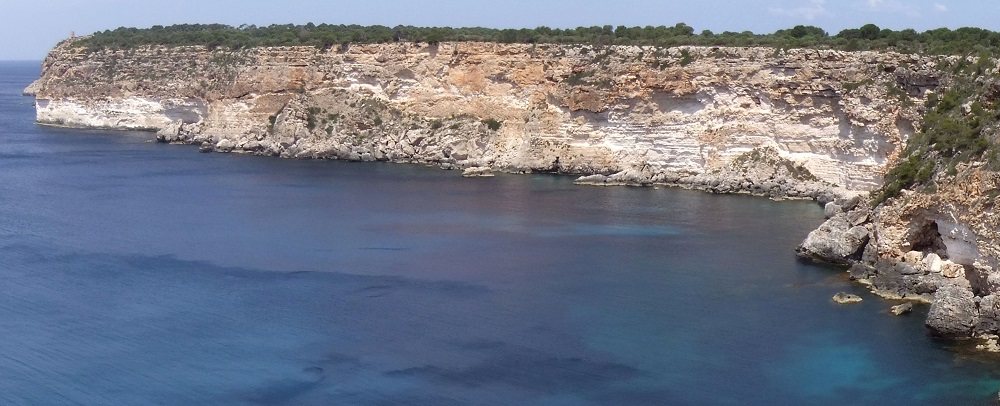
General view of Cap Blanc from Punta Negra.
During the Tortonian and Messinian (from 11.6 to 5.5 Ma) the island of Mallorca was already separated from the peninsula and had its present-day structure of elevated zones (horsts) and depressions (grabens).
The elevated zones, corresponding to the Serra de Tramuntana and the Serres de Llevant and the Central System, constituted islands surrounded by a shallow sea. The prevailing tropical climate propitiated the development of large coral reefs around the islands, similar to the present-day coral barriers found in the Caribbean or Australia.
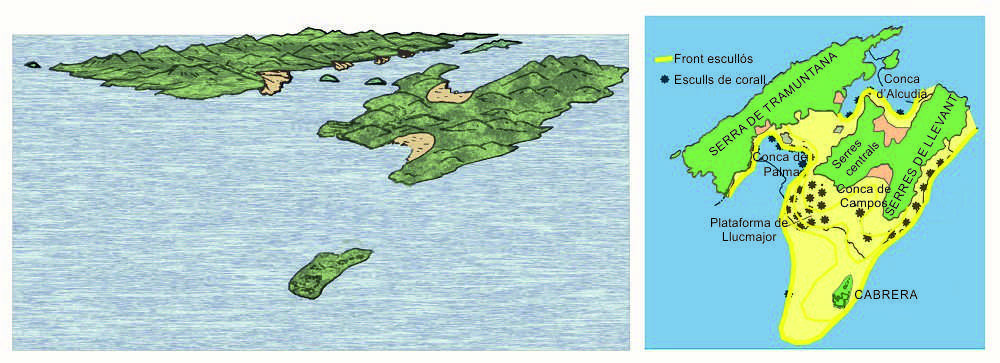
Reconstruction of Mallorca approximately 7 Ma ago (left), where large colonies of reefs developed (in yellow, right). Modified from Pomar et al. (1983).
Although the vestiges of this environment, so different from what we see today, can be seen at many points of the Migjorn and Llevant and in the central part of Mallorca, it is in the sector between Cap Blanc and Vallgornera where they are most easily observed.
Contrary to what might appear at first sight, the arrangement of coral reefs follows a predetermined and concrete pattern which can be detected at large and small scale and which varies according to the marine conditions of the time.
The reefs began to form in periods of a relative rise of the sea level, in a tropical environment and with clean, well-lit and agitated waters. The principal places are around volcanic islands in formation or in continental platforms: the corals of Cap Blanc correspond to this category. With slow but constant growth, the coral accumulations formed, grouped into what is called a reef core, growing both vertically and horizontally following the outline of the platform on which they rested. When the reef core grows sufficiently it slows down the waves, creating a shallow zone between the barrier and dry land called a lagoon, in which sandy sediment gradually accumulates. The zone preceding the reef core, for its part, forms what is called a reef slope.
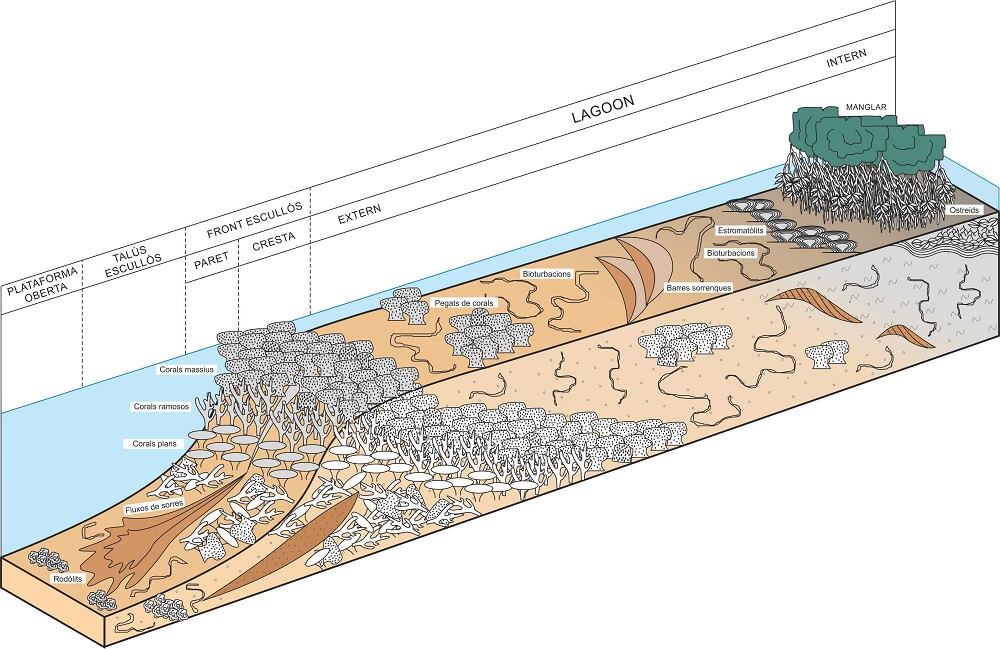
Diagram of the structure of a coral reef like those present in the Miocene of Mallorca. Based on Pomar & Ward (1991).
Once the reef has matured, it gradually adapts to the changes of sea level, always growing towards the shallowest and best-lit zones. When the conditions cease to be favourable for the growth of corals, the reef will stop growing and will finally die. The entire life cycle of a reef lasts tens of thousands of years, which permits the establishment of complex ecosystems which evolve around it.
In the case of reefs like that of Cap Blanc, as in many other Mediterranean localities, their extinction occurred close to the end of the Miocene, a little less than 6.0 Ma ago, when the Mediterranean dried out due to being cut off from the Atlantic, which heralded the end of most of the ecosystems of the zone, including those of the large reefs.
At the Cap Blanc, where the cliffs reach their greatest height and verticality, it is possible to observe from the sea a section of the enormous coral structures formed by the superimposition of several reef bodies and to distinguish the reef slope, reef core and lagoon.
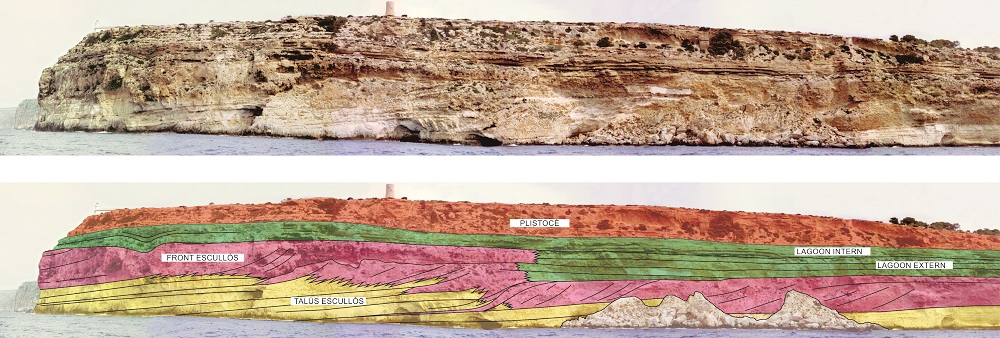
Panoramic view of Cap Blanc and diagram of the structure of the coral reefs displayed by its cliffs. (Courtesy of Lluís Pomar).
Although the tropical reefs of the Balearics disappeared several million years ago, thanks to outcrops like that of Cap Blanc we can imagine the islands with a very different appearance from what we see today, closer to that of the present-day Caribbean than that of the Mediterranean itself.
