Can Negret corresponds to one of the most important outcrops of the Jurassic (201-145 Ma) and Cretaceous (145-66 Ma) in the Balearic Islands. It is now a quarry that exploits Sedimentary rock whose main component is calcium carbonate (CaCO3). Its origin can be chemical, organic or detritic.</p><p><br></p></div>">limestone rocks as a raw material for producing cement.
The geological structure of the zone displays great complexity. In general terms, it is a syncline formed of soft rocks, marls and margo-limestones of the Lower Cretaceous, lying between two large faults that bring it into contact with the limestones of the Jurassic. Countless more discrete faults fracture the entire area. All of this constitutes clear testimony to the size of the tectonic forces that raised the Tramuntana Range some 25-15 Ma ago, during the Alpine Orogeny.

Panoramic view of the SW sector of the quarry and geological diagram.
The oldest observable materials correspond to the massive limestones of the Lower Jurassic (201- 175 Ma), which occasionally display geodes (calcite crystals which line cavities). They represent shallow seabeds and mainly lack observable fossils.
The materials of the Middle and Upper Jurassic (175-145 Ma) are notably different. They tend to appear in stratified form, with numerous sections of reddish colours. They correspond to the so-called ammonitico-rosso stratigraphic unit and reflect the specific environmental conditions in which they were formed.</p><p><br></p></div>">facies, a type of rock that is typical in the Jurassic of the island which presents an abundance of ammonites and belemnites, two types of extinct cephalopods endowed with a shell, relatives of present-day octopi and squids (see figure on next page).
The Cretaceous sequence (145-100 Ma) is primarily formed by a series of more or less homogeneous levels of limestones, margo-limestones and marls, on which clayey levels deposit. The whole sequence presents a substantial paleontological content composed of a great variety of species of ammonites and belemnites and, to a lesser extent, gastropods, bivalves, brachiopods, crinoids and remains of fishes and sharks. Notable among the ammonites are species displaying exotic forms quite different from the typical flattened spirals.
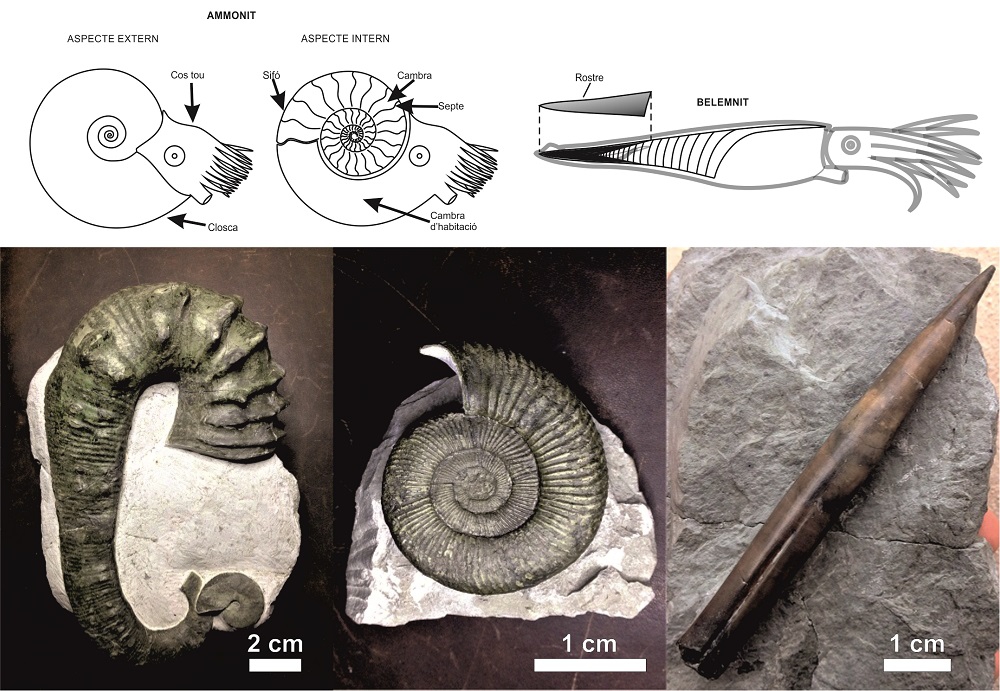
Representative fossils of Can Negret. Ammonites (left and centre) and belemnite (right). Courtesy of MBCN.
Above the quarry, adjoining the municipality of Binissalem, there are natural outcrops of materials ranging from the Jurassic, described above, to the Oligocene, 30 Ma ago.
