The lighthouse of Ansiola is an excellent spot for viewing the principal geological characteristics of the island of Cabrera, because it is on a small peninsula, some 500 m from the coast.

View of the lighthouse of Ansiola from the access track.
It is remarkable that such a small territory presents an enormous lithological variety and a tectonic complexity that make the task of geological mapping difficult.
As can be observed in this zone of Cabrera, there is a predominance of calcareous materials of the Jurassic, represented by the massive limestones of the Lias (Lower Jurassic, 200-175 Ma) and the very well-stratified margo-limestones and limestones of the Dogger-Malm (Middle-Upper Jurassic, 175- 145 Ma). There is a notable similarity between the materials of the Dogger and those of the Malm, with the result that in the cartography of Cabrera they have not been separated and have been named Pelagic Unit. While the materials of the Lower Jurassic represent shallow seabeds, those of the Middle and Upper Jurassic reflect much greater depths (pelagic environments, hence the name of the unit).
The contact between the Jurassic materials tens to be mechanical, by means of faults, and the Lias tends to thrust over the Dogger-Malm materials. A good example of a fault
<div class="ql-editor"><p class="ql-align-justify">Inverse fault in which the stratification plane.</p><p><br></p></div>">dip of the fault plane is at a low angle (generally less than 45<sup> o</sup>). It tends to refer to large-scale (regional) structures.</p><p><br></p></div>">thrust fault can be seen in the Ansiola cove.Within the Pelagic Unit we can see that there often emerge large Sedimentary rock whose main component is calcium carbonate (CaCO3). Its origin can be chemical, organic or detritic.</p><p><br></p></div>">limestone blocks of the Lias. These are olistolites, blocks of rock that have slid down the continental slope and been engulfed in the pelagic sediments.
If we look carefully we can see that the rocks which constitute the Punta den Mig and the Coll Roig present a yellowish-ochre colour. These are materials from the Eocene (Tertiary, 56-34 Ma) and consist of sandstones, limestones and conglomerates which contain lot of nummulites, a type of single-cell foraminifer organisms which can reach centimetric size.
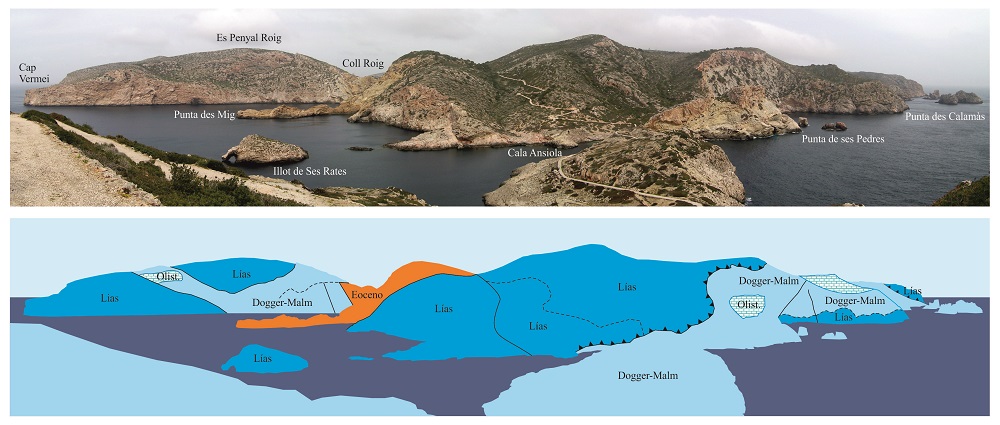
Geological interpretation of the panorama seen from the viewpoint.
