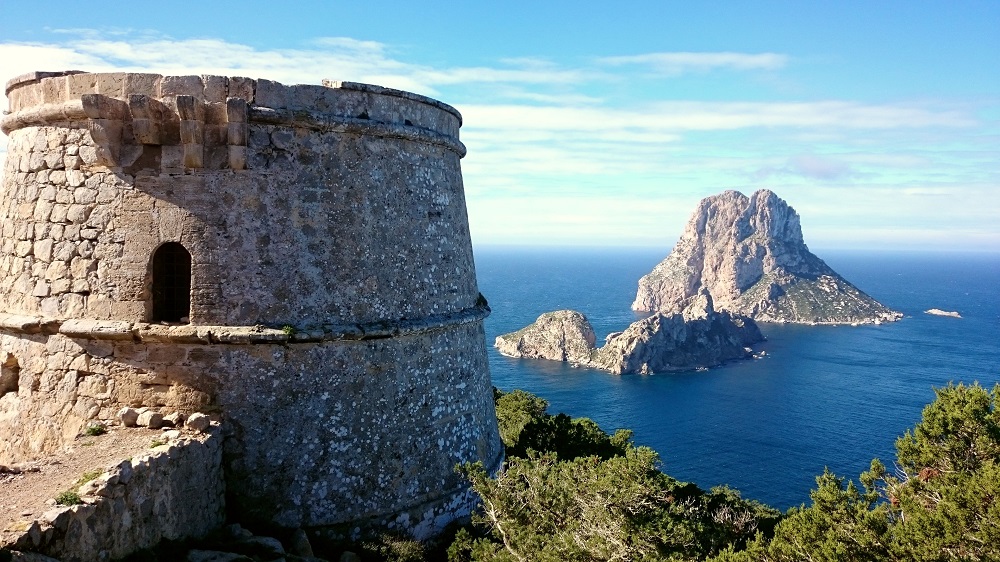
Torre des Savinar with the islets of Es Vedrà and Es Vedranell in the background.
The islets of Es Vedrà and Es Vedranell are a good example for understanding the magnitude of the tectonic forces that formed and structured the Balearic Islands during the Alpine Orogeny, which created those islets in a period between 14 and 12 Ma ago.
They are the result of a fault
<div class="ql-editor"><p class="ql-align-justify">Inverse fault in which the stratification plane.</p><p><br></p></div>">dip of the fault plane is at a low angle (generally less than 45<sup> o</sup>). It tends to refer to large-scale (regional) structures.</p><p><br></p></div>">thrust fault which caused the sliding of limestones and calcarenites of the Upper Jurassic– Lower Cretaceous (approx. 145 Ma) over the marls of the Miocene (approx. 20–13 Ma).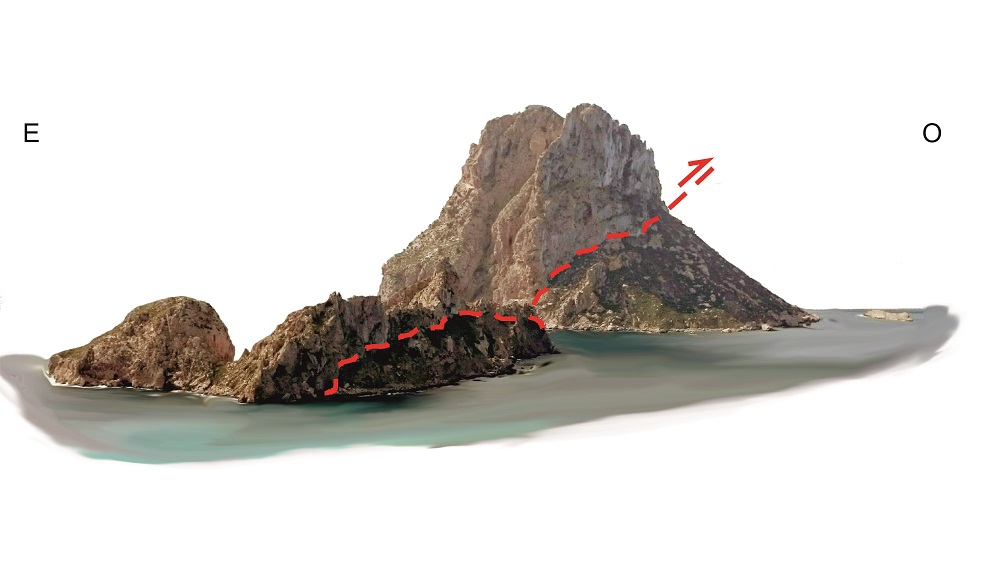
Approximate course of the thrust affecting the islets of Es Vedrà and Es Vedranell.
As limestones and calcarenites are very resistant compared with marls, the differential erosion caused the former to remain as a buttress that created the cliffs (in some cases up to 388 m in height), while the marls formed the gentler reliefs covered with vegetation.
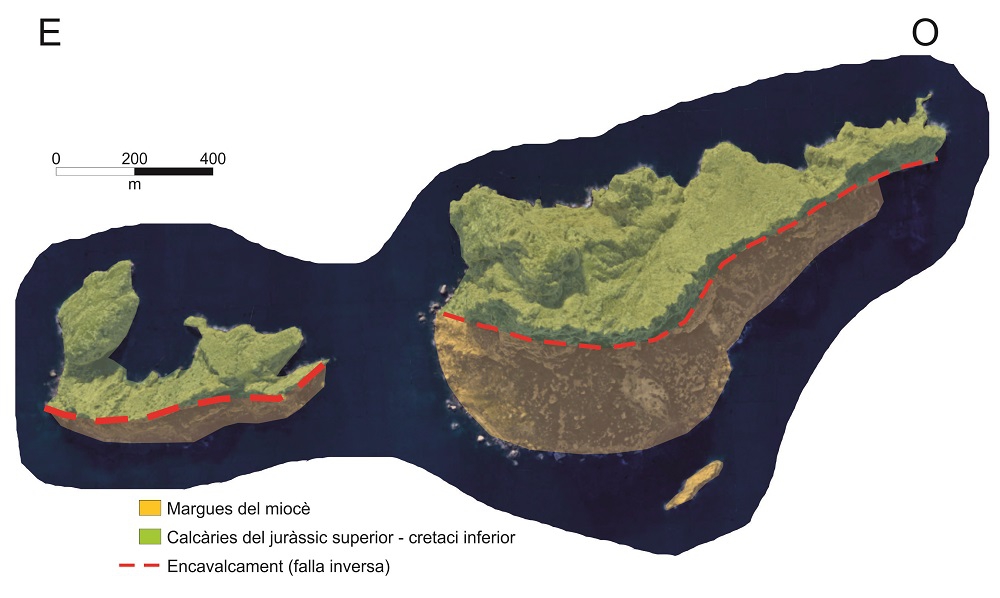
Schematic cartography of the lithologies which outcrop in the islets and are affected by the thrust.
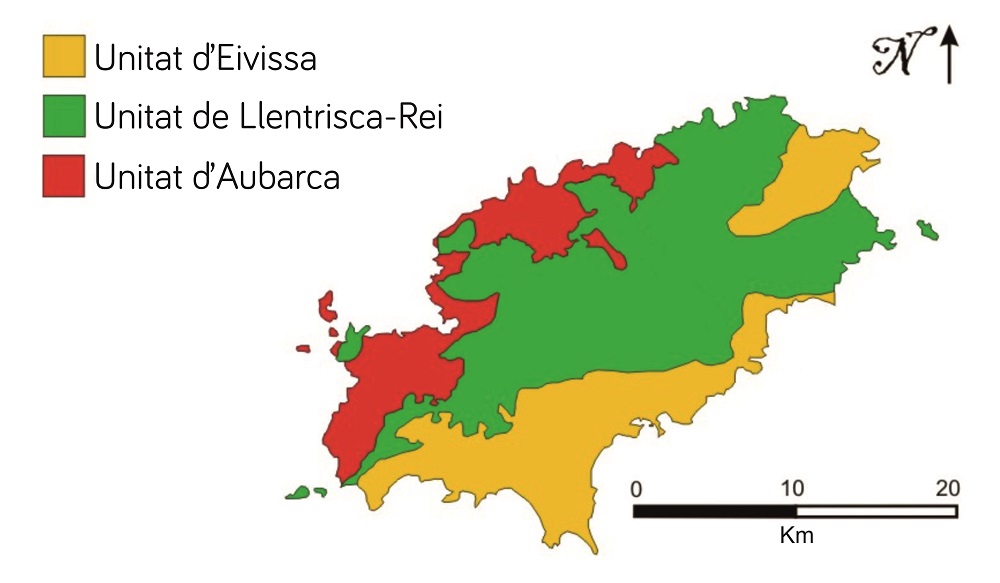
Cartographic map representing the three Structural Units which compose Eivissa.
