The aircraft observatory of La Coassa dates from the Second World War. There are two buildings: a lookout hut close to the cliff and a single-floor building with a kitchen and sitting room. The walls of the main room are decorated with pictures of aircraft to help the spotters identify them.
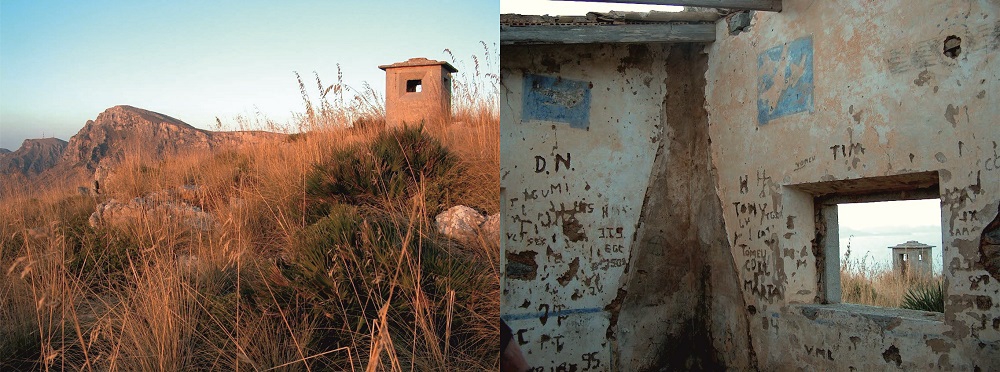
Lookout hut and main room of the post. Note the aircraft painted on the walls.
This privileged position overlooks the entire Bay of Alcúdia and in the distance the Serra de Tramuntana, making it a perfect site for viewing the structure of the island of Mallorca.
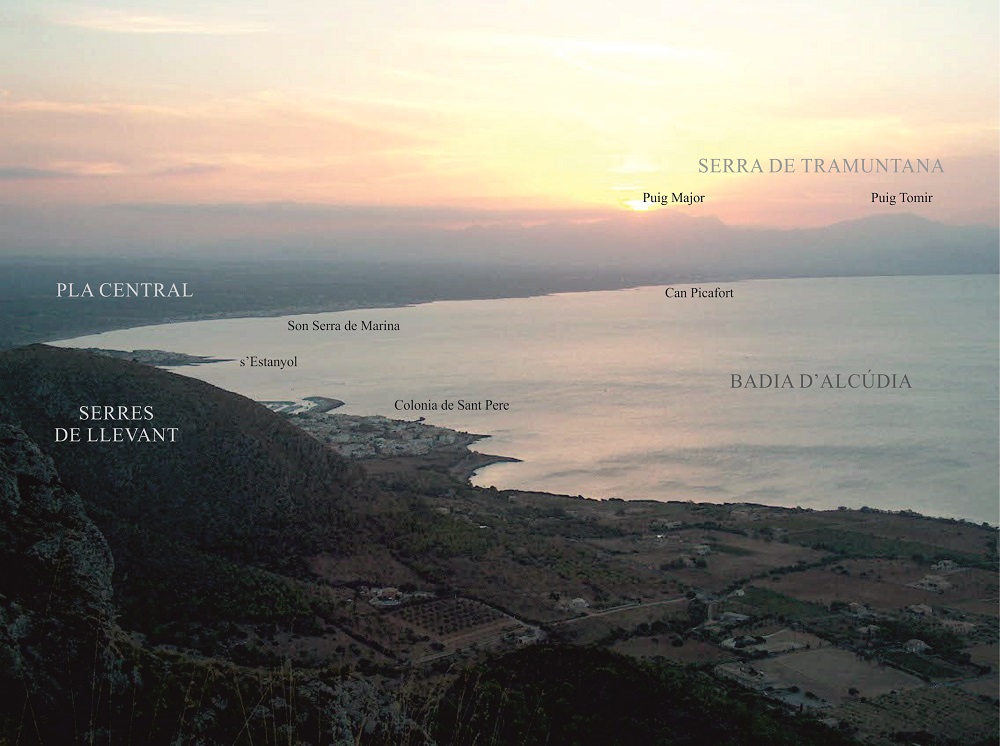
View to the west from the post, showing the Serres de Llevant, the Central Plain the Serra de Tramuntana.
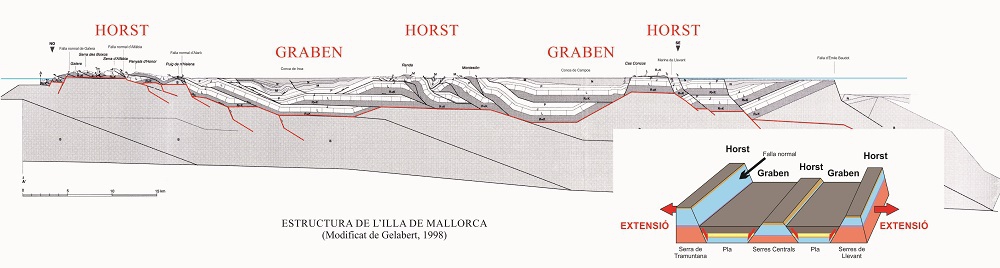
We are at a height of approximately 317 m in the Serres de Llevant, which, with the Serra de Tramuntana (seen in the distance), constitute the island’s two most important mountain ranges, with outcrops of Mesozoic materials. Between the two ranges there is a flat area called the Central Plain, a depressed zone filled with Tertiary and Quaternary materials with little or no deformation. This plain has a few small hilly elevations like Bonany, Randa, etc., which form the so-called Central Ranges.
All of this is due to the fact that the island is structured into elevated zones (Horst) and depressed zones (Graben), the result of the distension processes following the Alpine Orogeny.
If we now look east we have a bird’s-eye view of the alluvial fans of the Betlem zone, which is a Site of Geological Interest.

View from the lookout point towards the east, showing the alluvial fans that descend from the mountain range.
Alluvial fans are essentially deposits of sediments carried by river currents that deposit or accumulate at the foot of a slope due to an abrupt change of angle. They take their name from their shape in the form of a fan or cone (they are also called dejection cones). In this case, the fans originated during the Pleistocene, a little more than 100,000 years ago, and some of them are still active today.
