| UTM-X | UTM-Y | ||
|---|---|---|---|
| STOP 1: MIOCENE OF LA MOLA | |||
| STOP 2: GEOLOGY OF THE ES MIRADOR LANDSCAPE | |||
| STOP 3: FOSSIL BEACHES OF ES COPINYAR | |||
| STOP 4: THE QUATERNARY OF CALA EN BASTER |
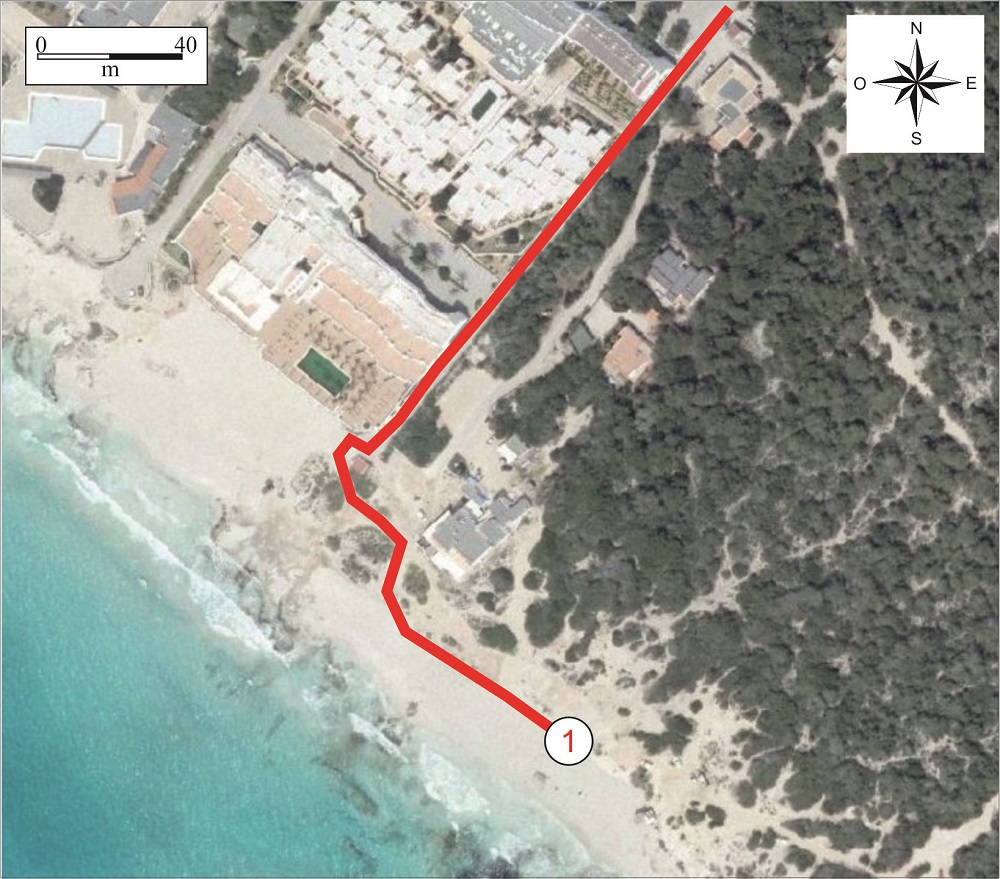
Recommended route.
As today, during the Pleistocene period at Formentera the beaches were deposited with abundant cockles. Although these have eroded away in part by the action of the waves, it is still possible today to observe good examples on the island.
The most outstanding one, for its visibility as well as its scientific interest, is at Es Copinyar. On this coastal strip, just a little above sea level, it is possible to see a type of rock called coquina, typically formed mainly by mollusc shell fossils. The formation of this rock took place in similar sedimentation conditions to those of the current beaches in the area. Its name is due to the high content of cockles that can be found in the area.
On the site, three levels with fossil content can be distinguished, corresponding to the different formation periods of the sand beaches. Their chronology is from 130 to 80 thousand years ago, approximately.
However, what the Pleistocene fauna reveals to us is that, despite the aforemetnioned similarities, the climate in which the lower level was deposited was significantly warmer than now. This is known due to the presence of subtropical and tropical kinds of molluscs among the different species found, now extinct in the Mediterranean but remaining on the Atlantic coasts of the centre of Africa.
These molluscs form a group known as Senegalese fauna, alluding to Senegal, the country where they are found in abundance today.
Unlike the lower level, the two higher levels only contain fauna present in the Mediterranean these days, which suggests a similar climate to today.
Of these, the most modern is characterised as having a high percentage of red silts, which suggests a humid environment with abundant rains. Above these marine levels, and as is common along a large part of the Formentera coast, fossil dunes are found, also from the Pleistocene period.
