| UTM-X | UTM-Y | ||
|---|---|---|---|
| STOP 1: MIOCENE OF LA MOLA | |||
| STOP 2: GEOLOGY OF THE ES MIRADOR LANDSCAPE | |||
| STOP 3: FOSSIL BEACHES OF ES COPINYAR | |||
| STOP 4: THE QUATERNARY OF CALA EN BASTER |
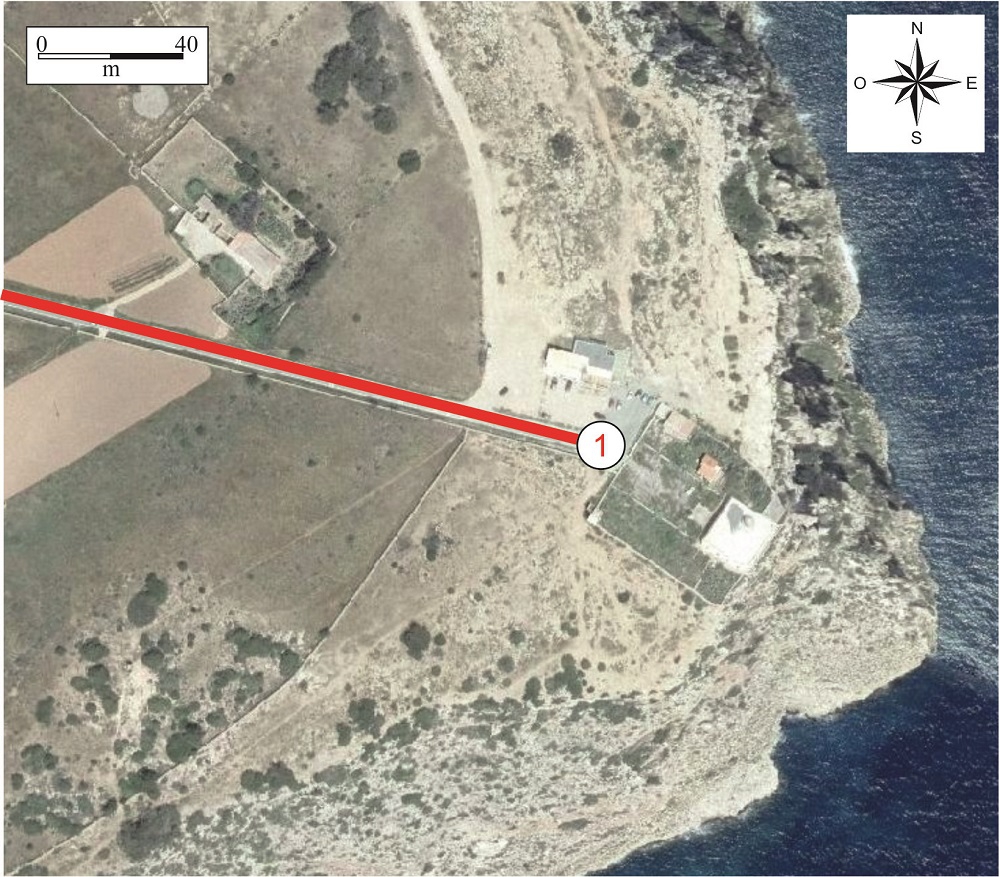
Recommended route.
The oldest materials of Formentera are from the Late Miocene period, specifically from 11 to 7 Ma.
During this period great coral reefs were formed, typically grew around the pre-existing reliefs arising during the Alpine Orogeny.
In Formentera, although these reliefs do not rise above the surface, the fossil reefs do so extensively. One of the best areas for observing them is La Mola.
The cliffs of La Mola comprise, in a large part, layers of coral colony structures that grew in successive generations during the life of the reef.
These reefs have become subaerially exposed due to a system of faults travelling NNE-SSW causing the elevation of the Promontory of La Mola in relation to the Central cordon. The best known is the fault of Racó de sa Pujada.
that has later given way to the cliffs of La Mola.
The cliffs of La Mola comprise, in a large part, layers of coral colony structures that grew in successive generations during the life of the reef.
These reefs have become subaerially exposed due to a system of faults travelling NNE-SSW causing the elevation of the Promontory of La Mola in relation to the Central cordon. The best known is the fault of Racó de sa Pujada.
As usual in these ecosystems, there is a great diversity of marine species, molluscs (bivalves and gastropods), as their shell tends to fossilize easily. However, at La Mola these fossils almost always appear as internal moulds, a very common preservation of the coral beds of the Balearic Islands. This is because the original calcium carbonate shell dissolves after the sediment has hardened, the part that was inside the shell being preserved.
Other fossils found in the area are the easily observable calcareous algae. Together they represent a shallow water environment that is laterally replaced by a set of coastal and continental deposits that emerge in the north of the described sector.
Adjacent to some part of the cliffs at La Mola there are dunes going back to the Pleistocene period, although do not appear in existing geological cartographies. These formed during the lowering of the sea level, exposing large areas of previously submerged sands which, due to the action of the wind, accumulated at the foot of La Mola.
