| UTM-X | UTM-Y | ||
|---|---|---|---|
| STOP 1: PAS D’EN REVULL | |||
| STOP 2: BARRANC DES CANALÓ | |||
| STOP 3: MARÈS | |||
| STOP 4: ES TORRETÓ |
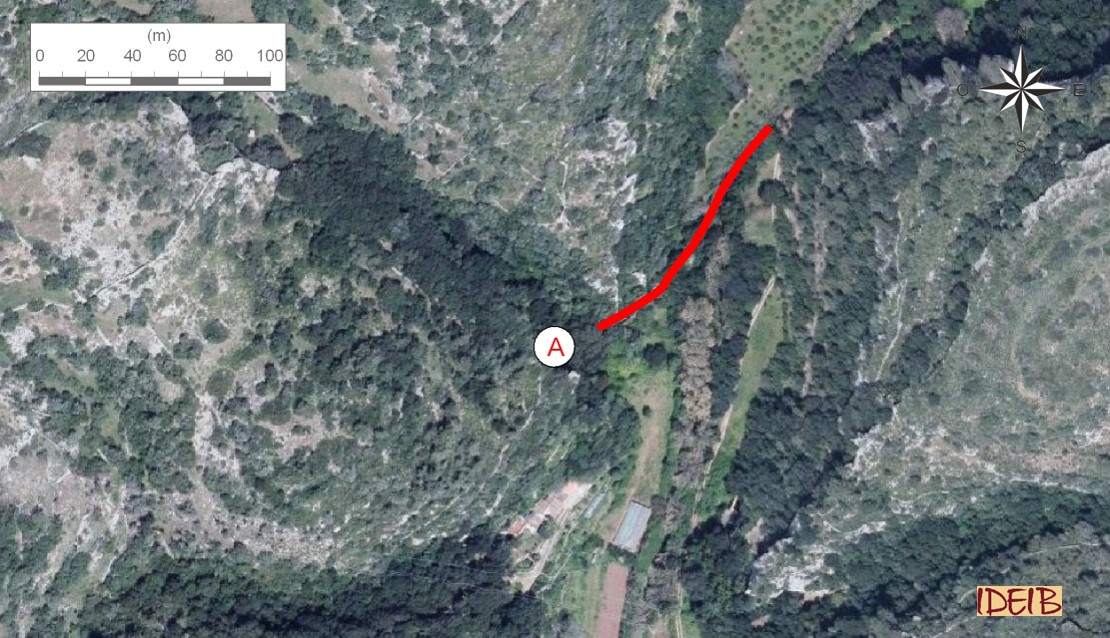
Access route to the stopping point.
Following Camí Reial, there will be a point when you stop walking alongside the stream and climb a steep slope. After starting to climb, after a few metres on the left is a small esplanade with a large holm oak tree at its entrance, where you can take a short stop.
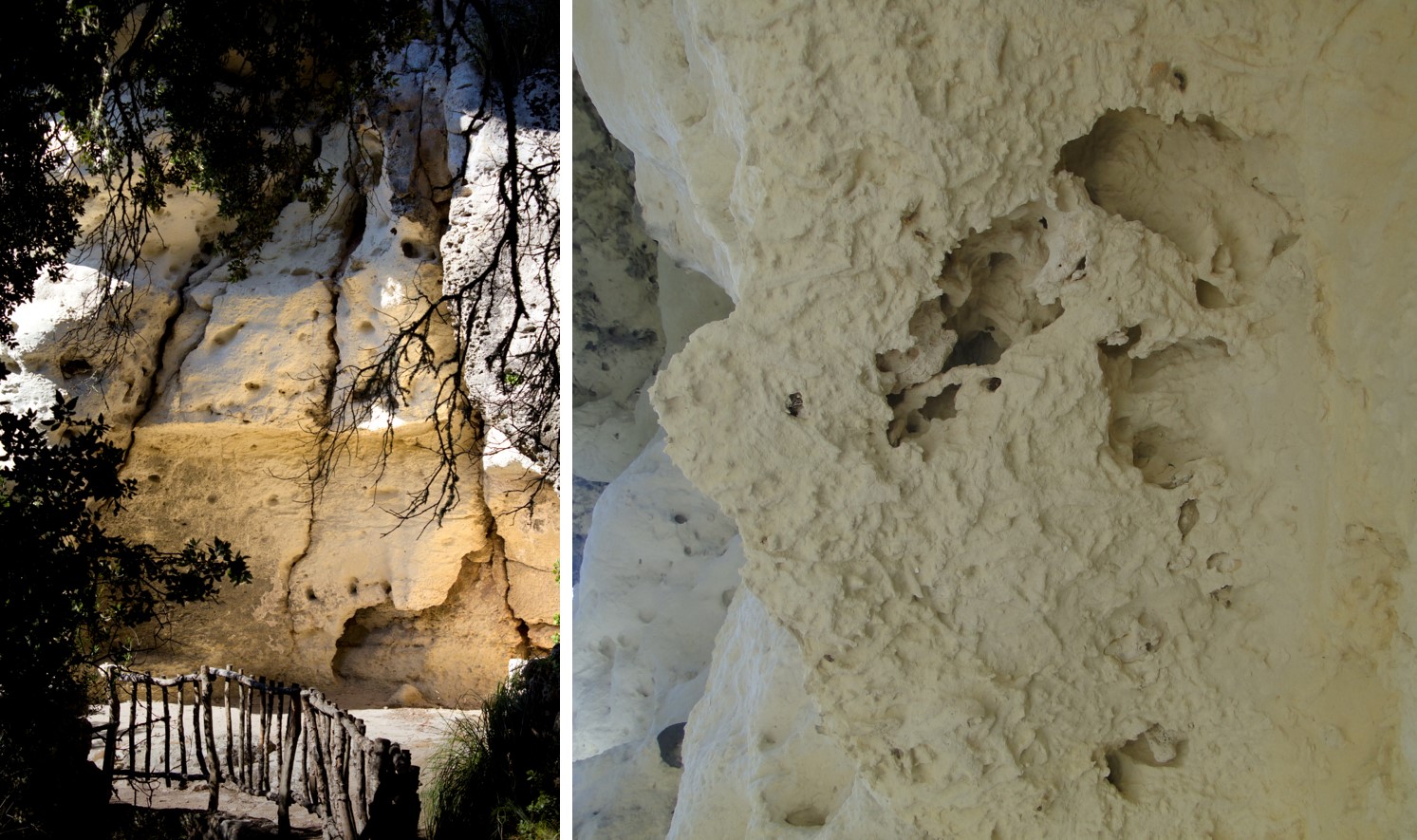
Point where you can take a stop and close-up of the marès, made up of very fine sand that is the remains of marine organisms (point A).
Here, you can take a look at the walls of the ravine and see how they are formed by a rock made up of fine whitish ochre sand, marès. In the sea where this rock was formed, a huge amount of organisms such as seaweed, molluscs, sea urchins, corals, amphibians and fish lived. Waves, erosion caused by living organisms (bioerosion) and other secondary phenomena gradually transformed the shells and skeletons of these organisms into sand, which was finally deposited on the seabed. This sand was mixed with sediments from the erosion of the rocks making up the mountains of the north of the island (the Tramuntana region). Over time, the mix of sands would end up consolidating and forming the stone called marès. On occasion, the erosive agents did not completely break down the shells of organisms, and for this reason, on the ravine walls you can see fossils like the ones you saw at the first stopping point, where we explained that the fossils you can see are the ancestors of certain types of animals that still live in warm waters, such as in the Caribbean. These fossils allow us to say that in the Miocene, the Mediterranean was a warm sea similar to tropical seas today.
In the Miocene, in Menorca only the Tramuntana region had emerged (which was, in turn, bigger than it is today, both in terms of extent and height); the Migjorn region sank due to the effect of tectonic movements and was under the sea. Warmer than today, the climate that dominated the island fostered the establishment of large accumulations of organisms. The erosive agents continuously and slowly turned the shells of these organisms into sand. The smaller fragments were carried into the sea by the waves, constituting soft rocks like the ones you can see at the observation point.
Therefore, all the cliffs that you can see in the ravine were under the sea, because in the Miocene, the sea level was much higher than it is today.
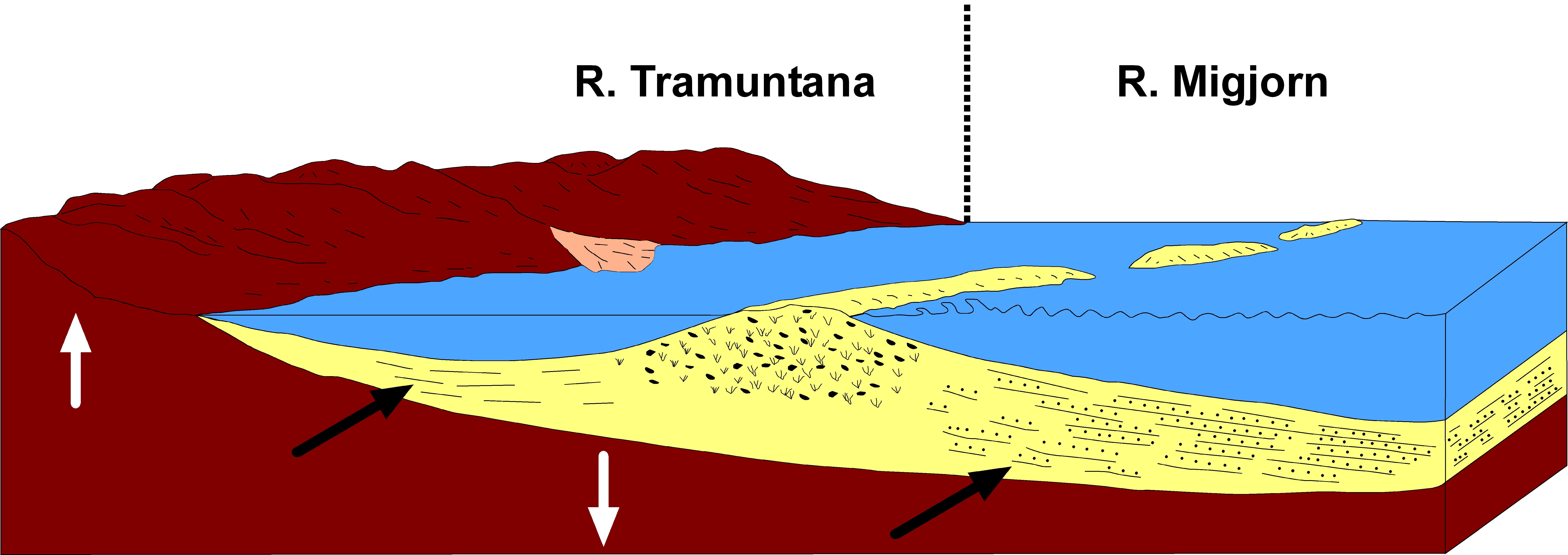
Idealised reconstruction of Menorca during the Miocene. The white arrows show the sinking of the Migjorn region compared with the Tramuntana, and the black arrows show the sand deposits that would, over time, become marès (modified from Rosell and Llompart 2002).
